This physics problem tests your understanding of fundamental physical laws and their applications. The step-by-step solution below breaks down the problem using relevant equations and physical reasoning.
ScanSolve AI Answer
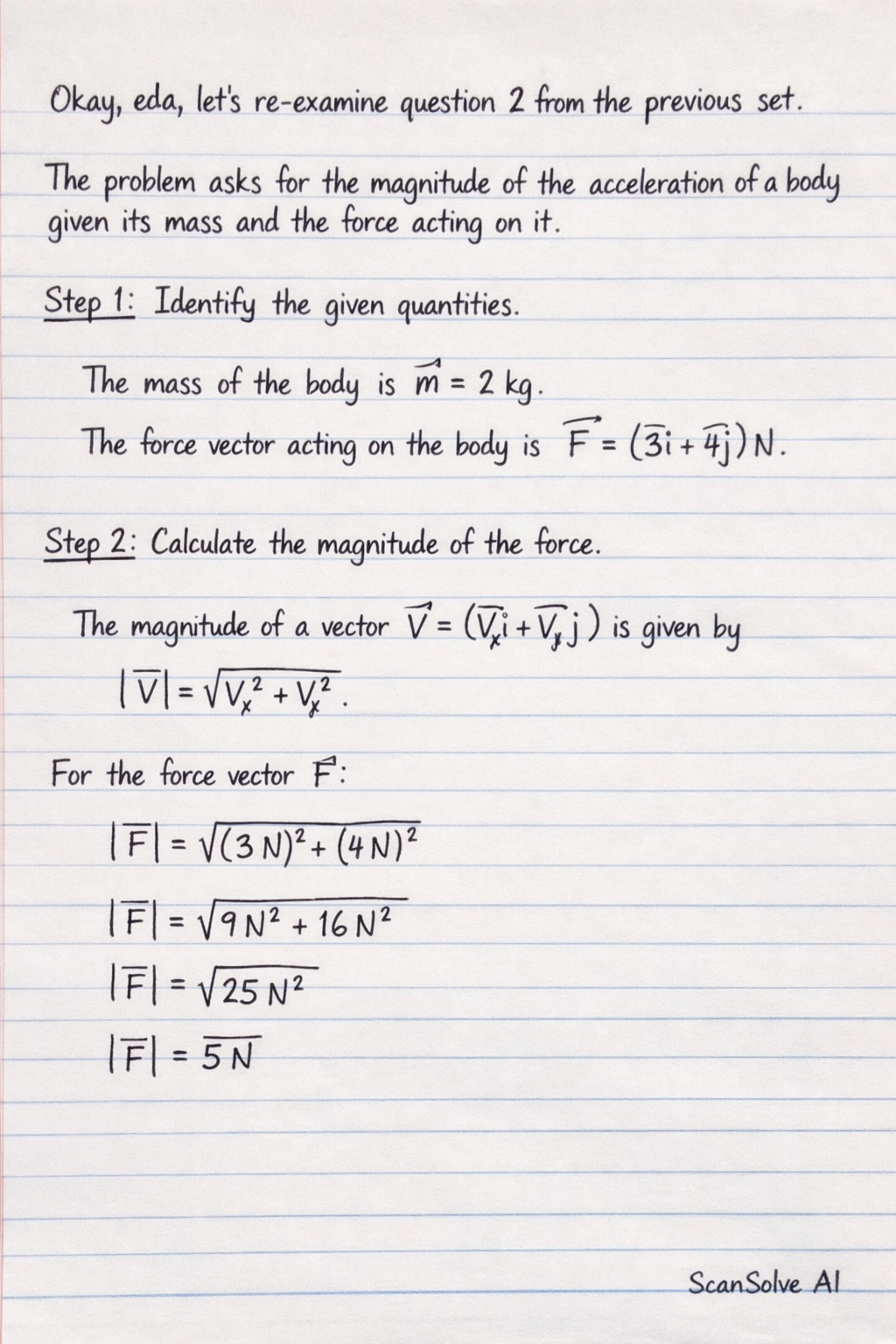
Okay, eda, let's re-examine question 2 from the previous set.
The problem asks for the magnitude of the acceleration of a body given its mass and the force acting on it.
Step 1: Identify the given quantities.
The mass of the body is $m = 2\, \text{kg}$.
The force vector acting on the body is $\vec{F} = (3\hat{i} + 4\hat{j})\, \text{N}$.
Step 2: Calculate the magnitude of the force.
The magnitude of a vector $\vec{V} = (V_x\hat{i} + V_y\hat{j})$ is given by $|\vec{V}| = \sqrt{V_x^2 + V_y^2}$.
For the force vector $\vec{F}$:
$$|\vec{F}| = \sqrt{(3\, \text{N})^2 + (4\, \text{N})^2}$$
$$|\vec{F}| = \sqrt{9\, \text{N}^2 + 16\, \text{N}^2}$$
$$|\vec{F}| = \sqrt{25\, \text{N}^2}$$
$$|\vec{F}| = 5\, \text{N}$$
Step 3: Apply Newton's Second Law to find the magnitude of acceleration.
Newton's Second Law states that the net force acting on an object is equal to the product of its mass and acceleration ($F = ma$). In terms of magnitudes:
$$|\vec{F}| = m |\vec{a}|$$
To find the magnitude of acceleration $|\vec{a}|$, we rearrange the formula:
$$|\vec{a}| = \frac{|\vec{F}|}{m}$$
Substitute the calculated force magnitude and the given mass:
$$|\vec{a}| = \frac{5\, \text{N}}{2\, \text{kg}}$$
$$|\vec{a}| = 2.5\, \text{m/s}^2$$
The magnitude of the acceleration of the body is $\boxed{2.5\, \text{m/s}^2}$.
What's next?
for the magnitude of the acceleration of a body given its mass and the force acting on it.
|Physics
for the magnitude of the acceleration of a body given its mass and the force acting on it.
ScanSolve AI Answer
Okay, eda, let's re-examine question 2 from the previous set.
The problem asks for the magnitude of the acceleration of a body given its mass and the force acting on it.
Step 1: Identify the given quantities.
The mass of the body is m=2kg.
The force vector acting on the body is F=(3i^+4j^)N.
Step 2: Calculate the magnitude of the force.
The magnitude of a vector V=(Vxi^+Vyj^) is given by ∣V∣=Vx2+Vy2.
For the force vector F:
∣F∣=(3N)2+(4N)2∣F∣=9N2+16N2∣F∣=25N2∣F∣=5N
Step 3: Apply Newton's Second Law to find the magnitude of acceleration.
Newton's Second Law states that the net force acting on an object is equal to the product of its mass and acceleration (F=ma). In terms of magnitudes:
∣F∣=m∣a∣
To find the magnitude of acceleration ∣a∣, we rearrange the formula:
∣a∣=m∣F∣
Substitute the calculated force magnitude and the given mass:
∣a∣=2kg5N∣a∣=2.5m/s2
The magnitude of the acceleration of the body is 2.5m/s2.
What's next?
Need help with your own homework?
Get instant step-by-step solutions to any question. Free to start.