
This physics problem tests your understanding of fundamental physical laws and their applications. The step-by-step solution below breaks down the problem using relevant equations and physical reasoning.
ScanSolve AI Answer
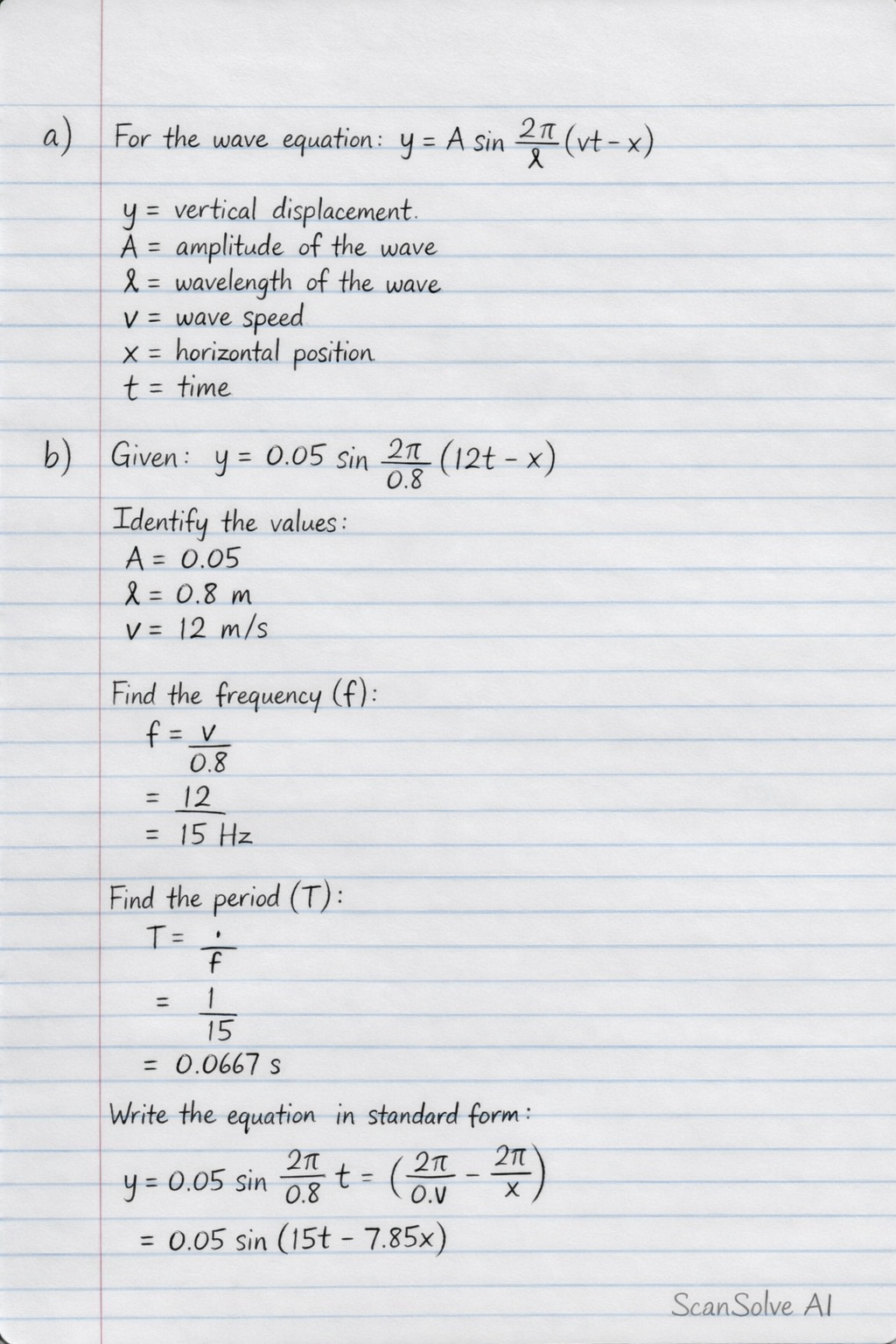
Here's the full explanation and calculation for the wave problem: a) The equation y = A (2)/() (vt - x) represents a sinusoidal progressive wave traveling in the positive x-direction. y: This is the vertical displacement* of a particle in the medium at a specific position x and time t. A: This represents the amplitude* of the wave, which is the maximum displacement of any particle from its equilibrium position. : This represents the wavelength* of the wave, which is the spatial period of the wave, or the distance between two consecutive points in the same phase (e.g., two crests or two troughs). v: This is the wave speed or phase velocity*, which is the speed at which the wave propagates through the medium. x: This is the horizontal position* along the direction of wave propagation. b) Given the wave equation y = 0.05 (2)/(0.8) (12t - x). Step 1: Identify the amplitude (A). Comparing the given equation to the general form y = A (2)/() (vt - x), we can directly identify the amplitude. A = 0.05 m Step 2: Identify the wavelength (). Comparing the given equation to the general form, we can directly identify the wavelength. = 0.8 m Step 3: Identify the wave speed (v). Comparing the term (vt - x) in the general form with (12t - x) in the given equation, we find the wave speed. v = 12 m/s Step 4: Calculate the frequency (f). The relationship between wave speed (v), frequency (f), and wavelength () is v = f. Rearranging for frequency: f = (v)/() Substitute the values for v and : f = 12 m/s0.8 m f = 15 Hz The amplitude, wavelength, and frequency are: Amplitude (A): 0.05 m Wavelength (): 0.8 m Frequency (f): 15 Hz Drop the next question!