
We read your photo as:
Solve this physics question
ScanSolve AI Answer
Answers
3 partsStep-by-step solution
9 stepsThe problem involves a concave spherical mirror with a focal length . We will use the mirror formula and magnification formula to calculate the image distance and describe the image for different object distances.
The mirror formula is:
where is the focal length, is the object distance, and is the image distance.
Rearranging for :
The magnification is given by:
- If , the image is real. If , the image is virtual.
- If , the image is inverted. If , the image is upright.
- If , the image is magnified. If , the image is diminished. If , the image is the same size.
Given:
Part a· 3 steps
Object distance
Calculate the image distance .
Find a common denominator (50):
Calculate the magnification .
Describe the image.
Since is positive, the image is real.
Since is negative, the image is inverted.
Since , the image is diminished.The image distance is . The image is real, inverted, and diminished.
Part b
Object distance
Calculate the image distance .
This implies .
Calculate the magnification .
Describe the image.
When the object is placed at the focal point of a concave mirror, the reflected rays are parallel and form an image at infinity.
The image is real, inverted, and highly magnified (at infinity).The image distance is . The image is real, inverted, and highly magnified.
Part c
Object distance
Calculate the image distance .
Find a common denominator (10):
Calculate the magnification .
Describe the image.
Since is negative, the image is virtual.
Since is positive, the image is upright.
Since , the image is magnified.The image distance is . The image is virtual, upright, and magnified.
Try one yourself
A new problem that tests the same skill.
Still stuck on this one?
Ask a follow-up, and the answer starts from this question.
More Physics Questions
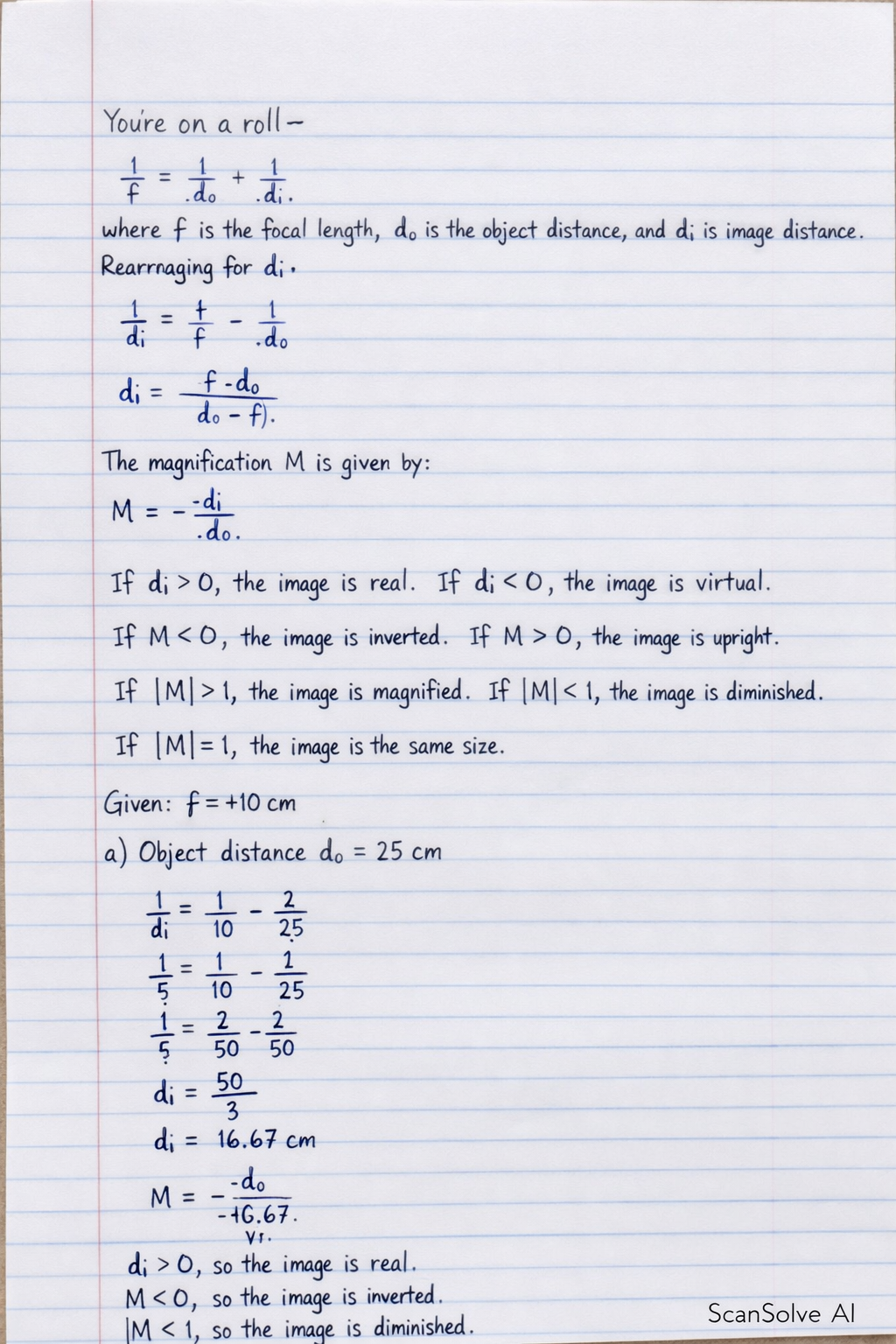
Handwritten Step-by-Step Solution
Get this as a handwritten image on WhatsApp — like a tutor wrote it for you.
Try on WhatsApp