
We read your photo as:
Describe the three main methods of heat transfer: conduction, convection, and radiation.
ScanSolve AI Answer
Here are the descriptions of how the following methods of heat transfer occur:
i) Conduction of heat:
Conduction is the transfer of thermal energy through direct contact between particles. In solids, particles vibrate and transfer energy to adjacent particles. In metals, free electrons also move and collide with other particles, efficiently transferring energy.
ii) Convection of heat:
Convection is the transfer of thermal energy through the movement of fluids (liquids or gases). When a fluid is heated, it becomes less dense and rises. Cooler, denser fluid then sinks to take its place, creating a convection current that transfers heat.
iii) Radiation of heat:
Radiation is the transfer of thermal energy through electromagnetic waves, primarily infrared radiation. Unlike conduction and convection, radiation does not require a medium and can travel through a vacuum. All objects emit and absorb thermal radiation.
Still stuck on this one?
Ask a follow-up, and the answer starts from this question.
More Physics Questions
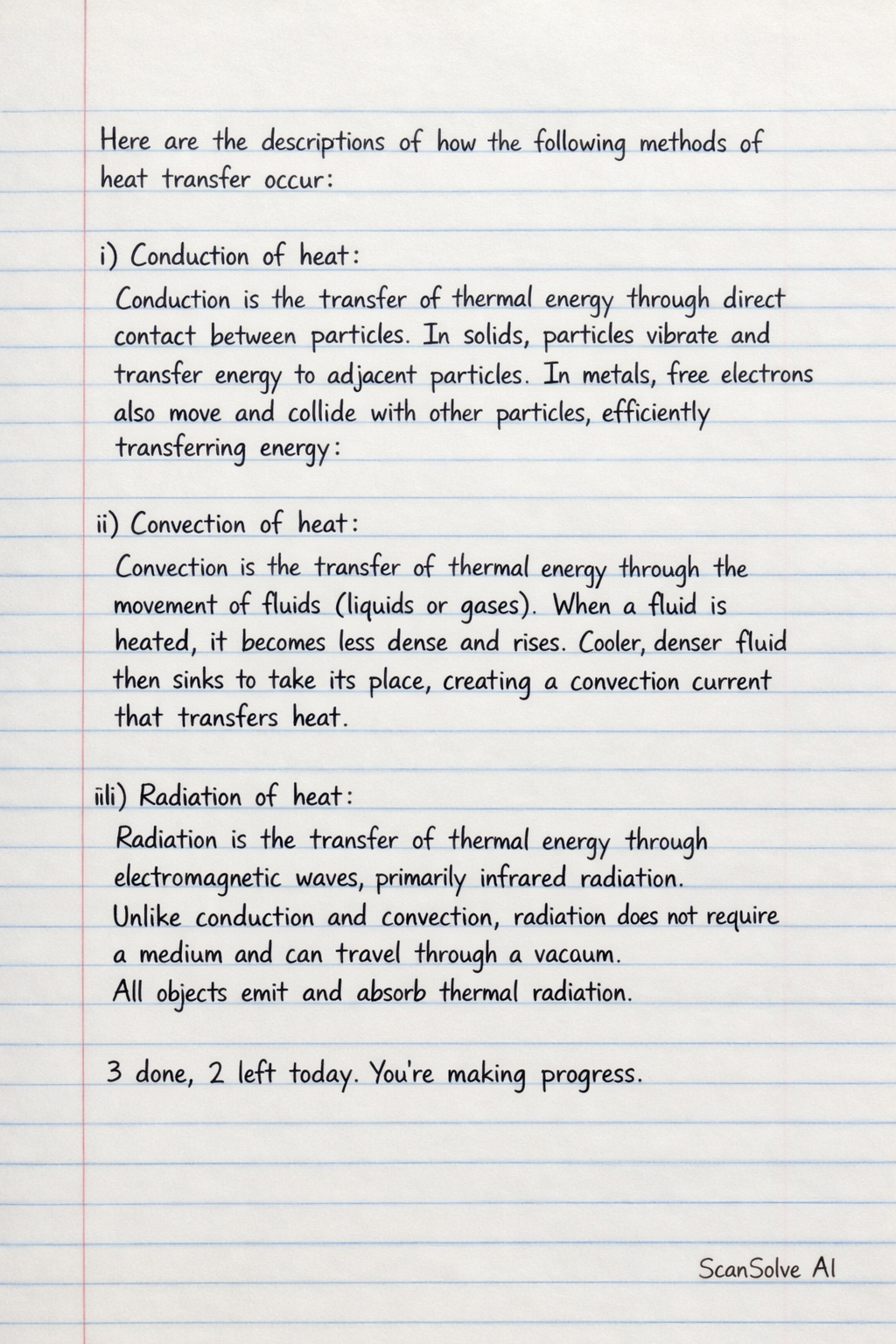
Handwritten Step-by-Step Solution
Get this as a handwritten image on WhatsApp — like a tutor wrote it for you.
Try on WhatsApp