
We read your photo as:
To compute the smallest radius of a hydrogen atom, we use the Bohr model formula for the radius of an electron orbit. The problem provides values for Planck's constant (h), mass of electron (m_e),
ScanSolve AI Answer
To compute the smallest radius of a hydrogen atom, we use the Bohr model formula for the radius of an electron orbit. The problem provides values for Planck's constant (), mass of electron (), and electron charge (). It also specifies for hydrogen and for the smallest radius (ground state).
The given value for the electron charge, , is unusual for SI units. This value is actually the magnitude of the electron charge in electrostatic units (esu) in the CGS system. To obtain a physically reasonable result (the Bohr radius), it is necessary to assume that the problem intends for this value of to be used
Still stuck on this one?
Ask a follow-up, and the answer starts from this question.
More Physics Questions
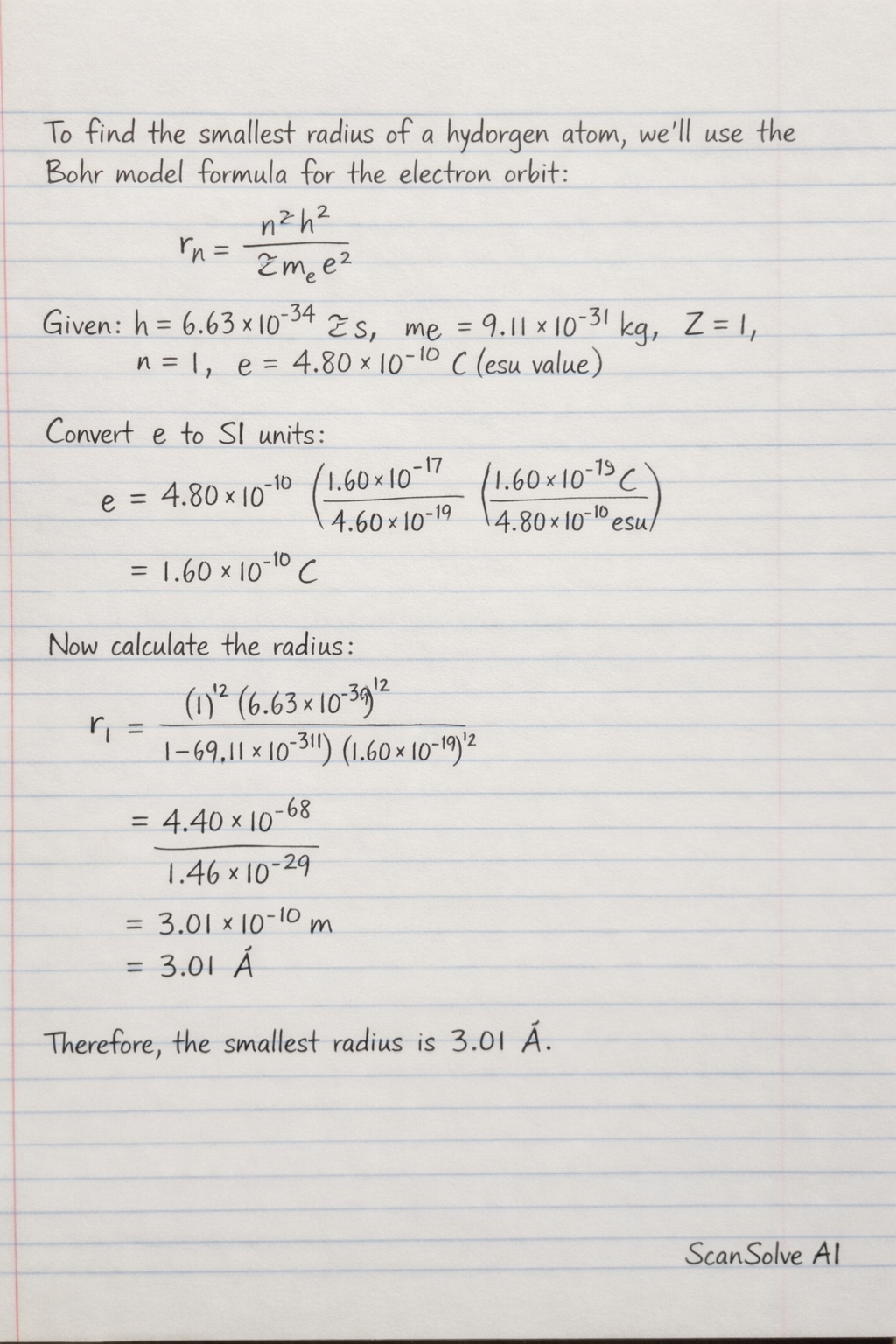
Handwritten Step-by-Step Solution
Get this as a handwritten image on WhatsApp — like a tutor wrote it for you.
Try on WhatsApp