
We read your photo as:
To determine the total resultant force acting on a vertical rectangular gate and the location of its center of pressure. However, the "figure below" mentioned in the question, which would provide the
ScanSolve AI Answer
Step-by-step solution
5 stepsThe problem asks to determine the total resultant force acting on a vertical rectangular gate and the location of its center of pressure. However, the "figure below" mentioned in the question, which would provide the dimensions of the gate (width and height) and the depth of the water, is missing.
To solve this problem, we need the following information from the figure:
- The width of the rectangular gate, .
- The height of the rectangular gate, .
- The depth of the water from the free surface to the top edge of the gate, . (If the gate starts at the free surface, ).
Assuming a vertical rectangular gate with width and height , submerged in water such that its top edge is at a depth from the free surface:
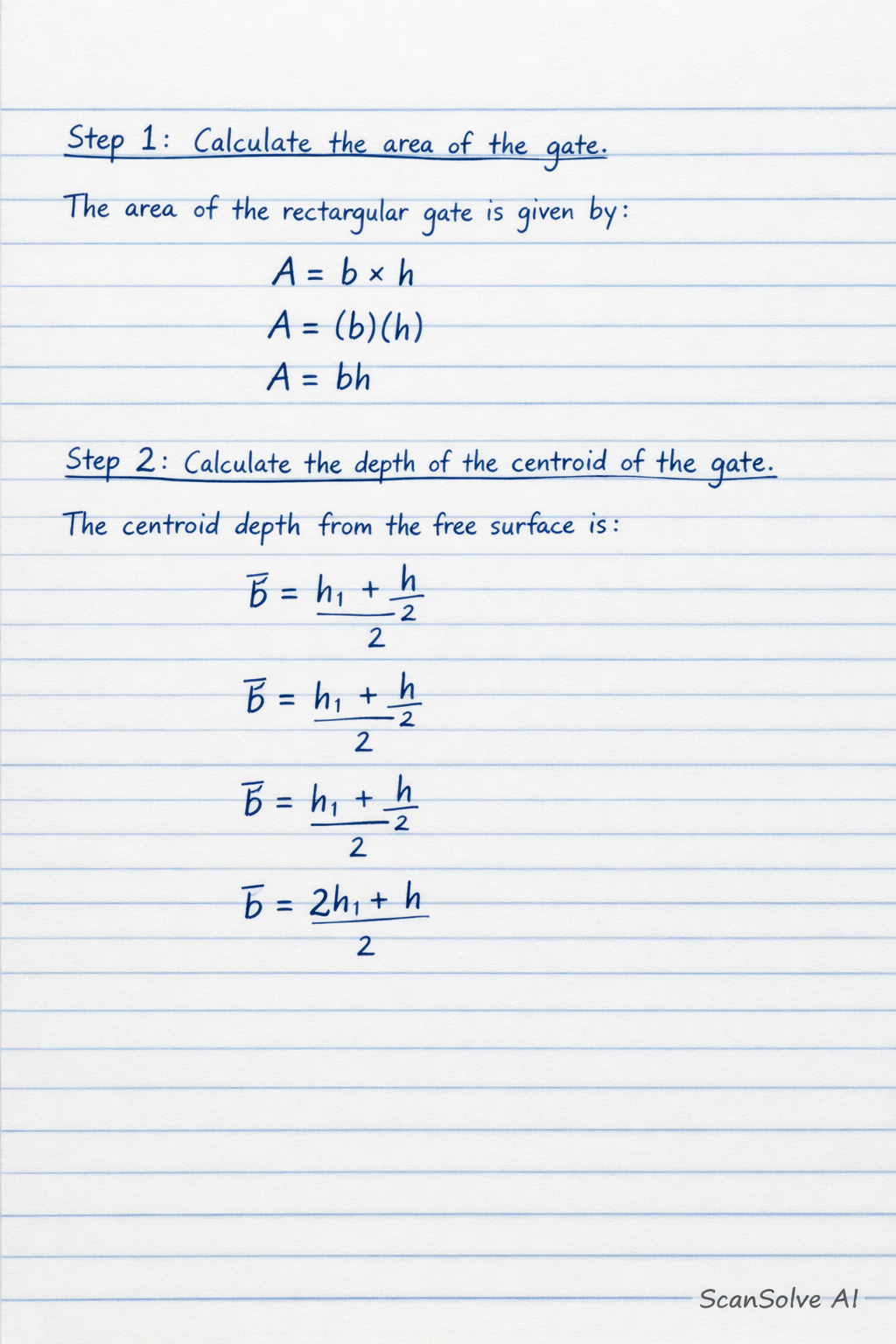
Calculate the area of the gate.
The area of the rectangular gate is given by:
Calculate the depth of the centroid of the gate.
The centroid of a rectangle is at its geometric center. The depth of the centroid from the free surface, , is:
Calculate the total resultant force () acting on the gate.
The resultant force on a submerged plane surface is given by the product of the pressure at the centroid of the surface and the area of the surface.
where:
- is the density of water (approximately ).
- is the acceleration due to gravity (approximately ).
- is the depth of the centroid.
- is the area of the gate.
Calculate the moment of inertia () of the gate about its centroidal axis.
For a rectangle, the moment of inertia about its horizontal centroidal axis is:
Calculate the location of the center of pressure ().
The center of pressure is the point where the resultant force acts. For a vertical plane surface, its depth from the free surface, , is given by:
Once the dimensions (, , and ) are provided from the figure, these formulas can be used to calculate the numerical values for the total resultant force and the location of the center of pressure.
Still stuck on this one?
Ask a follow-up, and the answer starts from this question.
More Physics Questions
Handwritten Step-by-Step Solution
Get this as a handwritten image on WhatsApp — like a tutor wrote it for you.
Try on WhatsApp