
We read your photo as:
Calculate the total capacitance of three parallel capacitors and draw the symbols for inductors in series and parallel.
ScanSolve AI Answer
Step-by-step solution
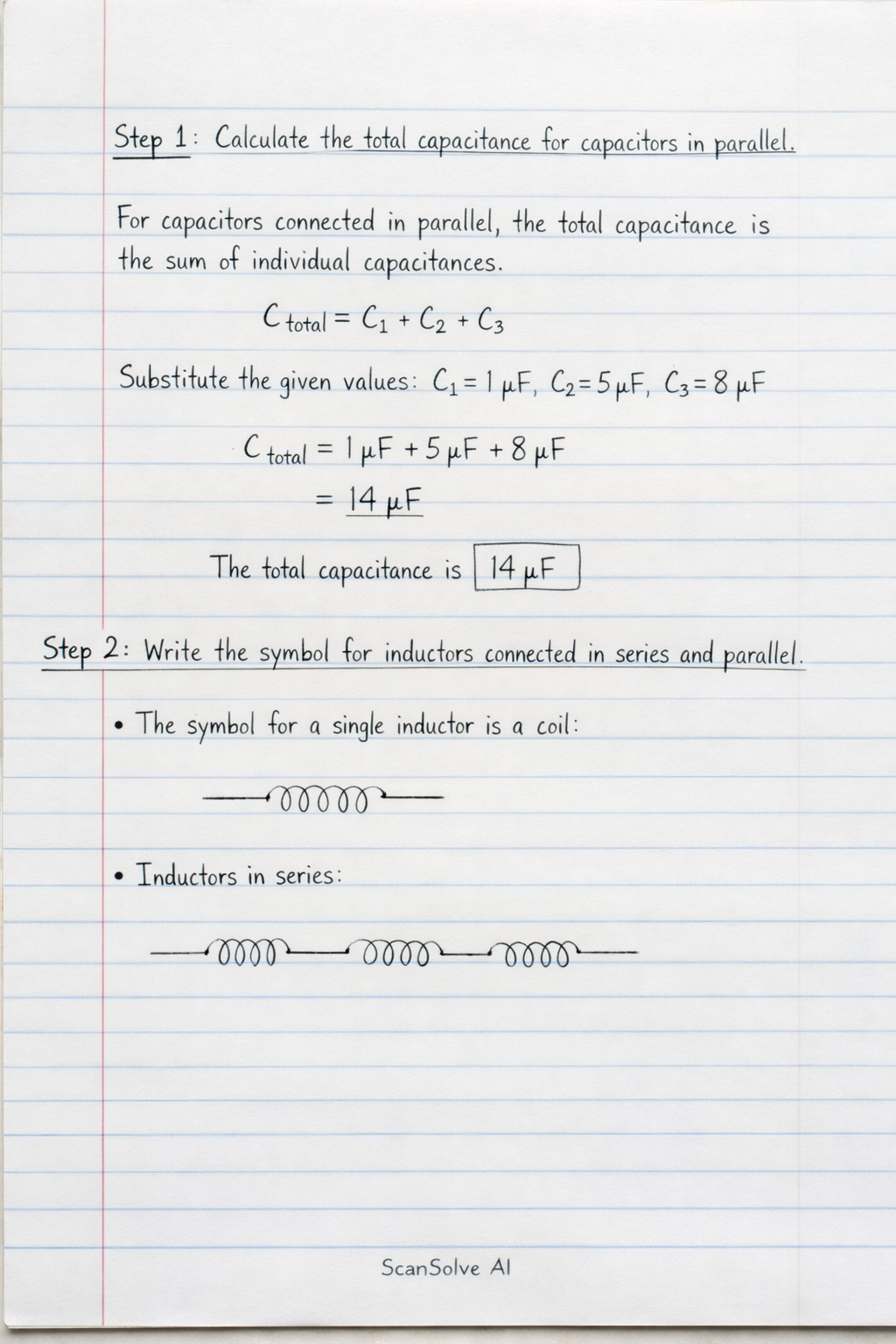
2 stepsStep 1: Calculate the total capacitance for capacitors in parallel.
For capacitors connected in parallel, the total capacitance is the sum of individual capacitances.
Substitute the given values: , , .
The total capacitance is .
Step 2: Write the symbol for inductors connected in series and parallel.
- The symbol for a single inductor is a coil:
\text{---} \begin{picture}(20,10) \put(0,5){\line(1,0){2}} \qbezier(2,5)(4,10)(6,5) \qbezier(6,5)(8,0)(10,5) \qbezier(10,5)(12,10)(14,5) \qbezier(14,5)(16,0)(18,5) \put(18,5){\line(1,0){2}} \end{picture} \text{---}
- Inductors in series:
\text{---} \begin{picture}(20,10) \put(0,5){\line(1,0){2}} \qbezier(2,5)(4,10)(6,5) \qbezier(6,5)(8,0)(10,5) \qbezier(10,5)(12,10)(14,5) \qbezier(14,5)(16,0)(18,5) \put(18,5){\line(1,0){2}} \end{picture} \text{---} \begin{picture}(20,10) \put(0,5){\line(1,0){2}} \qbezier(2,5)(4,10)(6,5) \qbezier(6,5)(8,0)(10,5) \qbezier(10,5)(12,10)(14,5) \qbezier(14,5)(16,0)(18,5) \put(18,5){\line(1,0){2}} \end{picture} \text{---}
- Inductors in parallel:
\begin{picture}(40,20) \put(0,15){\line(1,0){5}} \put(0,5){\line(1,0){5}} \put(5,15){\line(0,-1){10}} \put(35,15){\line(0,-1){10}} \put(5,15){\line(1,0){2}} \qbezier(7,15)(9,20)(11,15) \qbezier(11,15)(13,10)(15,15) \qbezier(15,15)(17,20)(19,15) \qbezier(19,15)(21,10)(23,15) \put(23,15){\line(1,0){12}} \put(5,5){\line(1,0){2}} \qbezier(7,5)(9,10)(11,5) \qbezier(11,5)(13,0)(15,5) \qbezier(15,5)(17,10)(19,5) \qbezier(19,5)(21,0)(23,5) \put(23,5){\line(1,0){12}} \put(35,15){\line(1,0){5}} \put(35,5){\line(1,0){5}} \end{picture}
Step 3: Define the terms as applied to electricity.
Part i
Voltage*: Voltage, also known as electric potential difference, is the work done per unit charge to move a test charge between two points in an electric field. It is measured in volts (V).
Part ii
Current*: Electric current is the rate of flow of electric charge through a conductor. It is measured in amperes (A).
Part iii
Resistance*: Electrical resistance is a measure of the opposition to the flow of electric current in an electrical circuit. It is measured in ohms ().
Part iv
Power*: Electric power is the rate at which electrical energy is transferred by an electric circuit. It is measured in watts (W).
Part v· 1 step
Multimeter*: A multimeter is an electronic measuring instrument that combines several measurement functions in one unit, typically including voltage, current, and resistance.
Identify instruments for measurement.
Part a(i)
Voltage*: A voltmeter is used to measure voltage.
Which instrument is used to measure the following
Part a(ii)
Current*: An ammeter is used to measure current.
Part a(iii)
Resistance*: An ohmmeter is used to measure resistance.
Part b· 1 step
State two (2) types of testing and measuring instrument system in the electrical field.
Two types of testing and measuring instrument systems are:
- Digital Multimeter (DMM): A versatile electronic instrument that measures various electrical parameters digitally.
- Oscilloscope: An instrument used to display and analyze the waveform of electronic signals over time.
Answer questions about maintenance and transformers.
Part b(i)
List any two (2) importance of maintenance.
Two importance of maintenance are:
- To prevent equipment failure and extend the lifespan of machinery.
- To ensure safety by identifying and rectifying potential hazards.
Part b(ii)
What is AC transformer?
An AC transformer is a static electrical device that transfers electrical energy between two or more circuits through electromagnetic induction, typically used to step up or step down AC voltage and current levels.
Part b(iii)
State two (2) types of transformer.
Two types of transformers are:
- Step-up transformer: Increases voltage from primary to secondary.
- Step-down transformer: Decreases voltage from primary to secondary.
Part b(iv)
State two (2) uses or applications of a transformer.
Two uses or applications of a transformer are:
- Power transmission: Stepping up voltage for long-distance transmission to reduce power loss.
- Electronic devices: Stepping down voltage to suitable levels for household appliances and electronic circuits.
Still stuck on this one?
Ask a follow-up, and the answer starts from this question.
More Physics Questions
Handwritten Step-by-Step Solution
Get this as a handwritten image on WhatsApp — like a tutor wrote it for you.
Try on WhatsApp