
We read your photo as:
Two electric bulbs A and B rated 200 V – 100 W and 200 V – 60 W are connected in series to a 200 V line. Then the potential drop across:
ScanSolve AI Answer
Step-by-step solution
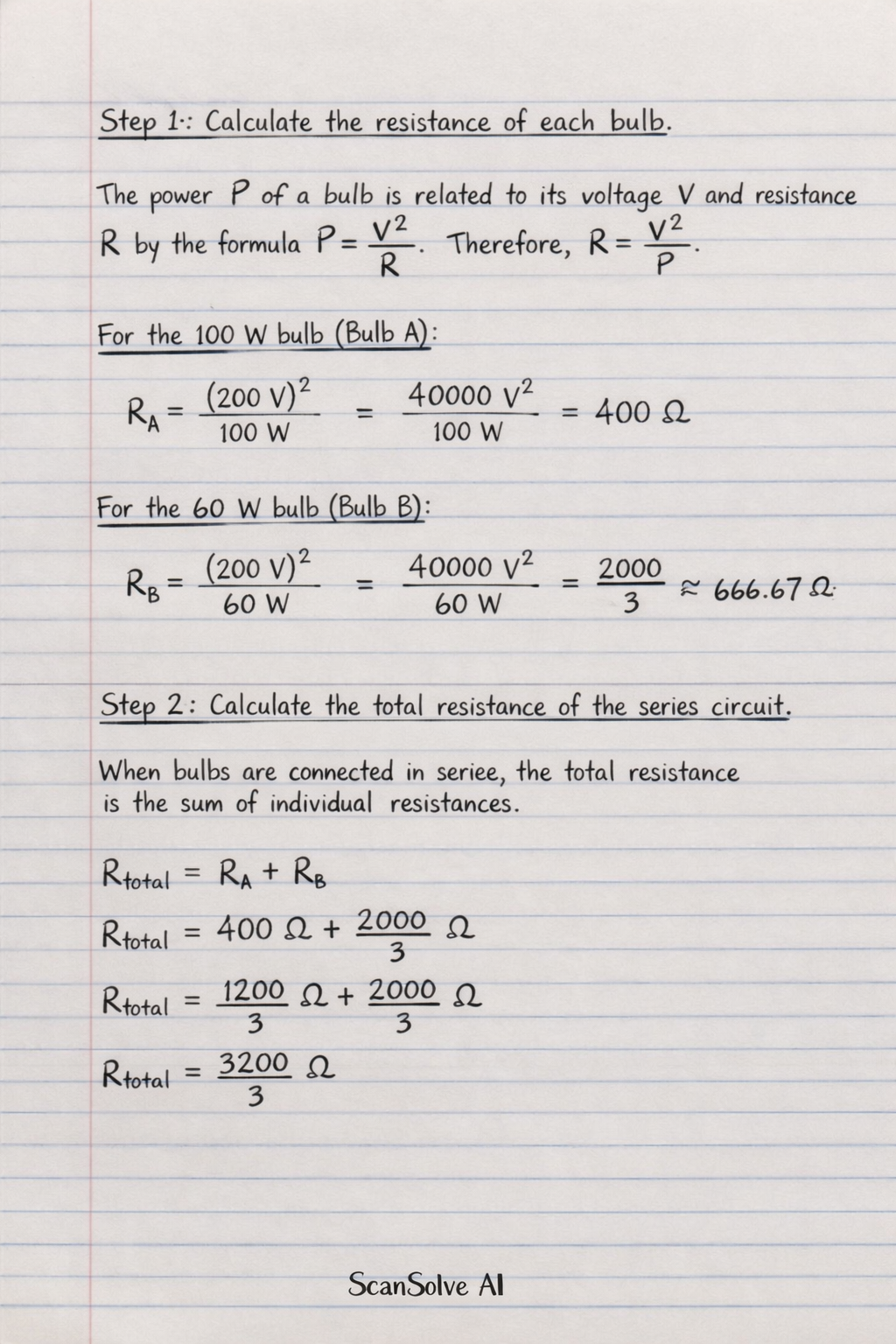
5 stepsCalculate the resistance of each bulb.
The power of a bulb is related to its rated voltage and resistance by the formula . Therefore, .
For the 100 W bulb (Bulb A):
For the 60 W bulb (Bulb B):
Calculate the total resistance of the series circuit.
When bulbs are connected in series, the total resistance is the sum of individual resistances.
Calculate the total current flowing through the circuit.
The total current in the series circuit is given by Ohm's law, , where is the supply voltage (200 V).
Calculate the potential drop across each bulb.
The potential drop across each bulb is given by .
Potential drop across the 100 W bulb ():
Potential drop across the 60 W bulb ():
Compare the potential drops.
We found that and .
This means the potential drop across the 100 W bulb () is smaller than the potential drop across the 60 W bulb ().Comparing this with the given options:
(A) Each bulb is 200 V - Incorrect.
(B) 100 W bulb is greater than that across 60 W bulb - Incorrect.
(C) 100 W bulb is smaller than that across 60 W bulb - Correct.
(D) Each bulb is 100 V - Incorrect.The final answer is
Still stuck on this one?
Ask a follow-up, and the answer starts from this question.
More Physics Questions
Handwritten Step-by-Step Solution
Get this as a handwritten image on WhatsApp — like a tutor wrote it for you.
Try on WhatsApp