
We read your photo as:
State two factors that affect the rate of evaporation of a liquid. Explain the term latent heat. Explain each of the following phenomena: On a dry day, water in a clay pot is cooler than water in a rubber container. Cooking of food is faster in a pressure cooker than in an ordinary pot.
ScanSolve AI Answer
Answer
Step-by-step solution
4 stepsPart e· 4 steps
Calculate its temperature.
Convert the initial temperature to Kelvin.
The relationship between the speed of sound () and absolute temperature () is given by .
Given at .Set up the ratio of speeds and temperatures.
We are given and need to find .
Solve for .
Square both sides of the equation:
Convert back to Celsius.
The temperature is approximately .
11. (a) State two factors that affect the rate of evaporation of a liquid.
- Temperature: A higher temperature increases the kinetic energy of liquid molecules, allowing more of them to escape into the vapor phase.
- Surface area: A larger exposed surface area allows more molecules to escape from the liquid's surface per unit time.
11. (b) Explain the term latent heat.
Latent heat is the energy absorbed or released by a substance during a phase change (e.g., melting, boiling, freezing, condensation) without a change in its temperature. This energy is used to break or form intermolecular bonds, changing the state of matter rather than increasing or decreasing its kinetic energy.
11. (c) Explain each of the following phenomena:
Part e(i)
On a dry day, water in a clay pot is cooler than water in a rubber container.
Clay pots are porous, allowing water to seep through to the outer surface. On a dry day, this water evaporates from the exterior of the pot. Evaporation is a cooling process because the most energetic water molecules absorb latent heat of vaporization from the remaining water and the pot itself to escape as vapor, thus lowering the temperature of the water inside. Rubber containers are non-porous, preventing this evaporative cooling.
Part e(ii)
Cooking of food is faster in a pressure cooker than in an ordinary pot.
In a pressure cooker, the sealed lid traps steam, which increases the pressure inside the cooker. This elevated pressure raises the boiling point of water above its normal 100 °C. Since the water boils at a higher temperature, the food cooks faster because chemical reactions involved in cooking proceed more rapidly at higher temperatures.
Try one yourself
A new problem that tests the same skill.
Still stuck on this one?
Ask a follow-up, and the answer starts from this question.
More Physics Questions
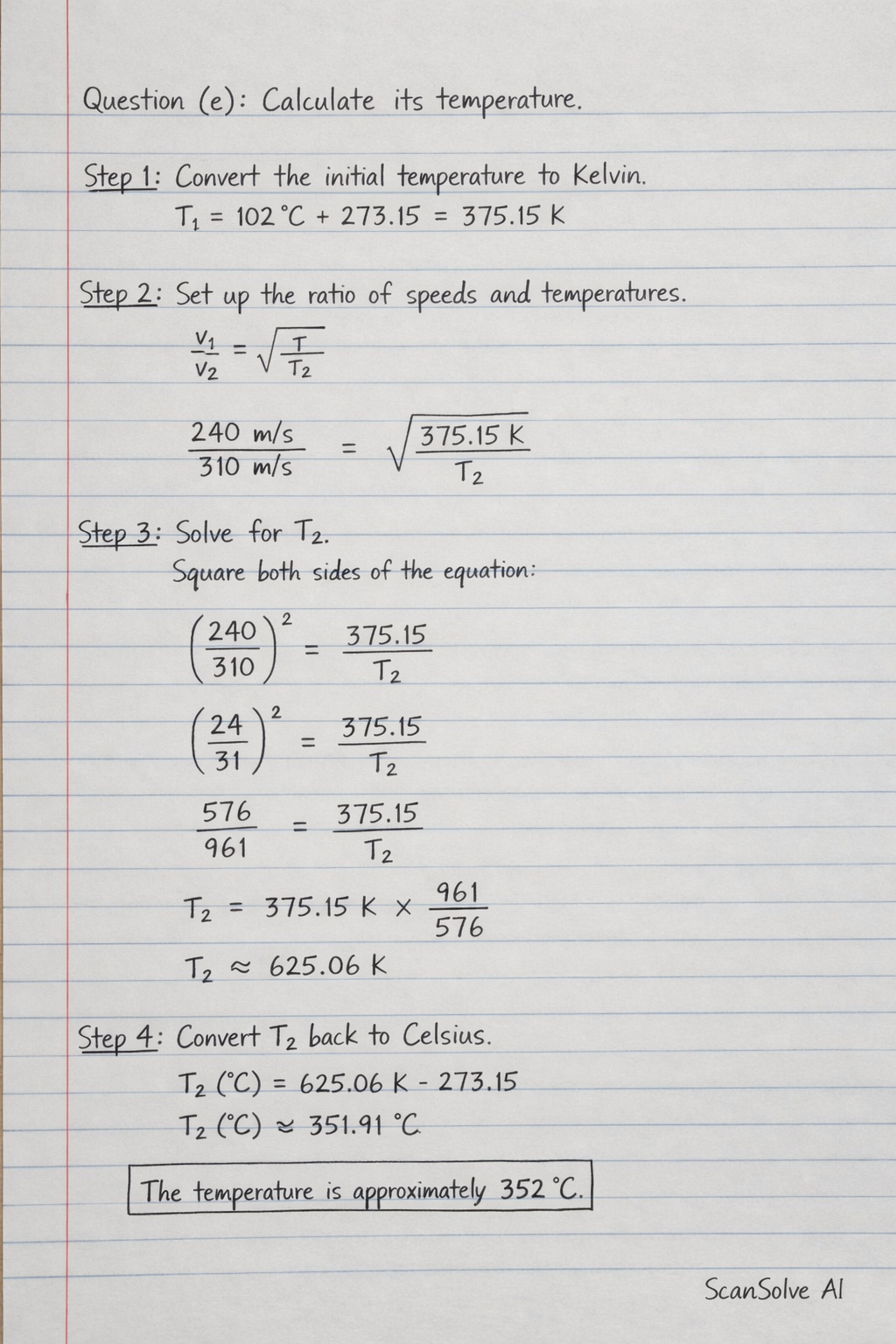
Handwritten Step-by-Step Solution
Get this as a handwritten image on WhatsApp — like a tutor wrote it for you.
Try on WhatsApp