
We read your photo as:
Explain why two friends standing at different distances from a brass band heard the sound at different intervals and why the sound was unclear.
ScanSolve AI Answer
Here are the explanations for the given physics problems:
Item 1:
-
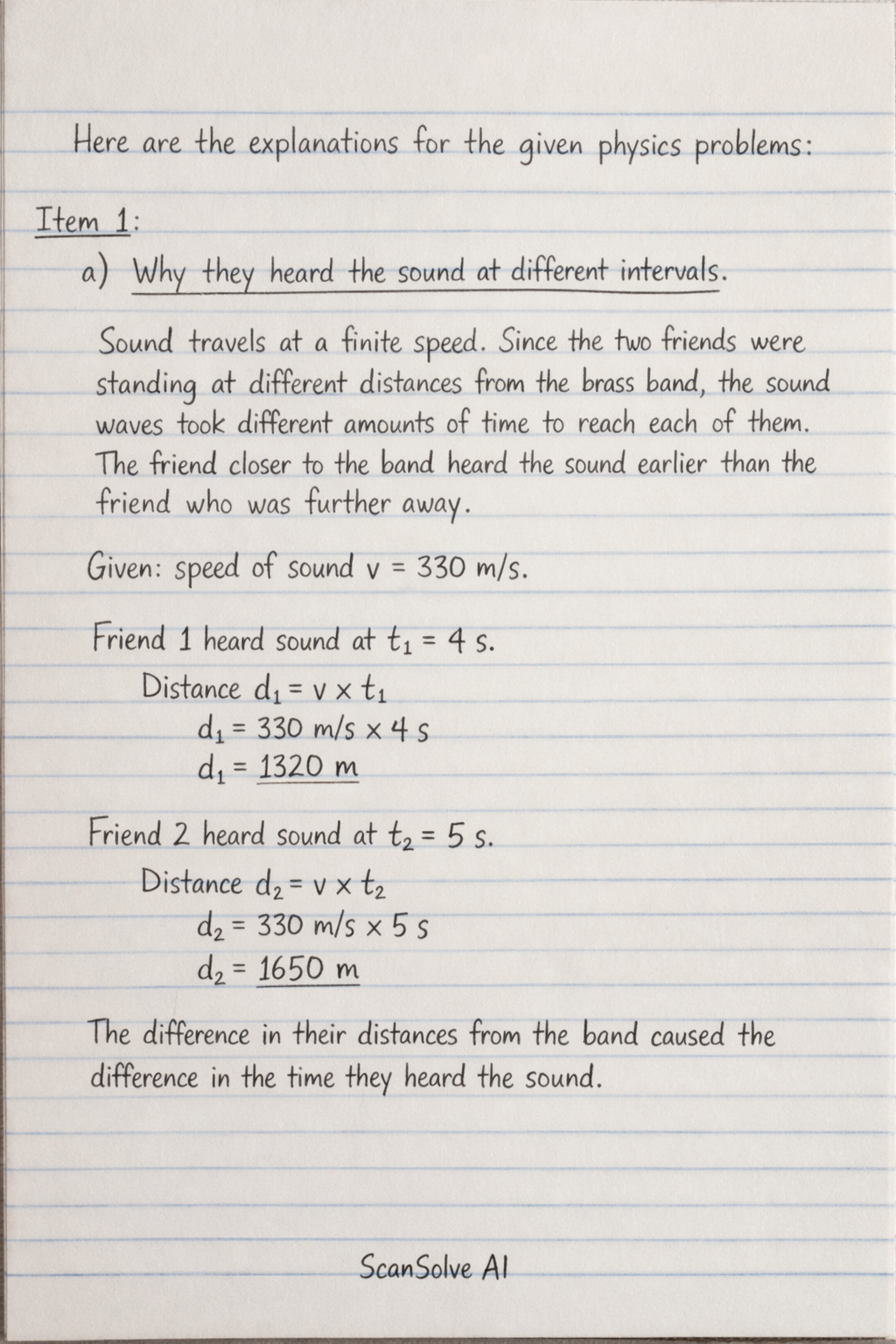
a) Why they heard the sound at different intervals. Sound travels at a finite speed. Since the two friends were standing at different distances from the brass band, the sound waves took different amounts of time to reach each of them. The friend closer to the band heard the sound earlier than the friend who was further away.
- Given speed of sound .
- Friend 1 heard sound at . Distance .
- Friend 2 heard sound at . Distance . The difference in their distances from the band caused the difference in the time they heard the sound.
-
b) Why the sound they heard was unclear, confused and indistinct. The sound was unclear, confused, and indistinct likely due to several factors:
- Echoes and Reverberation: Sound waves could have reflected off the "tall building" or other surrounding structures, reaching the listeners at slightly different times after the direct sound. These delayed reflections (echoes) would overlap with the original sound, making it muddled.
- Interference: Multiple sound waves (direct and reflected) interfering with each other can cause constructive and destructive interference, distorting the sound quality.
- Attenuation: Over the long distances (implied by the 4s and 5s travel times), sound energy is absorbed and scattered by the air and obstacles, reducing its intensity and clarity.
-
c) Why the colour of their clothes kept changing when coloured lights flashed on them. The perceived colour of an object depends on the colours of light it reflects and the colours of light incident upon it.
- The friends were originally wearing yellow clothes. Yellow objects reflect yellow light (which is a combination of red and green light) and absorb other colours.
- When red light flashed on the yellow clothes, the red component of the yellow light was reflected, making the clothes appear reddish.
- When blue light flashed on the yellow clothes, the blue light was absorbed (as yellow objects do not reflect blue light), making the clothes appear dark or black.
- When green light flashed on the yellow clothes, the green component of the yellow light was reflected, making the clothes appear greenish. This phenomenon is due to the selective absorption and reflection of light by the pigments in the clothes.
Item 2:
-
a) The possibility of it being day in one place and night in another place. The Earth is a sphere that rotates on its axis. At any given moment, only one half of the Earth is illuminated by the Sun, experiencing daytime. The other half, facing away from the Sun, experiences nighttime. As the Earth continuously rotates, different regions move from day to night and vice versa, explaining why it can be day in one country and night in another simultaneously.
-
b) The occurrence of high ocean tides. Ocean tides are primarily caused by the gravitational pull of the Moon and, to a lesser extent, the Sun on Earth's oceans.
- The Moon's gravity pulls the water on the side of Earth closest to it, creating a bulge (a high tide).
- On the side of the Earth opposite the Moon, the Earth itself is pulled more strongly towards the Moon than the water on that far side. This leaves the water behind, creating another bulge and thus a second high tide.
- In the regions between these two bulges, water is drawn away, resulting in low tides. As the Earth rotates, different locations pass through these bulges, experiencing two high tides and two low tides approximately every 24 hours.
-
c) How an event in one place can be broadcast live in another country. An event can be broadcast live across countries using communication satellites or fiber optic cables.
- Satellite Broadcasting: The live video and audio signals are converted into electromagnetic waves (radio waves or microwaves) and transmitted from a ground station to a geostationary satellite orbiting Earth. The satellite then receives, amplifies, and relays these signals back down to receiving dishes in other countries.
- Fiber Optic Networks: Signals can also be transmitted as light pulses through undersea fiber optic cables that span continents. Since electromagnetic waves and light travel at the speed of light, the transmission is virtually instantaneous, allowing for live viewing across different time zones with minimal delay.
Still stuck on this one?
Ask a follow-up, and the answer starts from this question.
More Physics Questions
Handwritten Step-by-Step Solution
Get this as a handwritten image on WhatsApp — like a tutor wrote it for you.
Try on WhatsApp