
We read your photo as:
Two hollow conducting concentric spheres of radii R and r have positive charges with equal surface charge densities (σ). What is the electric potential at their common center? (r>R)
ScanSolve AI Answer
Answer
Step-by-step solution
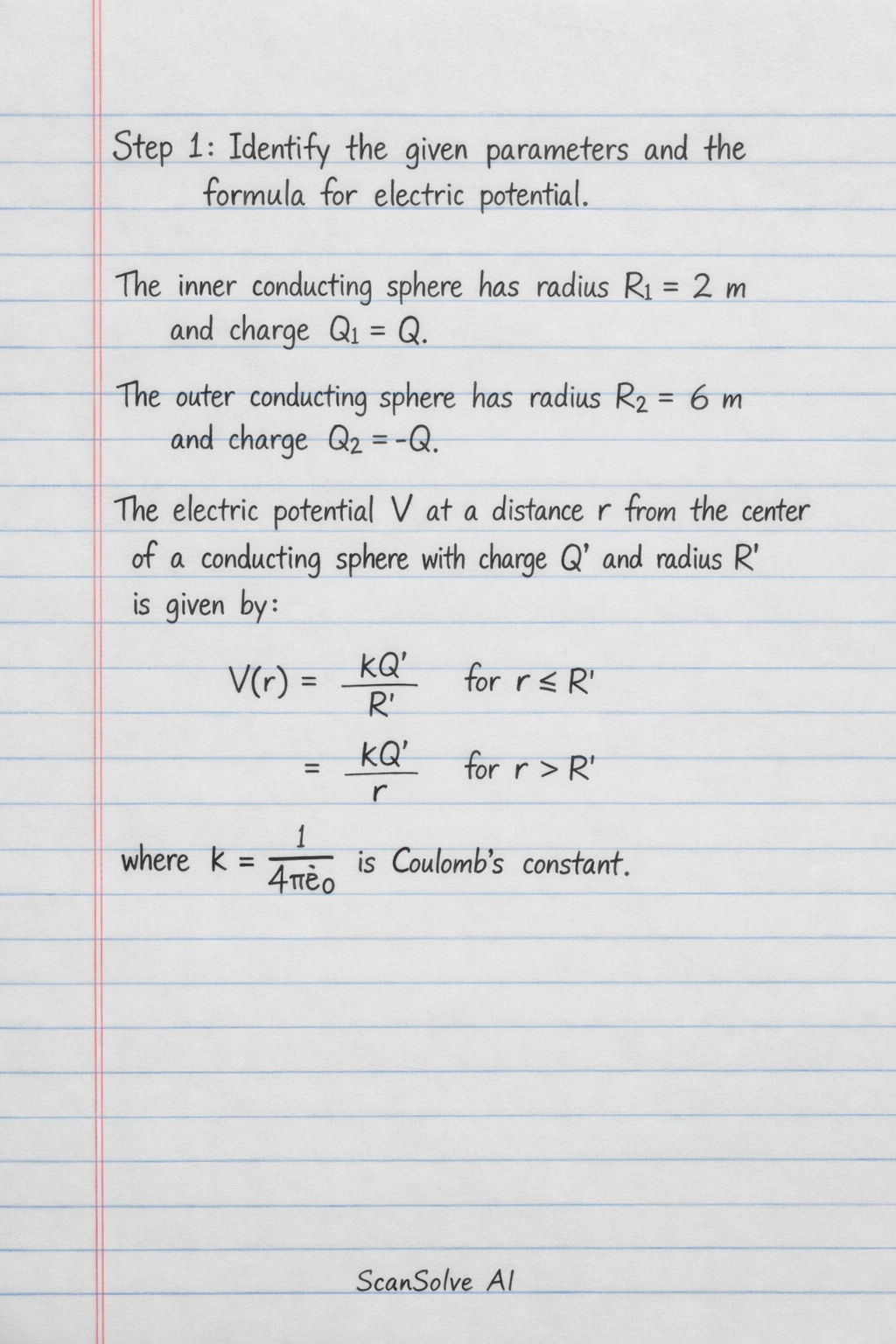
5 stepsIdentify the given parameters and the formula for electric potential.
The inner conducting sphere has radius m and charge .
The outer conducting sphere has radius m and charge .
The electric potential at a distance from the center of a conducting sphere with charge and radius is given by:where is Coulomb's constant.
Calculate the electric potential on the surface of the inner sphere ().
The potential on the inner sphere () is due to its own charge and the charge on the outer sphere.
The point is on the surface of the inner sphere and inside the outer sphere.
Potential due to :
Potential due to : Since , the potential due to the outer sphere at this point is the same as its surface potential.
The total potential on the inner sphere is:Calculate the electric potential on the surface of the outer sphere ().
The potential on the outer sphere () is due to the charge on the inner sphere and its own charge .
The point is outside the inner sphere and on the surface of the outer sphere.
Potential due to : Since ,
Potential due to :
The total potential on the outer sphere is:Calculate the potential difference between the two spheres.
The potential difference between the spheres is .
Compare the result with the given options.
The calculated potential difference is , which matches option (2).
The final answer is .
Try one yourself
A new problem that tests the same skill.
Still stuck on this one?
Ask a follow-up, and the answer starts from this question.
More Physics Questions
Handwritten Step-by-Step Solution
Get this as a handwritten image on WhatsApp — like a tutor wrote it for you.
Try on WhatsApp