
We read your photo as:
Two masses, 8kg and 6kg, are attached to the ends of a light inextensible string which passes over a smooth pulley. A third mass of 4kg is suspended from the pulley by another string, and this mass is
ScanSolve AI Answer
Answer
Step-by-step solution
3 stepsDetermine the tension in the strings supporting the 4kg mass.
The 4kg mass is in equilibrium. The weight of the mass acts downwards, and the vertical components of the tension in the two strings act upwards. Each string makes an angle of with the upward vertical. Let be the tension in each string.
The weight of the 4kg mass is .
For vertical equilibrium:Since :
Find the angle for the 8kg mass.
The 8kg mass is in equilibrium on a smooth inclined plane. The tension pulls the mass up the plane, and the component of gravity pulls it down the plane.
The component of gravity acting down the incline is .
For equilibrium along the incline:Substitute the value of from Step 1:
Divide both sides by :
Find the angle for the 6kg mass.
The 6kg mass is in equilibrium on a smooth inclined plane. The tension pulls the mass up the plane, and the component of gravity pulls it down the plane.
The component of gravity acting down the incline is .
For equilibrium along the incline:Substitute the value of from Step 1:
Divide both sides by :
Using a calculator:
The angles are:
Try one yourself
A new problem that tests the same skill.
Still stuck on this one?
Ask a follow-up, and the answer starts from this question.
More Physics Questions
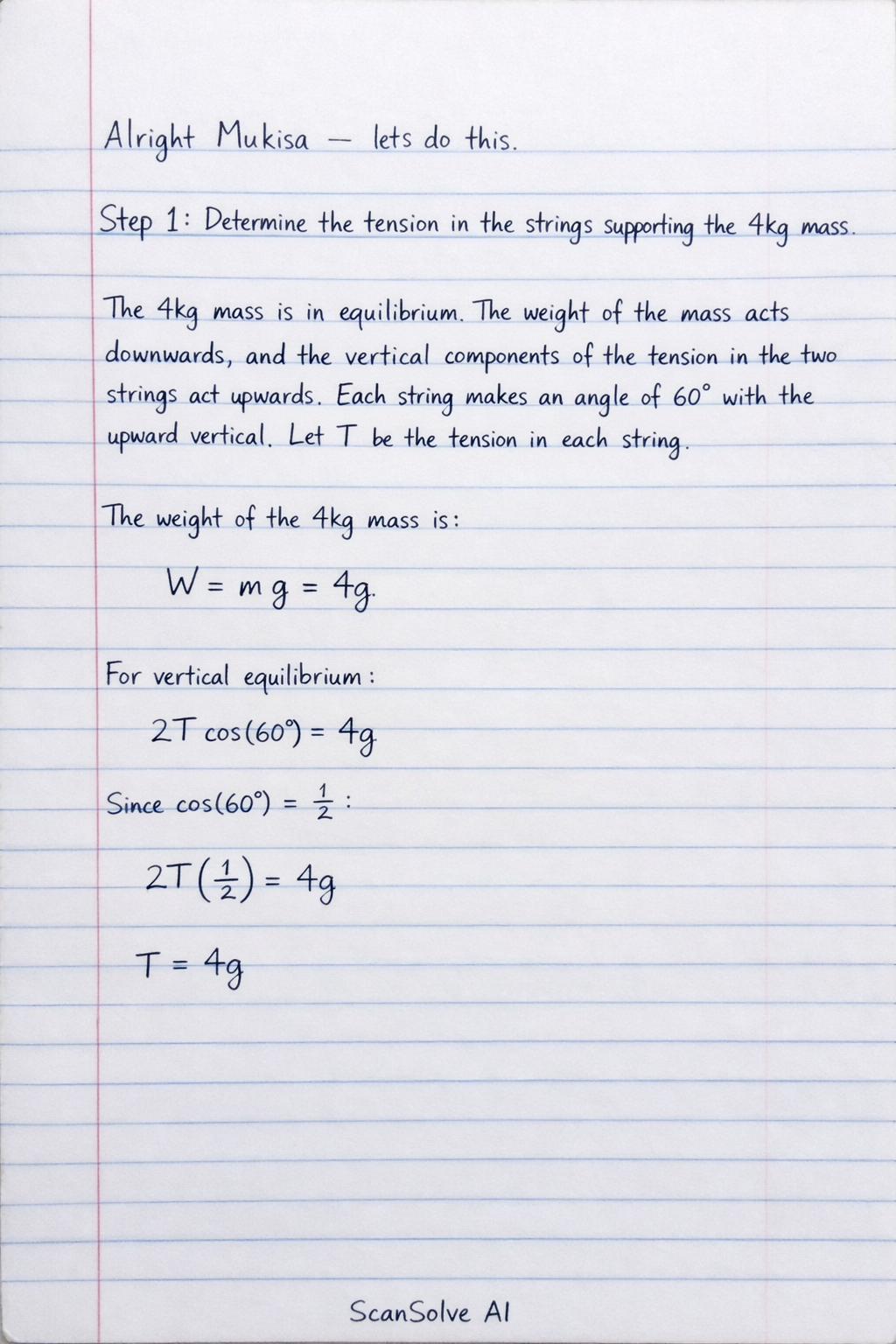
Handwritten Step-by-Step Solution
Get this as a handwritten image on WhatsApp — like a tutor wrote it for you.
Try on WhatsApp