
We read your photo as:
State two practical uses of photo cells.
ScanSolve AI Answer
Step-by-step solution
3 stepsHere are the solutions to the questions:
(b) (i) State two practical uses of photo cells.
- Automatic street lighting: Photo cells detect ambient light levels and switch streetlights on at dusk and off at dawn.
- Automatic door openers: They can detect the presence of a person by sensing an interruption in a light beam, triggering the door to open. Other uses include burglar alarms, light meters in cameras, and solar panels for electricity generation.
(b) (iii) A scientist uses a radioactive source with a half-life of as a clock. If the source initially emits 1220 particles per minute, what time interval has elapsed when he records 160 counts per minute?
Identify the given values.
Initial activity () = 1220 counts/min
Final activity () = 160 counts/min
Half-life () =Use the radioactive decay formula to find the number of half-lives ().
The formula for radioactive decay is:
Substitute the given values:
Divide both sides by 1220:
Take the natural logarithm of both sides:
Solve for :
Calculate the total time elapsed ().
The total time elapsed is the number of half-lives multiplied by the half-life period:
The time interval elapsed is .
Still stuck on this one?
Ask a follow-up, and the answer starts from this question.
More Physics Questions
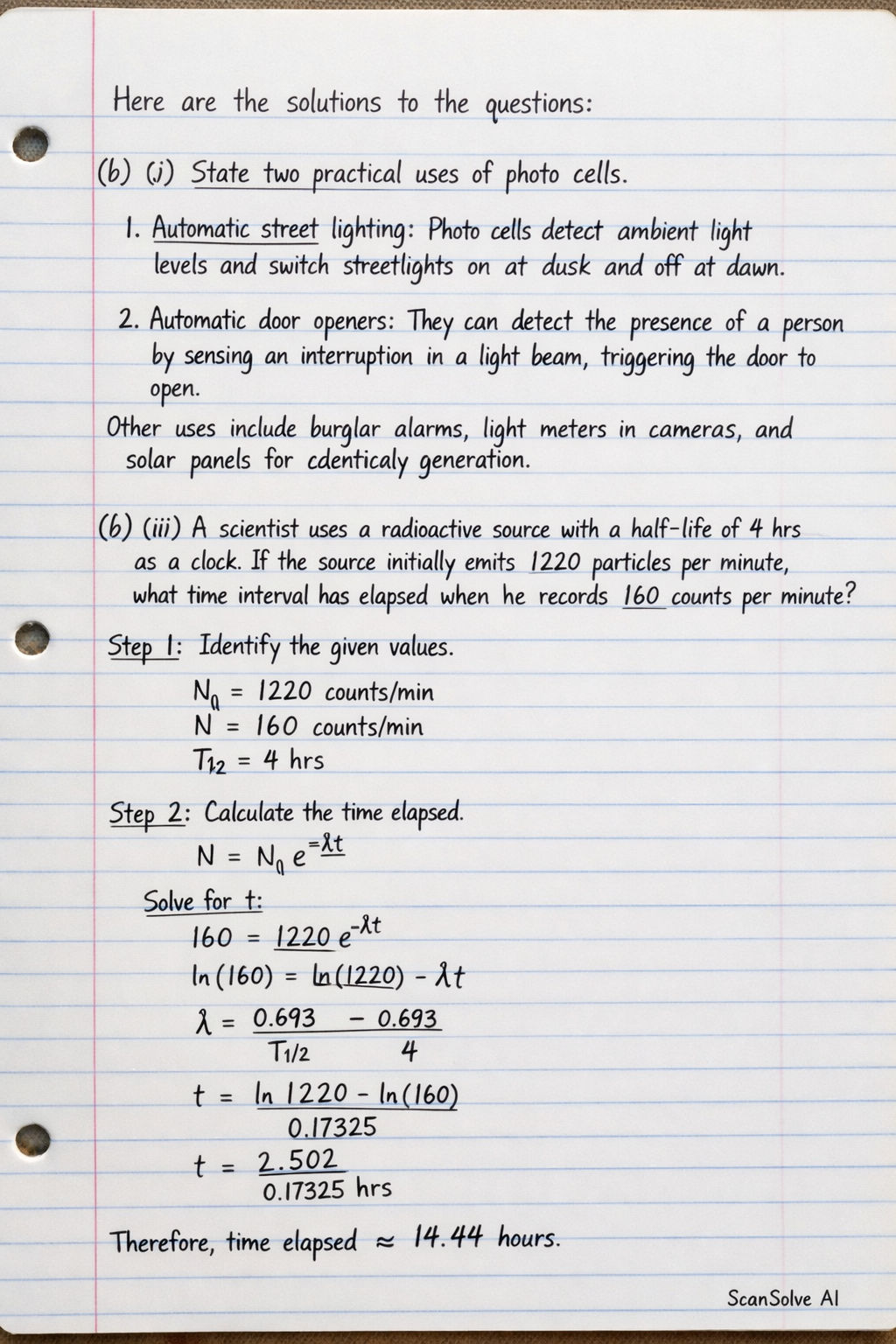
Handwritten Step-by-Step Solution
Get this as a handwritten image on WhatsApp — like a tutor wrote it for you.
Try on WhatsApp