We read your photo as:

Two vectors A and B have magnitudes such that A + B = 16 N and |A + B| = 8 N. If the resultant is perpendicular to A, what is the magnitude of B?

Physics

ScanSolve AI Answer

Step-by-step solution

6 steps
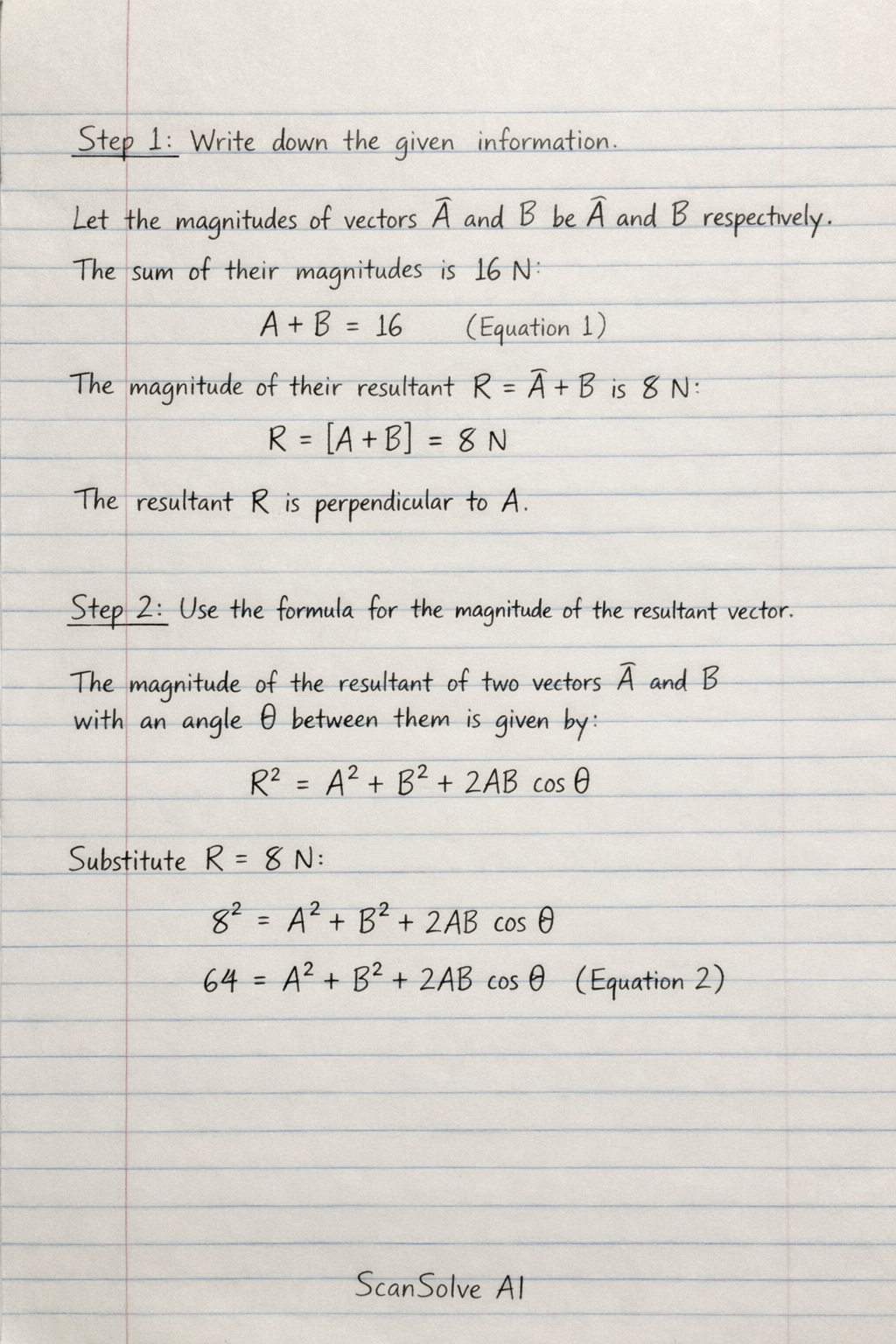
  1. Write down the given information.

    Let the magnitudes of vectors A⃗\vec{A} and B⃗\vec{B} be AA and BB respectively.
    The sum of their magnitudes is 16 N16 \, \text{N}:

    A+B=16(Equation 1)A + B = 16 \quad \text{(Equation 1)}

    The magnitude of their resultant R⃗=A⃗+B⃗\vec{R} = \vec{A} + \vec{B} is 8 N8 \, \text{N}:

    R=∣A⃗+B⃗∣=8 NR = |\vec{A} + \vec{B}| = 8 \, \text{N}

    The resultant R⃗\vec{R} is perpendicular to A⃗\vec{A}.

  2. Use the formula for the magnitude of the resultant vector.

    The magnitude of the resultant of two vectors A⃗\vec{A} and B⃗\vec{B} with an angle θ\theta between them is given by:

    R2=A2+B2+2ABcos⁡θR^2 = A^2 + B^2 + 2AB \cos \theta

    Substitute R=8 NR = 8 \, \text{N}:

    82=A2+B2+2ABcos⁡θ8^2 = A^2 + B^2 + 2AB \cos \theta 64=A2+B2+2ABcos⁡θ(Equation 2)64 = A^2 + B^2 + 2AB \cos \theta \quad \text{(Equation 2)}
  3. Use the condition that the resultant is perpendicular to vector A⃗\vec{A}.

    If the resultant R⃗\vec{R} is perpendicular to A⃗\vec{A}, the angle α\alpha between R⃗\vec{R} and A⃗\vec{A} is 90∘90^\circ. The direction of the resultant is given by:

    tan⁡α=Bsin⁡θA+Bcos⁡θ\tan \alpha = \frac{B \sin \theta}{A + B \cos \theta}

    Since α=90∘\alpha = 90^\circ, tan⁡90∘\tan 90^\circ is undefined. This implies the denominator must be zero:

    A+Bcos⁡θ=0A + B \cos \theta = 0 Bcos⁡θ=−A(Equation 3)B \cos \theta = -A \quad \text{(Equation 3)}
  4. Substitute Equation 3 into Equation 2.

    Substitute Bcos⁡θ=−AB \cos \theta = -A into Equation 2:

    64=A2+B2+2A(−A)64 = A^2 + B^2 + 2A(-A) 64=A2+B2−2A264 = A^2 + B^2 - 2A^2 64=B2−A264 = B^2 - A^2

    This is a difference of squares:

    64=(B−A)(B+A)(Equation 4)64 = (B - A)(B + A) \quad \text{(Equation 4)}
  5. Solve the system of equations to find AA and BB.

    From Equation 1, we know A+B=16A + B = 16. Substitute this into Equation 4:

    64=(B−A)(16)64 = (B - A)(16)

    Divide by 16:

    B−A=6416B - A = \frac{64}{16} B−A=4(Equation 5)B - A = 4 \quad \text{(Equation 5)}

    Now we have a system of two linear equations:

    1. A+B=16A + B = 16
    2. −A+B=4-A + B = 4 Add Equation 1 and Equation 5:
    (A+B)+(−A+B)=16+4(A + B) + (-A + B) = 16 + 4 2B=202B = 20 B=10 NB = 10 \, \text{N}

    Substitute B=10 NB = 10 \, \text{N} into Equation 1:

    A+10=16A + 10 = 16 A=16−10A = 16 - 10 A=6 NA = 6 \, \text{N}
  6. Calculate the ratio A/BA/B.

    AB=6 N10 N=35\frac{A}{B} = \frac{6 \, \text{N}}{10 \, \text{N}} = \frac{3}{5}

    The magnitudes of A⃗\vec{A} and B⃗\vec{B} are 6 N6 \, \text{N} and 10 N10 \, \text{N} respectively.
    The ratio A/BA/B is 3/53/5.

    The magnitude of A⃗\vec{A} is 6 N\boxed{\text{6 N}}
    The magnitude of B⃗\vec{B} is 10 N\boxed{\text{10 N}}
    The ratio A/BA/B is 35\boxed{\frac{3}{5}}

Was this helpful?

Still stuck on this one?

Ask a follow-up, and the answer starts from this question.

Got a different question?Ask your own question
Handwritten step-by-step solution preview

Handwritten Step-by-Step Solution

Get this as a handwritten image on WhatsApp — like a tutor wrote it for you.

Try on WhatsApp