We read your photo as:

The resultant of A and B is perpendicular to A. What is the angle between A and B

Physics

ScanSolve AI Answer

Answer

All of these\text{All of these}

Step-by-step solution

5 steps
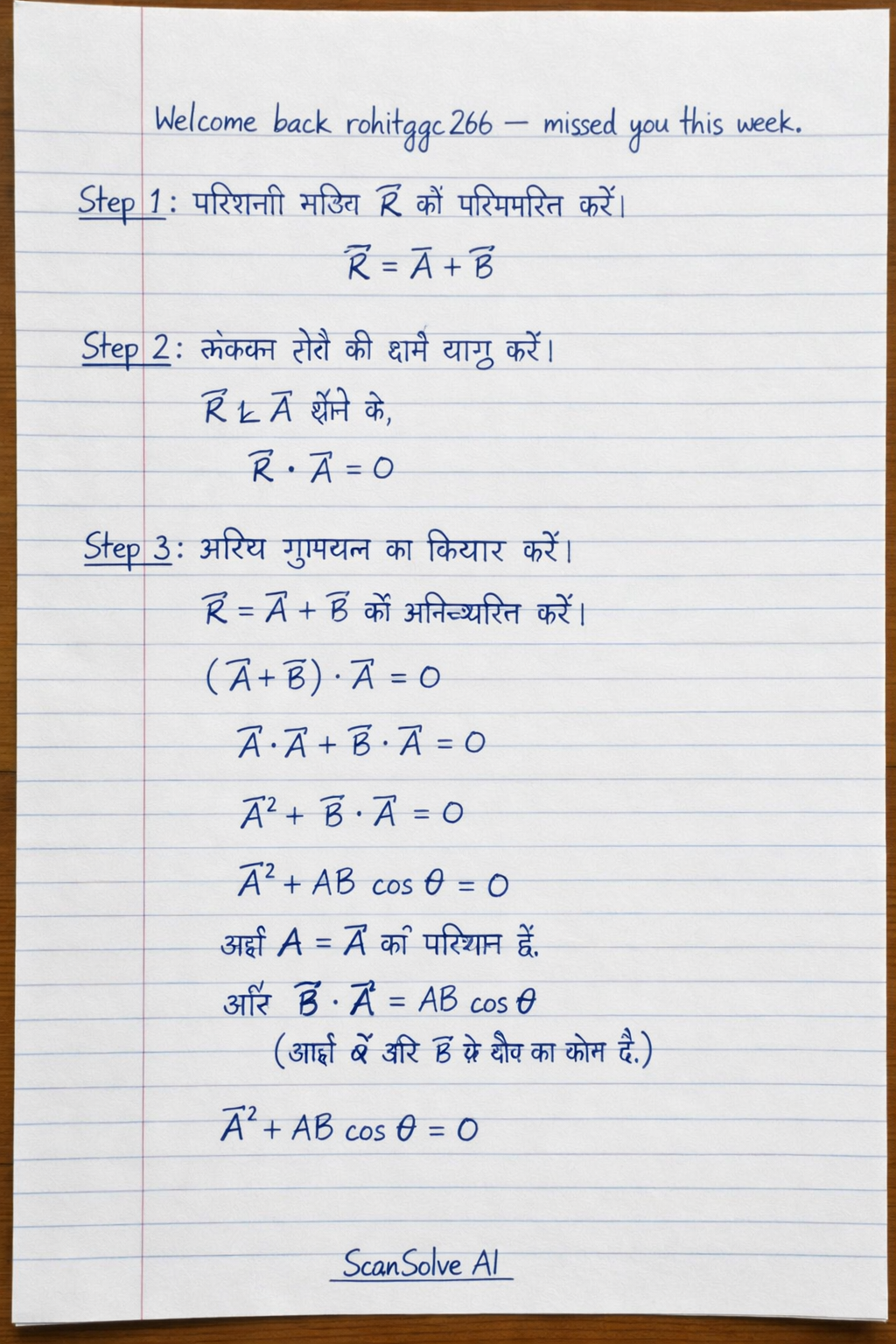
  1. परिणामी सदिश R⃗\vec{R} को परिभाषित करें।

    दिया गया है कि सदिश A⃗\vec{A} और B⃗\vec{B} का परिणामी R⃗\vec{R} है, तो:

    R⃗=A⃗+B⃗\vec{R} = \vec{A} + \vec{B}
  2. लंबवत होने की शर्त लागू करें।

    प्रश्न में कहा गया है कि परिणामी R⃗\vec{R} सदिश A⃗\vec{A} के लंबवत है। इसका मतलब है कि उनका अदिश गुणनफल (dot product) शून्य होगा:

    R⃗⋅A⃗=0\vec{R} \cdot \vec{A} = 0
  3. अदिश गुणनफल का विस्तार करें।

    R⃗\vec{R} के लिए समीकरण को प्रतिस्थापित करें:

    (A⃗+B⃗)⋅A⃗=0(\vec{A} + \vec{B}) \cdot \vec{A} = 0 A⃗⋅A⃗+B⃗⋅A⃗=0\vec{A} \cdot \vec{A} + \vec{B} \cdot \vec{A} = 0

    हम जानते हैं कि A⃗⋅A⃗=A2\vec{A} \cdot \vec{A} = A^2 (जहाँ AA सदिश A⃗\vec{A} का परिमाण है) और B⃗⋅A⃗=ABcos⁡θ\vec{B} \cdot \vec{A} = AB \cos \theta (जहाँ θ\theta सदिश A⃗\vec{A} और B⃗\vec{B} के बीच का कोण है)।

    A2+ABcos⁡θ=0A^2 + AB \cos \theta = 0
  4. cos⁡θ\cos \theta के लिए हल करें।

    समीकरण को cos⁡θ\cos \theta के लिए पुनर्व्यवस्थित करें:

    ABcos⁡θ=−A2AB \cos \theta = -A^2

    यदि A≠0A \neq 0 है, तो हम AA से भाग दे सकते हैं:

    Bcos⁡θ=−AB \cos \theta = -A cos⁡θ=−AB\cos \theta = -\frac{A}{B}

    इसलिए, θ\theta का मान है:

    θ=cos⁡−1(−AB)\theta = \cos^{-1}\left(-\frac{A}{B}\right)

    यह विकल्प (1) से मेल खाता है।

  5. अन्य विकल्पों की जाँच करें।

    अब हम जाँचते हैं कि क्या अन्य विकल्प भी इसी कोण को दर्शाते हैं।
    यदि cos⁡θ=−AB\cos \theta = -\frac{A}{B} है, तो θ\theta दूसरे चतुर्थांश में होगा (क्योंकि AA और BB परिमाण हैं, वे धनात्मक हैं, इसलिए −AB-\frac{A}{B} ऋणात्मक है)। दूसरे चतुर्थांश में sin⁡θ\sin \theta धनात्मक होता है।
    त्रिकोणमितीय सर्वसमिका sin⁡2θ+cos⁡2θ=1\sin^2 \theta + \cos^2 \theta = 1 का उपयोग करके:

    sin⁡2θ=1−cos⁡2θ=1−(−AB)2=1−A2B2=B2−A2B2\sin^2 \theta = 1 - \cos^2 \theta = 1 - \left(-\frac{A}{B}\right)^2 = 1 - \frac{A^2}{B^2} = \frac{B^2 - A^2}{B^2} sin⁡θ=B2−A2B2=B2−A2B\sin \theta = \sqrt{\frac{B^2 - A^2}{B^2}} = \frac{\sqrt{B^2 - A^2}}{B}

    इसलिए, θ\theta का मान है:

    θ=sin⁡−1(B2−A2B)\theta = \sin^{-1}\left(\frac{\sqrt{B^2 - A^2}}{B}\right)

    यह विकल्प (2) से मेल खाता है।

    अब tan⁡θ\tan \theta के लिए:

    tan⁡θ=sin⁡θcos⁡θ=B2−A2B−AB=−B2−A2A\tan \theta = \frac{\sin \theta}{\cos \theta} = \frac{\frac{\sqrt{B^2 - A^2}}{B}}{-\frac{A}{B}} = -\frac{\sqrt{B^2 - A^2}}{A}

    इसलिए, θ\theta का मान है:

    θ=tan⁡−1(−B2−A2A)\theta = \tan^{-1}\left(-\frac{\sqrt{B^2 - A^2}}{A}\right)

    यह विकल्प (3) से मेल खाता है।

    चूंकि सभी तीनों विकल्प एक ही कोण θ\theta को व्यक्त करते हैं, इसलिए सही उत्तर "इनमें से सभी" होगा।

    The final answer is All of these\text{All of these}.

Was this helpful?

Try one yourself

A new problem that tests the same skill.

Still stuck on this one?

Ask a follow-up, and the answer starts from this question.

Got a different question?Ask your own question
Handwritten step-by-step solution preview

Handwritten Step-by-Step Solution

Get this as a handwritten image on WhatsApp — like a tutor wrote it for you.

Try on WhatsApp