

This physics problem tests your understanding of fundamental physical laws and their applications. The step-by-step solution below breaks down the problem using relevant equations and physical reasoning.
ScanSolve AI Answer
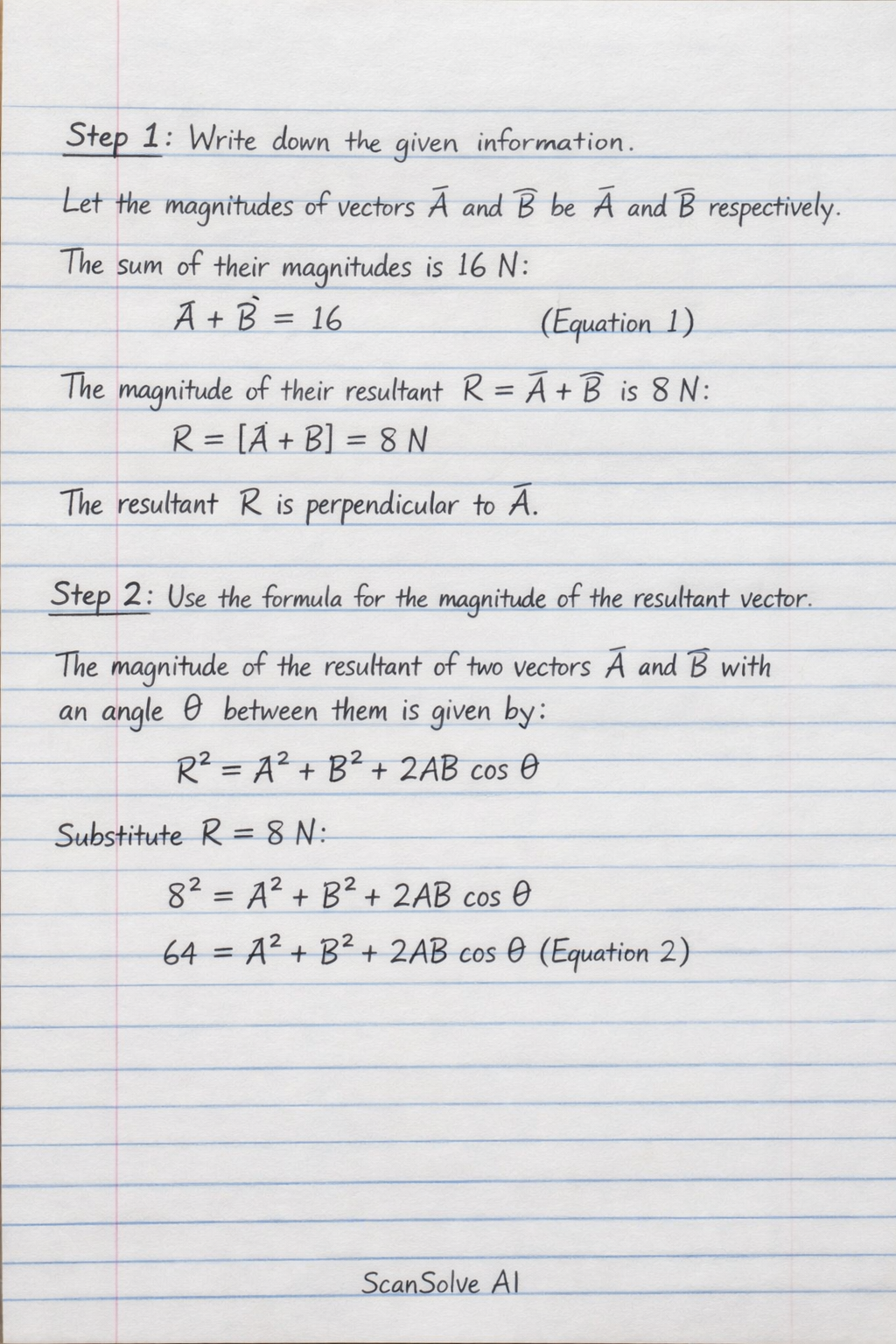
Step 1: Write down the given information. Let the magnitudes of vectors A and B be A and B respectively. The sum of their magnitudes is 16 \, N: A + B = 16 (Equation 1) The magnitude of their resultant R = A + B is 8 \, N: R = |A + B| = 8 \, N The resultant R is perpendicular to A. Step 2: Use the formula for the magnitude of the resultant vector. The magnitude of the resultant of two vectors A and B with an angle between them is given by: R^2 = A^2 + B^2 + 2AB Substitute R = 8 \, N: 8^2 = A^2 + B^2 + 2AB 64 = A^2 + B^2 + 2AB (Equation 2) Step 3: Use the condition that the resultant is perpendicular to vector A. If the resultant R is perpendicular to A, the angle between R and A is 90^. The direction of the resultant is given by: = (B )/(A + B ) Since = 90^, 90^ is undefined. This implies the denominator must be zero: A + B = 0 B = -A (Equation 3) Step 4: Substitute Equation 3 into Equation 2. Substitute B = -A into Equation 2: 64 = A^2 + B^2 + 2A(-A) 64 = A^2 + B^2 - 2A^2 64 = B^2 - A^2 This is a difference of squares: 64 = (B - A)(B + A) (Equation 4) Step 5: Solve the system of equations to find A and B. From Equation 1, we know A + B = 16. Substitute this into Equation 4: 64 = (B - A)(16) Divide by 16: B - A = (64)/(16) B - A = 4 (Equation 5) Now we have a system of two linear equations: 1) A + B = 16 5) -A + B = 4 Add Equation 1 and Equation 5: (A + B) + (-A + B) = 16 + 4 2B = 20 B = 10 \, N Substitute B = 10 \, N into Equation 1: A + 10 = 16 A = 16 - 10 A = 6 \, N Step 6: Calculate the ratio A/B. (A)/(B) = 6 \, N10 \, N = (3)/(5) The magnitude of A is 6 N The magnitude of B is 10 N The ratio A/B is (3)/(5)