
We read your photo as:
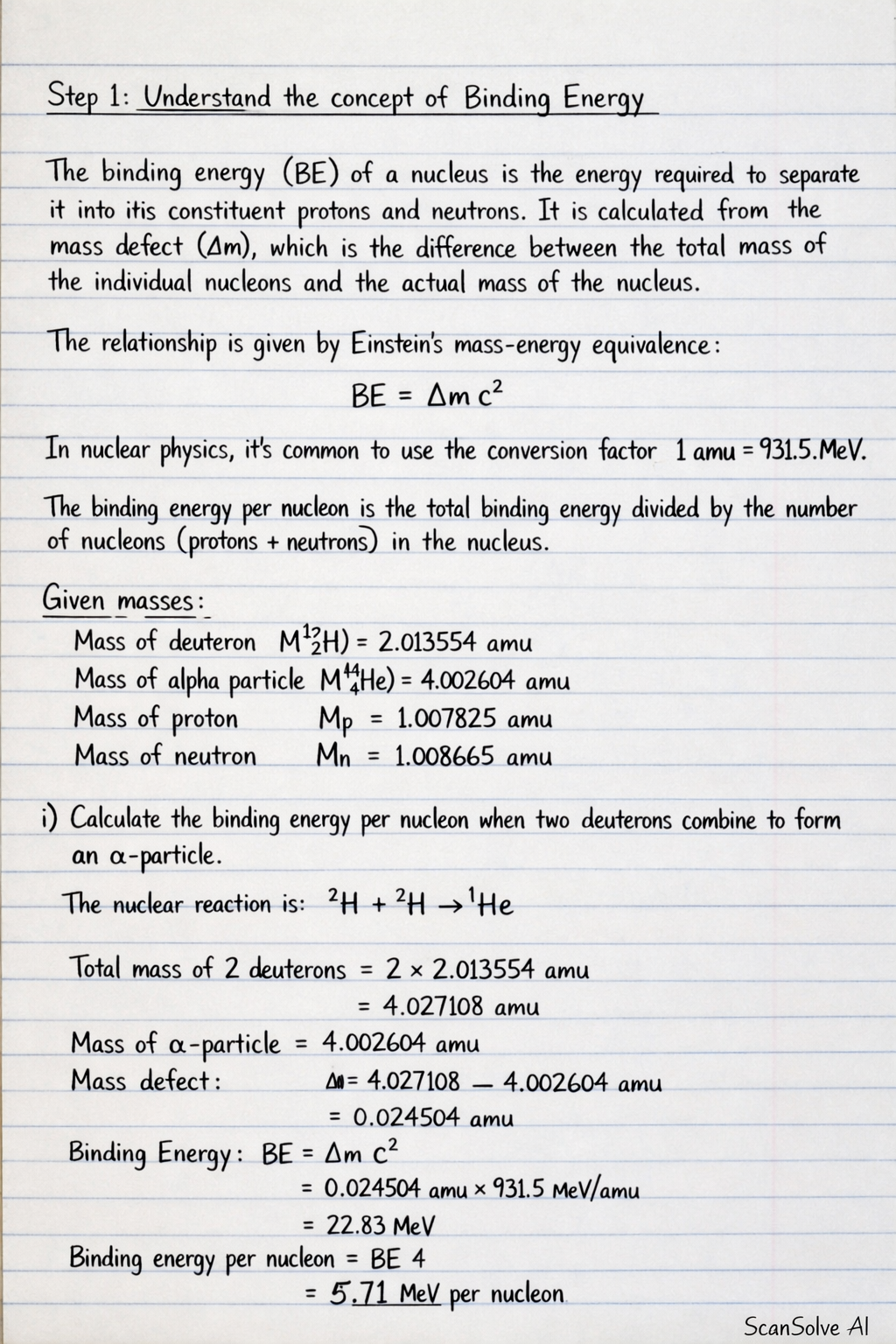
Understand the concept of Binding Energy.
ScanSolve AI Answer
Answers
2 partsStep-by-step solution
10 stepsStep 1: Understand the concept of Binding Energy.
The binding energy (BE) of a nucleus is the energy required to separate it into its constituent protons and neutrons. It is calculated from the mass defect (), which is the difference between the total mass of the individual nucleons and the actual mass of the nucleus.
The relationship is given by Einstein's mass-energy equivalence: .
In nuclear physics, it's common to use the conversion factor .
The binding energy per nucleon is the total binding energy divided by the number of nucleons (protons + neutrons) in the nucleus.
Given masses:
Mass of deuteron
Mass of alpha particle
Mass of proton
Mass of neutron
Part i· 5 steps
Calculate the binding energy per nucleon when two deuterons combine to form an -particle.
The nuclear reaction is:
Calculate the total mass of the reactants.
Identify the mass of the product.
Calculate the mass defect ().
Calculate the total binding energy (BE).
Calculate the binding energy per nucleon.
The -particle () has 4 nucleons (2 protons and 2 neutrons).
Part ii
Calculate the binding energy per nucleon when two neutrons and two protons combine to form an -particle.
The nuclear reaction is:
Calculate the total mass of the reactants.
Identify the mass of the product.
Calculate the mass defect ().
Calculate the total binding energy (BE).
Calculate the binding energy per nucleon.
The -particle () has 4 nucleons.
Try one yourself
A new problem that tests the same skill.
Still stuck on this one?
Ask a follow-up, and the answer starts from this question.
More Physics Questions
Handwritten Step-by-Step Solution
Get this as a handwritten image on WhatsApp — like a tutor wrote it for you.
Try on WhatsApp