
This physics problem tests your understanding of fundamental physical laws and their applications. The step-by-step solution below breaks down the problem using relevant equations and physical reasoning.
ScanSolve AI Answer
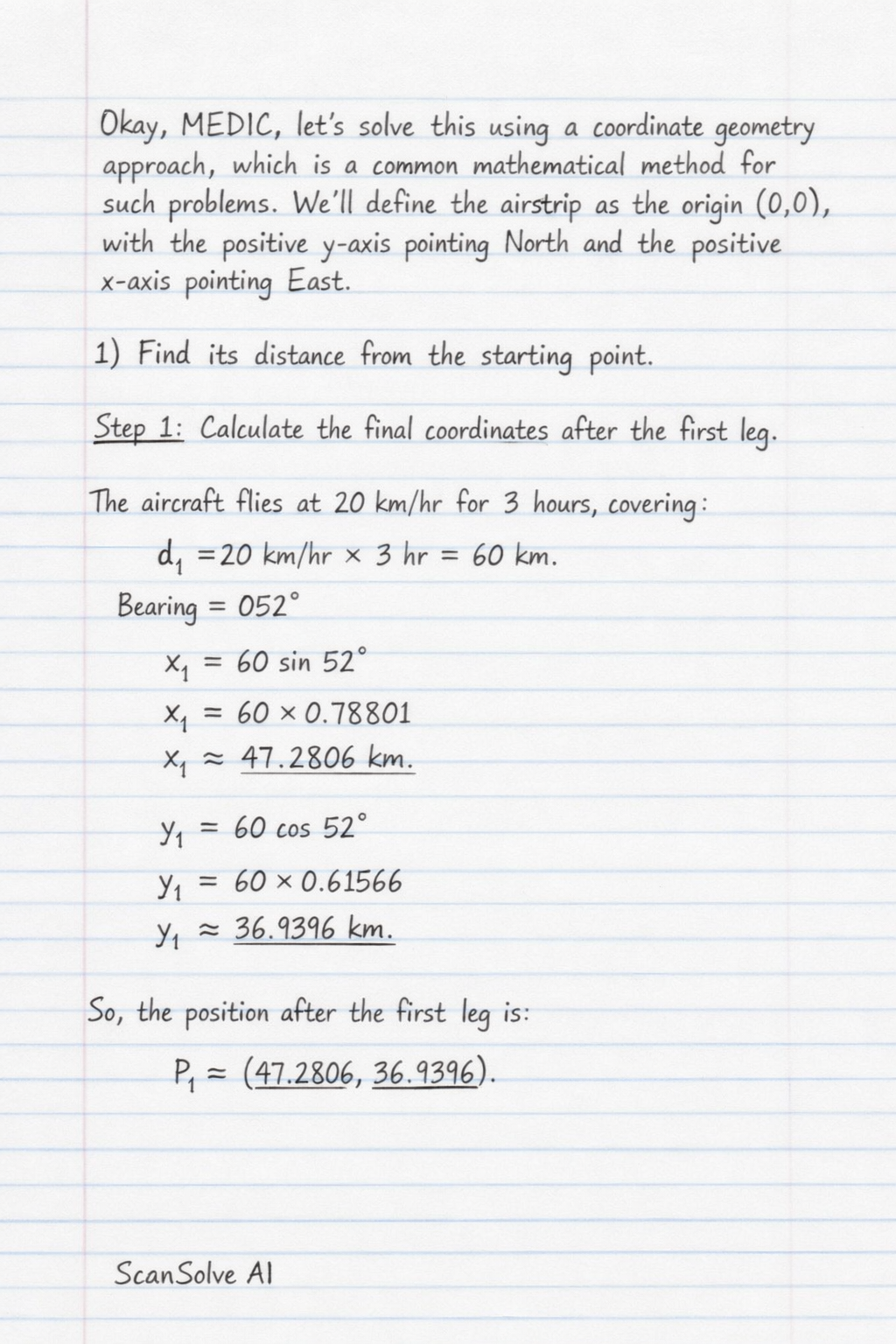
Okay, MEDIC, let's solve this using a coordinate geometry approach, which is a common mathematical method for such problems. We'll define the airstrip as the origin (0,0), with the positive y-axis pointing North and the positive x-axis pointing East. 1) Find its distance from the starting point Step 1: Calculate the final coordinates after the first leg. The aircraft flies at 20 km/hr for 3 hours, covering a distance d_1 = 20 km/hr × 3 hr = 60 km. The bearing is 052^. The coordinates (x_1, y_1) are calculated using sine for the East component and cosine for the North component: x_1 = d_1 (52^) = 60 (52^) y_1 = d_1 (52^) = 60 (52^) x_1 ≈ 60 × 0.78801 = 47.2806 km y_1 ≈ 60 × 0.61566 = 36.9396 km So, the position after the first leg is P_1 = (47.2806, 36.9396). Step 2: Calculate the displacement for the second leg. The aircraft flies at 30 km/hr for 1.5 hours, covering a distance d_2 = 30 km/hr × 1.5 hr = 45 km. The bearing is 028^. The displacement components ( x_2, y_2) for this leg are: x_2 = d_2 (28^) = 45 (28^) y_2 = d_2 (28^) = 45 (28^) x_2 ≈ 45 × 0.46947 = 21.1262 km y_2 ≈ 45 × 0.88295 = 39.7328 km Step 3: Calculate the final coordinates of the aircraft from the starting point. The final position (x_f, y_f) is the sum of the coordinates from the first leg and the displacements from the second leg: x_f = x_1 + x_2 = 47.2806 + 21.1262 = 68.4068 km y_f = y_1 + y_2 = 36.9396 + 39.7328 = 76.6724 km So, the final position of the aircraft is (68.4068, 76.6724). Step 4: Calculate the total distance from the starting point. The distance from the origin (0,0) to the final position (x_f, y_f) is found using the distance formula: D = sqrt(x_f^2 + y_f^2) D = sqrt((68.4068)^2 + (76.6724)^2) D = sqrt(4679.49 + 5878.62) D = sqrt(10558.11) D ≈ 102.75 km 2) The bearing of the aircraft from the airstrip Step 5: Calculate the bearing. The bearing is the angle measured clockwise from the North axis (positive y-axis). Since both x_f (East) and y_f (North) are positive, the aircraft is in the first quadrant (North-East). () = East displacementNorth displacement = (x_f)/(y_f) () = (68.4068)/(76.6724) () ≈ 0.89210 = (0.89210) ≈ 41.72^ Expressed as a three-digit bearing: Bearing = 041.7° That's 2 down. 3 left today — send the next one.