

This physics problem tests your understanding of fundamental physical laws and their applications. The step-by-step solution below breaks down the problem using relevant equations and physical reasoning.
ScanSolve AI Answer
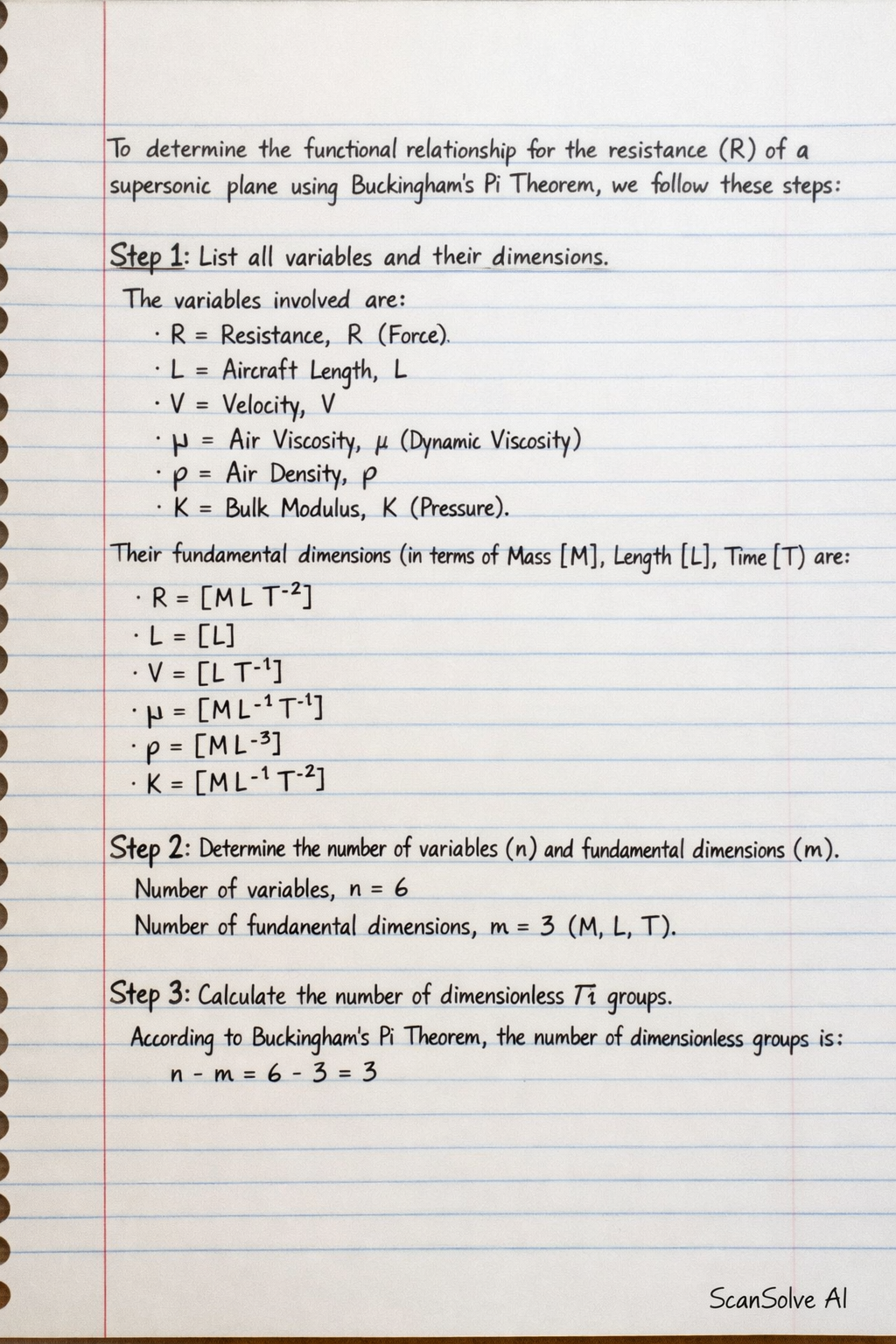
To determine the functional relationship for the resistance (R) of a supersonic plane using Buckingham's Pi Theorem, we follow these steps: Step 1: List all variables and their dimensions. The variables involved are: Resistance, R (Force) Aircraft Length, L Velocity, V Air Viscosity, (Dynamic Viscosity) Air Density, Bulk Modulus, K (Pressure) Their fundamental dimensions (in terms of Mass [M], Length [L], Time [T]) are: R = [M L T^-2] L = [L] V = [L T^-1] = [M L^-1 T^-1] = [M L^-3] K = [M L^-1 T^-2] Step 2: Determine the number of variables (n) and fundamental dimensions (m). Number of variables, n = 6 Number of fundamental dimensions, m = 3 (M, L, T) Step 3: Calculate the number of dimensionless groups. According to Buckingham's Pi Theorem, the number of dimensionless groups is n - m = 6 - 3 = 3. Step 4: Select repeating variables. We need to choose m=3 repeating variables that collectively contain all fundamental dimensions (M, L, T) and do not form a dimensionless group among themselves. A common and suitable choice for fluid dynamics problems is: Density, = [M L^-3] Velocity, V = [L T^-1] Length, L = [L] Step 5: Form the dimensionless groups. Each group is formed by combining a non-repeating variable with the repeating variables raised to unknown powers (a, b, c): _i = (non-repeating variable) × ^a V^b L^c _1 (using Resistance, R): _1 = R ^a V^b L^c Substitute dimensions: [M^0 L^0 T^0] = [M L T^-2] [M L^-3]^a [L T^-1]^b [L]^c [M^0 L^0 T^0] = [M^1+a L^1-3a+b+c T^-2-b] Equating powers for M, L, T: For M: 1 + a = 0 a = -1 For T: -2 - b = 0 b = -2 For L: 1 - 3a + b + c = 0 1 - 3(-1) + (-2) + c = 0 1 + 3 - 2 + c = 0 2 + c = 0 c = -2 Therefore, _1 = R ^-1 V^-2 L^-2 = (R)/( V^2 L^2) _2 (using Air Viscosity, ): _2 = ^a V^b L^c Substitute dimensions: [M^0 L^0 T^0] = [M L^-1 T^-1] [M L^-3]^a [L T^-1]^b [L]^c [M^0 L^0 T^0] = [M^1+a L^-1-3a+b+c T^-1-b] Equating powers for M, L, T: For M: 1 + a = 0 a = -1 For T: -1 - b = 0 b = -1 For L: -1 - 3a + b + c = 0 -1 - 3(-1) + (-1) + c = 0 -1 + 3 - 1 + c = 0 1 + c = 0 c = -1 Therefore, _2 = ^-1 V^-1 L^-1 = ()/( V L) (This is the inverse of the Reynolds number, Re = ( V L)/()) _3 (using Bulk Modulus, K): _3 = K ^a V^b L^c Substitute dimensions: [M^0 L^0 T^0] = [M L^-1 T^-2] [M L^-3]^a [L T^-1]^b [L]^c [M^0 L^0 T^0] = [M^1+a L^-1-3a+b+c T^-2-b] Equating powers for M, L, T: For M: 1 + a = 0 a = -1 For T: -2 - b = 0 b = -2 For L: $-1 - 3a + b + c = 0 -1 - 3(-1) + (-2) + c = 0 -1 + 3 - 2 + c =