Using dimensional analysis, derive the formula for the orbital velocity of a satellite and verify its units.
|Physics
Using dimensional analysis, derive the formula for the orbital velocity of a satellite and verify its units.
ScanSolve AI Answer
Answer
the equation V=rGM is
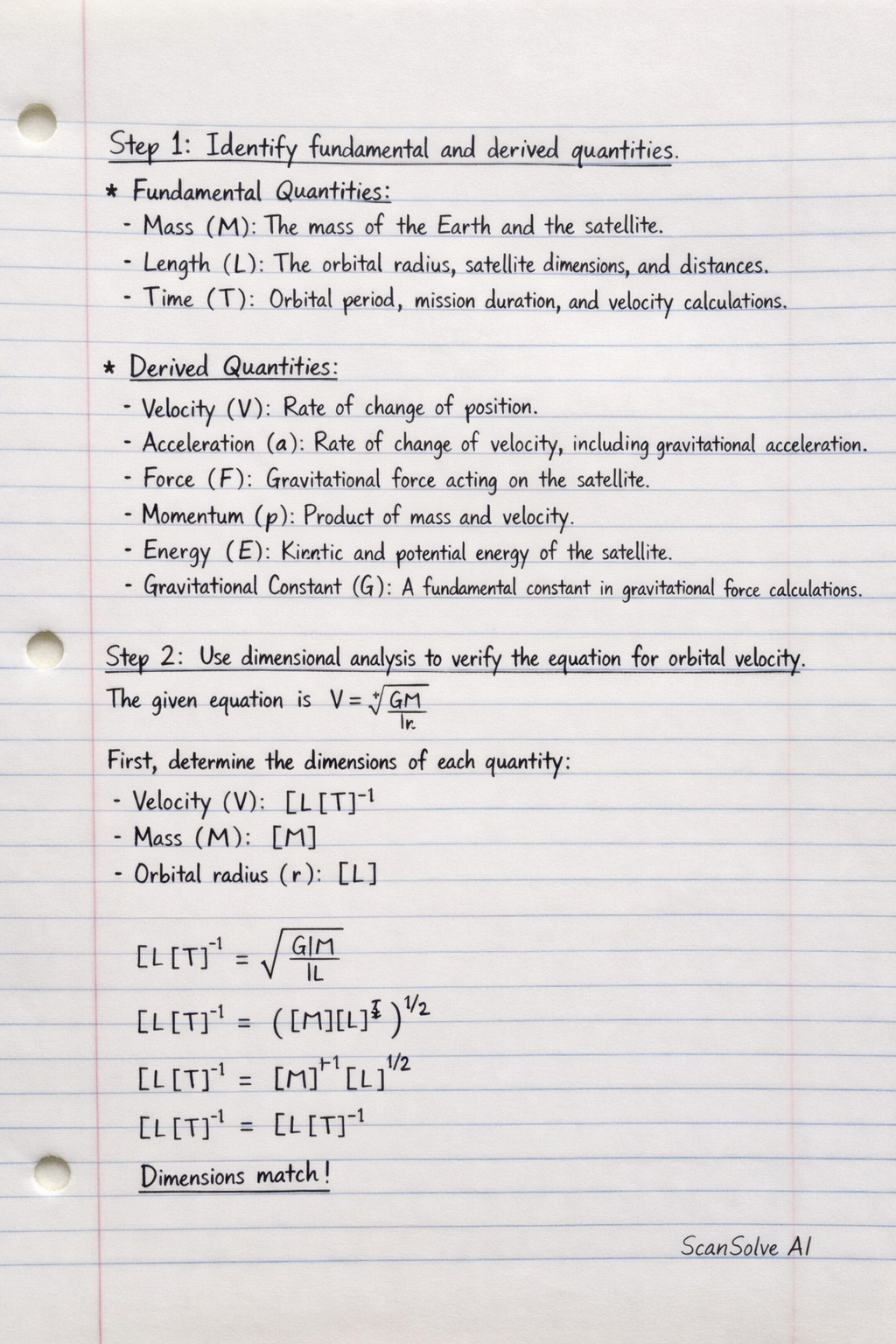
Step 1: Identify fundamental and derived quantities.
Fundamental Quantities:
Mass (M): The mass of the Earth and the satellite.
Length (L): The orbital radius, satellite dimensions, and distances.
Time (T): Orbital period, mission duration, and velocity calculations.
Derived Quantities:
Velocity (V): Rate of change of position.
Acceleration (a): Rate of change of velocity, including gravitational acceleration.
Force (F): Gravitational force acting on the satellite.
Momentum (p): Product of mass and velocity.
Energy (E): Kinetic and potential energy of the satellite.
Gravitational Constant (G): A fundamental constant in gravitational force calculations.
Step 2: Use dimensional analysis to verify the equation for orbital velocity.
The given equation is V=rGM.
First, determine the dimensions of each quantity:
Velocity (V): [L][T]−1
Mass (M): [M]
Orbital radius (r): [L]
To find the dimensions of the gravitational constant (G), use Newton's Law of Universal Gravitation: F=r2GMm.
Rearrange for G: G=MmFr2.
The dimensions are:
Force (F): [M][L][T]−2
Mass (m): [M]
Radius squared (r2): [L]2
So, the dimensions of G are:
[G]=[M][M][M][L][T]−2[L]2=[M]−1[L]3[T]−2
Now, substitute the dimensions into the orbital velocity equation:
[V]=[r][G][M][L][T]−1=[L]([M]−1[L]3[T]−2)[M][L][T]−1=[L][L]3[T]−2[L][T]−1=[L]2[T]−2[L][T]−1=[L][T]−1
The dimensions on both sides of the equation are equal.
Therefore, the equation V=rGM is dimensionally consistent.
Step 3: Explain the importance of using correct dimensions in space mission planning.
Using correct dimensions is critical in space mission planning because it ensures the fundamental validity of all physical equations and models. Incorrect dimensions would lead to equations that do not represent physical reality, resulting in catastrophic mission failure, such as a satellite entering the wrong orbit, re-entering the atmosphere prematurely, or escaping Earth's gravity. It serves as a crucial initial check to prevent costly errors and ensure the safety and success of the mission.
Step 4: Discuss potential challenges if incorrect values are used in calculations and how they could be corrected.
Potential Challenges if Incorrect Values are Used:
Orbital Instability: Incorrect values for velocity, mass, or radius could lead to the satellite being placed in an unstable orbit, causing it to drift, re-enter the atmosphere, or escape Earth's gravity.
Collision Risk: Miscalculated trajectories could result in collisions with space debris or other satellites, leading to damage or destruction.
Fuel Depletion: Incorrect orbital parameters might require excessive thruster firings to correct the trajectory, leading to premature depletion of fuel and shortening the mission lifespan.
Communication Loss: If the satellite is not in its predicted position, ground stations may lose contact, hindering data transmission and control.
Correction Methods:
Independent Verification: All calculations should be performed and verified by multiple independent teams or software systems to catch numerical errors.
Standardized Units: Ensure all input values are consistently converted to a single system of units (e.g., SI units) before calculations to prevent unit conversion errors.
Sensitivity Analysis: Conduct analyses to understand how small variations or errors in input values affect the final orbital parameters, identifying critical parameters that require high precision.
Simulation and Modeling: Utilize advanced computer simulations to model the satellite's trajectory under various conditions and input values, allowing for error detection and correction in a virtual environment.
Telemetry and Real-time Adjustments: Continuously monitor the satellite's actual position and velocity using telemetry data, allowing for real-time course corrections and adjustments to compensate for any initial calculation errors.
Was this helpful?
Need help with your own homework?
Get instant step-by-step solutions to any question. Free to start.
This physics problem tests your understanding of fundamental physical laws and their applications. The step-by-step solution below breaks down the problem using relevant equations and physical reasoning.
ScanSolve AI Answer
Step 1: Identify fundamental and derived quantities. Fundamental Quantities*: Mass* (M): The mass of the Earth and the satellite. Length* (L): The orbital radius, satellite dimensions, and distances. Time* (T): Orbital period, mission duration, and velocity calculations. Derived Quantities*: Velocity* (V): Rate of change of position. Acceleration* (a): Rate of change of velocity, including gravitational acceleration. Force* (F): Gravitational force acting on the satellite. Momentum* (p): Product of mass and velocity. Energy* (E): Kinetic and potential energy of the satellite. Gravitational Constant* (G): A fundamental constant in gravitational force calculations. Step 2: Use dimensional analysis to verify the equation for orbital velocity. The given equation is V = sqrt((GM)/(r)). First, determine the dimensions of each quantity: Velocity (V): [L][T]^-1 Mass (M): [M] Orbital radius (r): [L] To find the dimensions of the gravitational constant (G), use Newton's Law of Universal Gravitation: F = (GMm)/(r^2). Rearrange for G: G = (Fr^2)/(Mm). The dimensions are: Force (F): [M][L][T]^-2 Mass (m): [M] Radius squared (r^2): [L]^2 So, the dimensions of G are: [G] = [M][L][T]^-2[L]^2[M][M] = [M]^-1[L]^3[T]^-2 Now, substitute the dimensions into the orbital velocity equation: [V] = sqrt(([G][M])/([r])) [L][T]^-1 = sqrt(([M]^-1)[L]^3[T]^-2)[M][L] [L][T]^-1 = sqrt([L]^3[T]^-2)[L] [L][T]^-1 = sqrt([L]^2[T]^-2) [L][T]^-1 = [L][T]^-1 The dimensions on both sides of the equation are equal. Therefore, the equation V = sqrt((GM)/(r)) is dimensionally consistent. Step 3: Explain the importance of using correct dimensions in space mission planning. Using correct dimensions is critical in space mission planning because it ensures the fundamental validity of all physical equations and models. Incorrect dimensions would lead to equations that do not represent physical reality, resulting in catastrophic mission failure, such as a satellite entering the wrong orbit, re-entering the atmosphere prematurely, or escaping Earth's gravity. It serves as a crucial initial check to prevent costly errors and ensure the safety and success of the mission. Step 4: Discuss potential challenges if incorrect values are used in calculations and how they could be corrected. Potential Challenges if Incorrect Values are Used: Orbital Instability*: Incorrect values for velocity, mass, or radius could lead to the satellite being placed in an unstable orbit, causing it to drift, re-enter the atmosphere, or escape Earth's gravity. Collision Risk*: Miscalculated trajectories could result in collisions with space debris or other satellites, leading to damage or destruction. Fuel Depletion*: Incorrect orbital parameters might require excessive thruster firings to correct the trajectory, leading to premature depletion of fuel and shortening the mission lifespan. Communication Loss*: If the satellite is not in its predicted position, ground stations may lose contact, hindering data transmission and control. Correction Methods: Independent Verification*: All calculations should be performed and verified by multiple independent teams or software systems to catch numerical errors. Standardized Units*: Ensure all input values are consistently converted to a single system of units (e.g., SI units) before calculations to prevent unit conversion errors. Sensitivity Analysis*: Conduct analyses to understand how small variations or errors in input values affect the final orbital parameters, identifying critical parameters that require high precision. Simulation and Modeling*: Utilize advanced computer simulations to model the satellite's trajectory under various conditions and input values, allowing for error detection and correction in a virtual environment. Telemetry and Real-time Adjustments*: Continuously monitor the satellite's actual position and velocity using telemetry data, allowing for real-time course corrections and adjustments to compensate for any initial calculation errors.