
We read your photo as:
Determine the velocity of an electron with a wavelength of 1 imes 10⁻¹⁰ m, and calculate the minimum uncertainty in momentum if position uncertainty is 2.0 imes 10⁻¹¹ m.
ScanSolve AI Answer
Answer
Step-by-step solution
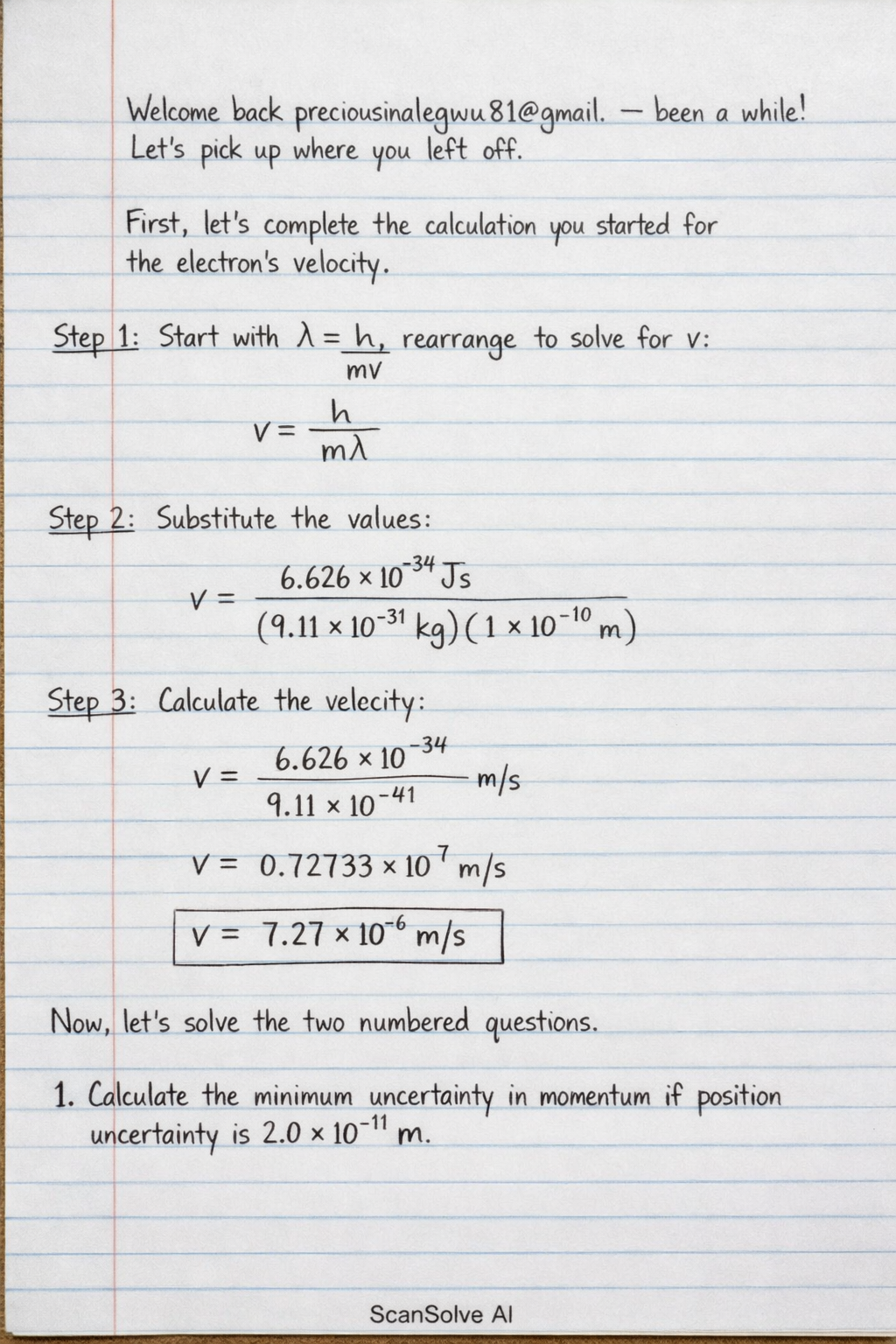
9 stepsFirst, let's complete the calculation you started for the electron's velocity.
Problem: Determine the velocity of an electron with a wavelength of m, given its mass is kg and Planck's constant () is J s.
Use the de Broglie wavelength formula, , and rearrange it to solve for velocity ().
Substitute the given values into the formula.
Calculate the velocity.
Now, let's solve the two numbered questions.
1. Calculate the minimum uncertainty in momentum if position uncertainty is m.
Use the Heisenberg Uncertainty Principle for minimum uncertainty, which states .
Rearrange to solve for the uncertainty in momentum ().
Substitute the given values
Planck's constant J s and uncertainty in position m.
Calculate the minimum uncertainty in momentum.
2. Determine the momentum of a photon with wavelength 400 nm.
Use the relationship between momentum (), Planck's constant (), and wavelength () for a photon.
Convert the wavelength from nanometers (nm) to meters (m) and substitute the values
J s and .
Calculate the momentum of the photon.
Still stuck on this one?
Ask a follow-up, and the answer starts from this question.
More Physics Questions
Handwritten Step-by-Step Solution
Get this as a handwritten image on WhatsApp — like a tutor wrote it for you.
Try on WhatsApp