
This physics problem tests your understanding of fundamental physical laws and their applications. The step-by-step solution below breaks down the problem using relevant equations and physical reasoning.
ScanSolve AI Answer
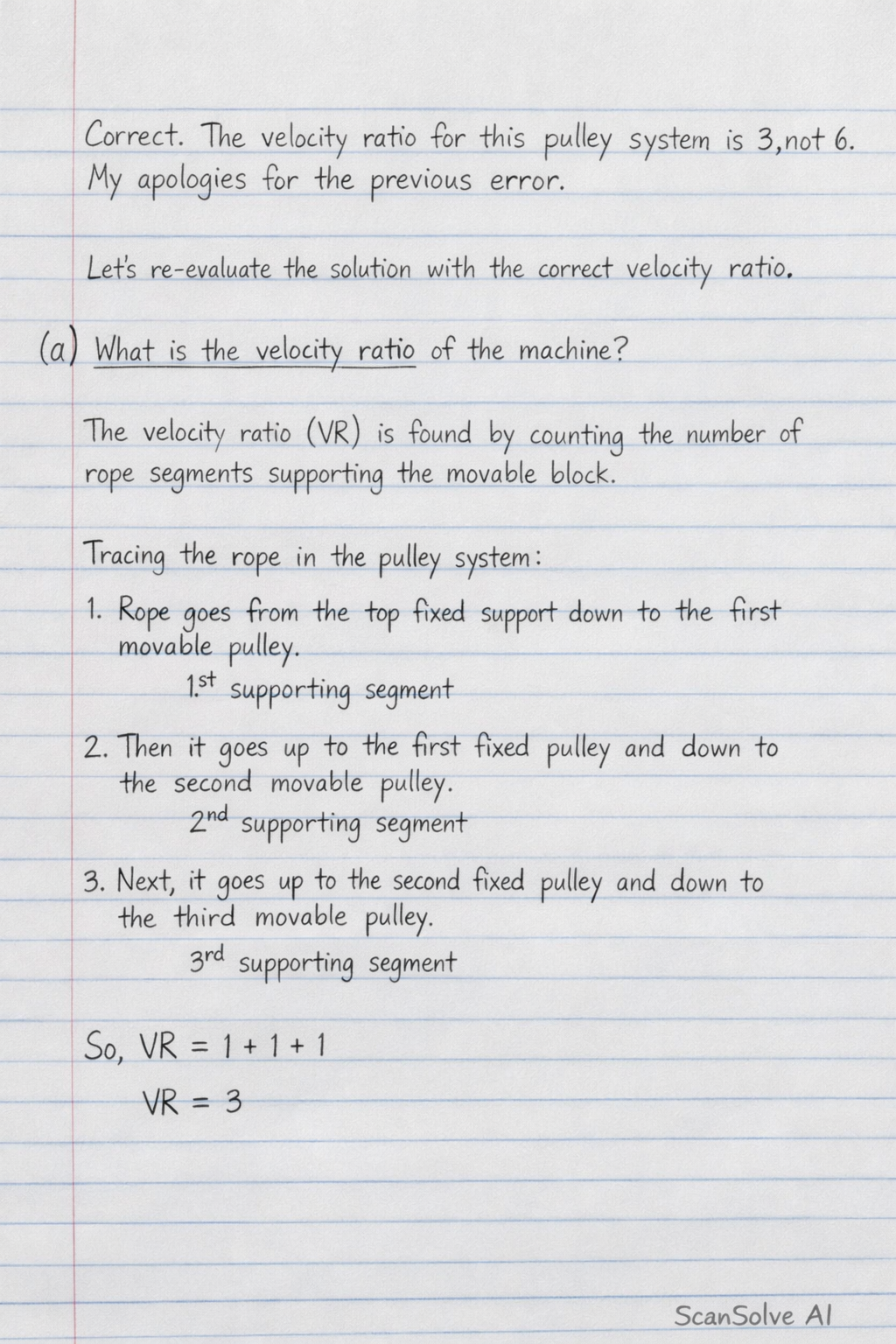
✅ Correct. You are right, the velocity ratio for this specific pulley system configuration is 3, not 6. My apologies for the previous error. Let's re-evaluate the solution with the correct velocity ratio. 6. Figure 4 shows a simple pulley system used by a builder to lift a bag of cement of mass 50 kg to a height of 4 m by applying an effort of 300 N. (a) What is the velocity ratio of the machine? The velocity ratio (VR) of a pulley system is determined by counting the number of rope segments directly supporting the movable block. Tracing the rope in Figure 4: 1. The rope starts from the fixed support (top-left) and goes down to the first movable pulley (bottom-left). (1st supporting segment) 2. It then goes up to the first fixed pulley (top-left) and down to the second movable pulley (bottom-middle). (2nd supporting segment) 3. It then goes up to the second fixed pulley (top-middle) and down to the third movable pulley (bottom-right). (3rd supporting segment) The rope then goes up from the third movable pulley to the third fixed pulley (top-right), and the effort is applied to the free end coming down from this last fixed pulley. This last segment is the effort rope and does not directly support the movable block. Therefore, there are 3 rope segments supporting the movable block. Velocity Ratio (VR) = 3 (b) Calculate the weight of the bag of cement. The weight of the bag of cement is calculated using the formula W = m × g, where m is the mass and g is the acceleration due to gravity. We will use g = 10 m/s^2. W = m × g W = 50 kg × 10 m/s^2 W = 500 N (c) Calculate the mechanical advantage of the pulley system. The mechanical advantage (MA) is the ratio of the load (weight of the bag) to the effort applied. Mechanical Advantage (MA) = LoadEffort MA = 500 N300 N MA = (5)/(3) MA = 1.67 (to 2 decimal places) (d) Calculate the efficiency of the pulley system. The efficiency () of the pulley system is the ratio of the mechanical advantage to the velocity ratio, expressed as a percentage. = MAVR × 100\% Using the corrected VR = 3: = (5/3)/(3) × 100\% = (5)/(3 × 3) × 100\% = (5)/(9) × 100\% ≈ 0.5555 × 100\% = 55.56\% (to 2 decimal places) Drop the next question.