This physics problem tests your understanding of fundamental physical laws and their applications. The step-by-step solution below breaks down the problem using relevant equations and physical reasoning.
ScanSolve AI Answer
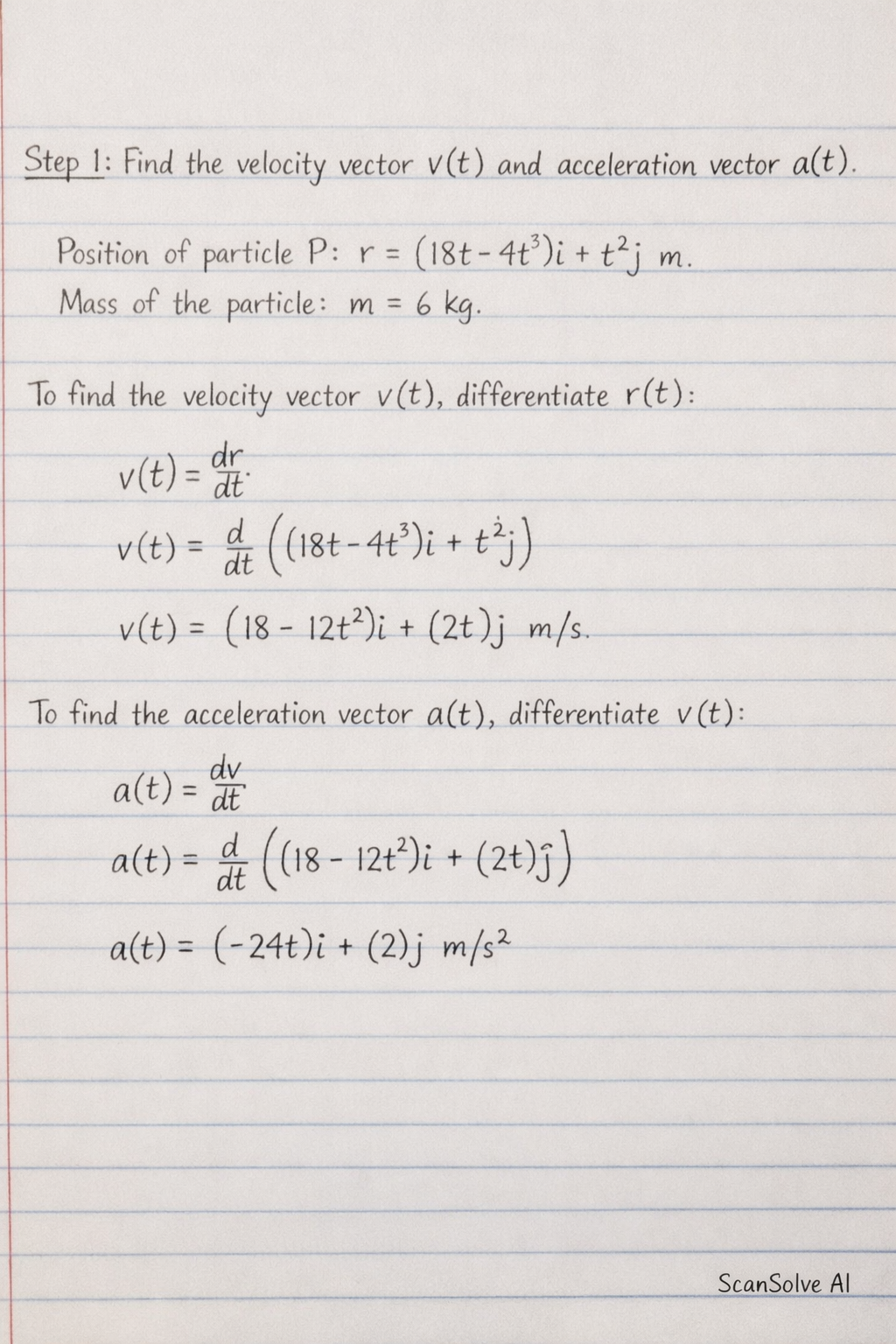
Step 1: Find the velocity vector $v(t)$ and acceleration vector $a(t)$.
The position vector of particle P is given by $r = [(18t - 4t^3)i + t^2j]$ m.
The mass of the particle is $m = 6$ kg.
To find the velocity vector $v(t)$, differentiate the position vector $r(t)$ with respect to time $t$:
$$v(t) = \frac{dr}{dt} = \frac{d}{dt}((18t - 4t^3)i + t^2j)$$
$$v(t) = (18 - 12t^2)i + (2t)j \text{ m/s}$$
To find the acceleration vector $a(t)$, differentiate the velocity vector $v(t)$ with respect to time $t$:
$$a(t) = \frac{dv}{dt} = \frac{d}{dt}((18 - 12t^2)i + (2t)j)$$
$$a(t) = (-24t)i + (2)j \text{ m/s}^2$$
a) Find the kinetic energy of P when $t = 1$.
First, find the velocity of P at $t=1$ s:
$$v(1) = (18 - 12(1)^2)i + (2(1))j$$
$$v(1) = (18 - 12)i + 2j$$
$$v(1) = 6i + 2j \text{ m/s}$$
Next, calculate the magnitude of the velocity $|v(1)|$:
$$|v(1)| = \sqrt{6^2 + 2^2} = \sqrt{36 + 4} = \sqrt{40} \text{ m/s}$$
The kinetic energy $KE$ is given by the formula $KE = \frac{1}{2}mv^2$.
$$KE = \frac{1}{2}(6 \text{ kg})(\sqrt{40} \text{ m/s})^2$$
$$KE = \frac{1}{2}(6)(40)$$
$$KE = 3 \times 40$$
$$KE = 120 \text{ J}$$
The kinetic energy of P when $t=1$ is $\boxed{120 \text{ J}}$.
b) Calculate the magnitude of the force acting on P when $t = 2$.
First, find the acceleration of P at $t=2$ s:
$$a(2) = (-24(2))i + (2)j$$
$$a(2) = -48i + 2j \text{ m/s}^2$$
Next, calculate the force vector $F(2)$ using Newton's second law, $F = ma$:
$$F(2) = (6 \text{ kg})(-48i + 2j \text{ m/s}^2)$$
$$F(2) = -288i + 12j \text{ N}$$
Finally, calculate the magnitude of the force $|F(2)|$:
$$|F(2)| = \sqrt{(-288)^2 + 12^2}$$
$$|F(2)| = \sqrt{82944 + 144}$$
$$|F(2)| = \sqrt{83088} \text{ N}$$
$$|F(2)| \approx 288.250 \text{ N}$$
The magnitude of the force acting on P when $t=2$ is $\boxed{\sqrt{83088} \text{ N} \approx 288.25 \text{ N}}$.
c) Determine, to 2 decimal places, the value of $t$ for which the velocity and the acceleration vectors of P are at right angles.
If two vectors are at right angles, their dot product is zero. So, $v(t) \cdot a(t) =
Find the velocity vector v(t) and acceleration vector a(t).
|Physics
Find the velocity vector v(t) and acceleration vector a(t).
ScanSolve AI Answer
Step 1: Find the velocity vector v(t) and acceleration vector a(t).
The position vector of particle P is given by r=[(18t−4t3)i+t2j] m.
The mass of the particle is m=6 kg.
To find the velocity vector v(t), differentiate the position vector r(t) with respect to time t:
v(t)=dtdr=dtd((18t−4t3)i+t2j)v(t)=(18−12t2)i+(2t)j m/s
To find the acceleration vector a(t), differentiate the velocity vector v(t) with respect to time t:
a(t)=dtdv=dtd((18−12t2)i+(2t)j)a(t)=(−24t)i+(2)jm/s2
a) Find the kinetic energy of P when t=1.
First, find the velocity of P at t=1 s:
v(1)=(18−12(1)2)i+(2(1))jv(1)=(18−12)i+2jv(1)=6i+2j m/s
Next, calculate the magnitude of the velocity ∣v(1)∣:
∣v(1)∣=62+22=36+4=40 m/s
The kinetic energy KE is given by the formula KE=21mv2.
KE=21(6kg)(40m/s)2KE=21(6)(40)KE=3×40KE=120 J
The kinetic energy of P when t=1 is ∗120J∗.
b) Calculate the magnitude of the force acting on P when t=2.
First, find the acceleration of P at t=2 s:
a(2)=(−24(2))i+(2)ja(2)=−48i+2jm/s2
Next, calculate the force vector F(2) using Newton's second law, F=ma:
F(2)=(6kg)(−48i+2jm/s2)F(2)=−288i+12j N
Finally, calculate the magnitude of the force ∣F(2)∣:
∣F(2)∣=(−288)2+122∣F(2)∣=82944+144∣F(2)∣=83088 N∣F(2)∣≈288.250 N
The magnitude of the force acting on P when t=2 is ∗83088N≈288.25N∗.
c) Determine, to 2 decimal places, the value of t for which the velocity and the acceleration vectors of P are at right angles.
If two vectors are at right angles, their dot product is zero. So, $v(t) \cdot a(t) =
Need help with your own homework?
Get instant step-by-step solutions to any question. Free to start.