

This physics problem tests your understanding of fundamental physical laws and their applications. The step-by-step solution below breaks down the problem using relevant equations and physical reasoning.
ScanSolve AI Answer
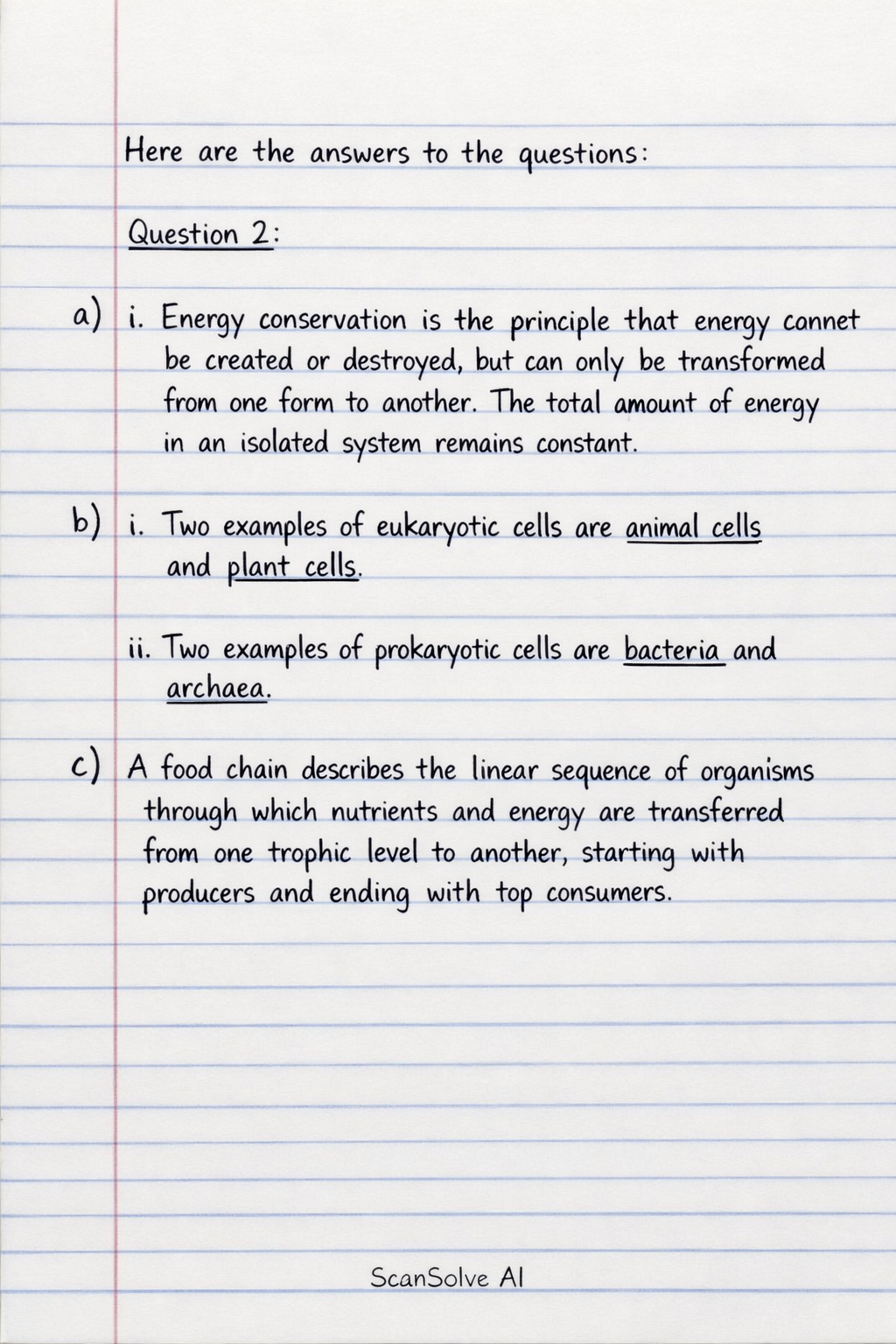
Here are the answers to the questions: Question 2: a) i. Energy conservation is the principle that energy cannot be created or destroyed, but can only be transformed from one form to another. The total amount of energy in an isolated system remains constant. b) i. Two examples of eukaryotic cells are animal cells and plant cells. ii. Two examples of prokaryotic cells are bacteria and archaea. c) A food chain describes the linear sequence of organisms through which nutrients and energy are transferred from one trophic level to another, starting with producers and ending with top consumers. d) i. Newton's Second Law of Motion states that the acceleration of an object is directly proportional to the net force acting on it and inversely proportional to its mass, and is in the direction of the net force. Mathematically, this is expressed as F = ma. ii. Two applications of Newton's Second Law of Motion are: • Rocket propulsion: The force exerted by the expelled gases causes the rocket to accelerate upwards. • Car braking: Applying brakes creates a force that decelerates the car. Question 3: a) An ecosystem is a community of living organisms (biotic components) interacting with their non-living environment (abiotic components) in a specific area. b) i. Two differences between a prokaryotic cell and a eukaryotic cell: • Prokaryotic cells lack a true nucleus and membrane-bound organelles, while eukaryotic cells have both. • Prokaryotic cells typically have a single circular chromosome, while eukaryotic cells have multiple linear chromosomes. ii. Two similarities between a prokaryotic cell and a eukaryotic cell: • Both have a cell membrane that regulates the passage of substances. • Both contain ribosomes for protein synthesis. c) Two usefulness of prokaryotes to human life: • They are essential in decomposition and nutrient cycling, breaking down organic matter and returning nutrients to the soil. • Some prokaryotes are used in food production, such as bacteria in making yogurt and cheese. d) Three types of seedbeds are: • Flat seedbed • Raised seedbed • Sunken seedbed Question 4: a) i. Two ways of conserving energy are: • Turning off lights and appliances when not in use. • Using energy-efficient appliances (e.g., LED bulbs, ENERGY STAR rated devices). ii. Two importance of conserving energy at home: • It reduces electricity bills, saving money for households. • It minimizes the carbon footprint, contributing to environmental protection and combating climate change. b) A food web is a complex network of interconnected food chains in an ecosystem, showing multiple feeding relationships between different organisms. c) Three uses of magnets in everyday life: • In refrigerators to keep the doors closed. • In speakers and headphones to convert electrical signals into sound. • In credit cards and ATM cards for storing data on magnetic strips. d) Two importance of using raised beds in gardens: • They provide better drainage and aeration for plant roots, preventing waterlogging. • They allow for better soil control, as gardeners can fill them with specific soil mixes tailored to plant needs.