
With the use of sketches, free body diagram and equations where necessary, explain the following terms used in the study of mechanical vibration: Single Degree of freedom. Double degree of freedom. Resonance. Damped free vibration. Forced vibration with harmonic excitation. Solve these questions showing the free body diagrams, please.
Physics
ScanSolve AI Answer
Step-by-step solution
5 stepsHere are the explanations for the terms used in mechanical vibration:
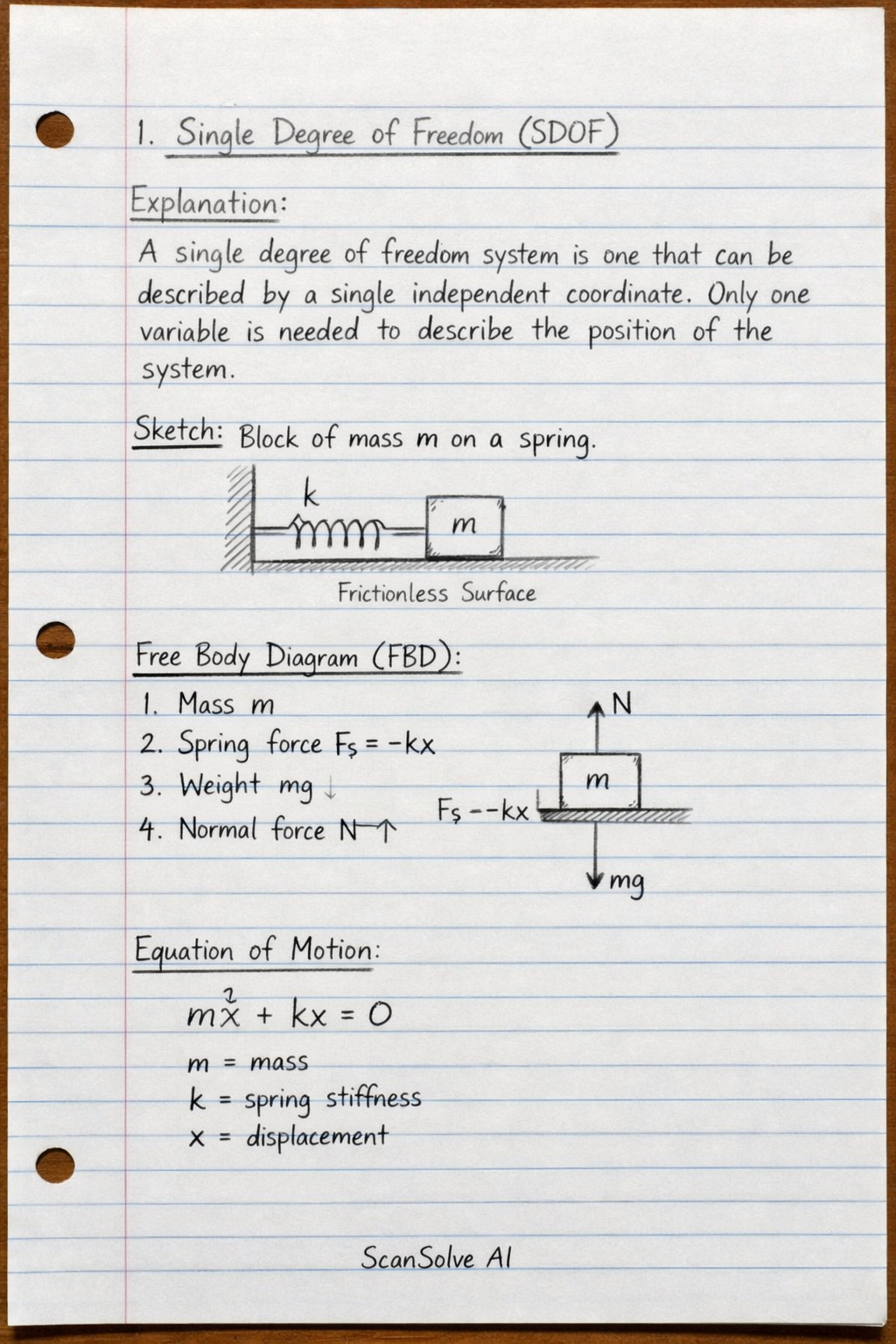
Single Degree of Freedom (SDOF)
- Explanation: A single degree of freedom system is one whose motion can be completely described by a single independent coordinate. This means only one variable is needed to specify the position of all parts of the system at any given time.
- Sketch: Imagine a block of mass attached to one end of a spring with stiffness , with the other end of the spring fixed to a rigid wall. The block rests on a frictionless horizontal surface. The only motion allowed is horizontal translation.
- Free Body Diagram (FBD):
- A block of mass .
- A spring force acting on the block, opposing displacement .
- Gravitational force acting downwards.
- Normal force acting upwards, balancing gravity.
- Equation of Motion (undamped): where is mass, is spring stiffness, and is displacement.
Double Degree of Freedom (DDOF)
- Explanation: A double degree of freedom system requires two independent coordinates to completely describe its motion. This typically involves two masses or two distinct modes of motion that are coupled.
- Sketch: Imagine two blocks, and , connected in series by springs and . Block is attached to a fixed wall by spring , and block is attached to by spring . Both blocks rest on a frictionless horizontal surface.
- Free Body Diagram (FBD):
- For mass :
- Spring force from spring .
- Spring force from spring .
- Gravitational force and normal force .
- For mass :
- Spring force from spring .
- Gravitational force and normal force .
- For mass :
- Equations of Motion (undamped): where are masses, are spring stiffnesses, and are displacements.
Resonance
- Explanation: Resonance is a phenomenon that occurs when the frequency of an external exciting force matches or is very close to the natural frequency of a system. This leads to a significant increase in the amplitude of vibration, potentially causing large oscillations and structural failure.
- Sketch: A graph showing the amplitude of vibration on the y-axis versus the excitation frequency on the x-axis. The graph would show a sharp peak in amplitude at a specific frequency, which is the natural frequency () of the system.
- Free Body Diagram (FBD): No specific FBD is needed for the concept of resonance itself, but it occurs in systems undergoing forced vibration (see point 5).
- Equation (Amplitude for undamped forced vibration): where is the amplitude, is the amplitude of the exciting force, is stiffness, is the excitation frequency, and is the natural frequency. Resonance occurs when , causing the denominator to approach zero and to become very large.
Damped Free Vibration
- Explanation: Damped free vibration describes the oscillatory motion of a system that gradually decreases in amplitude over time due to energy dissipation mechanisms (damping), without any external driving force. The system eventually returns to its equilibrium position.
- Sketch: A graph of displacement versus time, showing a decaying sinusoidal wave. The peaks of the oscillations would progressively get smaller.
- Free Body Diagram (FBD):
- A block of mass .
- A spring force opposing displacement .
- A damping force opposing velocity , where is the damping coefficient.
- Gravitational force and normal force .
- Equation of Motion: where is mass, is damping coefficient, is spring stiffness, is displacement, and is velocity.
Forced Vibration with Harmonic Excitation
- Explanation: Forced vibration with harmonic excitation occurs when a system is subjected to a continuous, periodic external force that varies sinusoidally with time. The system will oscillate at the frequency of the applied force, and its amplitude will depend on the force's magnitude, the system's properties, and the proximity of the excitation frequency to the natural frequency.
- Sketch: A mass-spring-damper system with an external force applied to the mass.
- Free Body Diagram (FBD):
- A block of mass .
- A spring force opposing displacement .
- A damping force opposing velocity .
- An external harmonic force acting on the mass.
- Gravitational force and normal force .
- Equation of Motion: where is mass, is damping coefficient, is spring stiffness, is displacement, is velocity, is the amplitude of the exciting force, and is the excitation frequency.
Was this helpful?
Still stuck on this one?
Ask a follow-up, and the answer starts from this question.
Got a different question?Ask your own question
More Physics Questions
QForce diagrams and free body diagramQDefine inertia and explain three different directions of forces with diagrams. Sketch the Free Body…QDescribe simple examples of free oscillations such as the simple pendulum, spring-mass system and…QDefine Simple Harmonic Motion. Give four examples of systems that undergo SHM. A 10kg mass attached…QWhat are the definitions and units of equilibrium, center of gravity, moment of force, and simple…
Handwritten Step-by-Step Solution
Get this as a handwritten image on WhatsApp — like a tutor wrote it for you.
Try on WhatsApp