
This physics problem tests your understanding of fundamental physical laws and their applications. The step-by-step solution below breaks down the problem using relevant equations and physical reasoning.
ScanSolve AI Answer
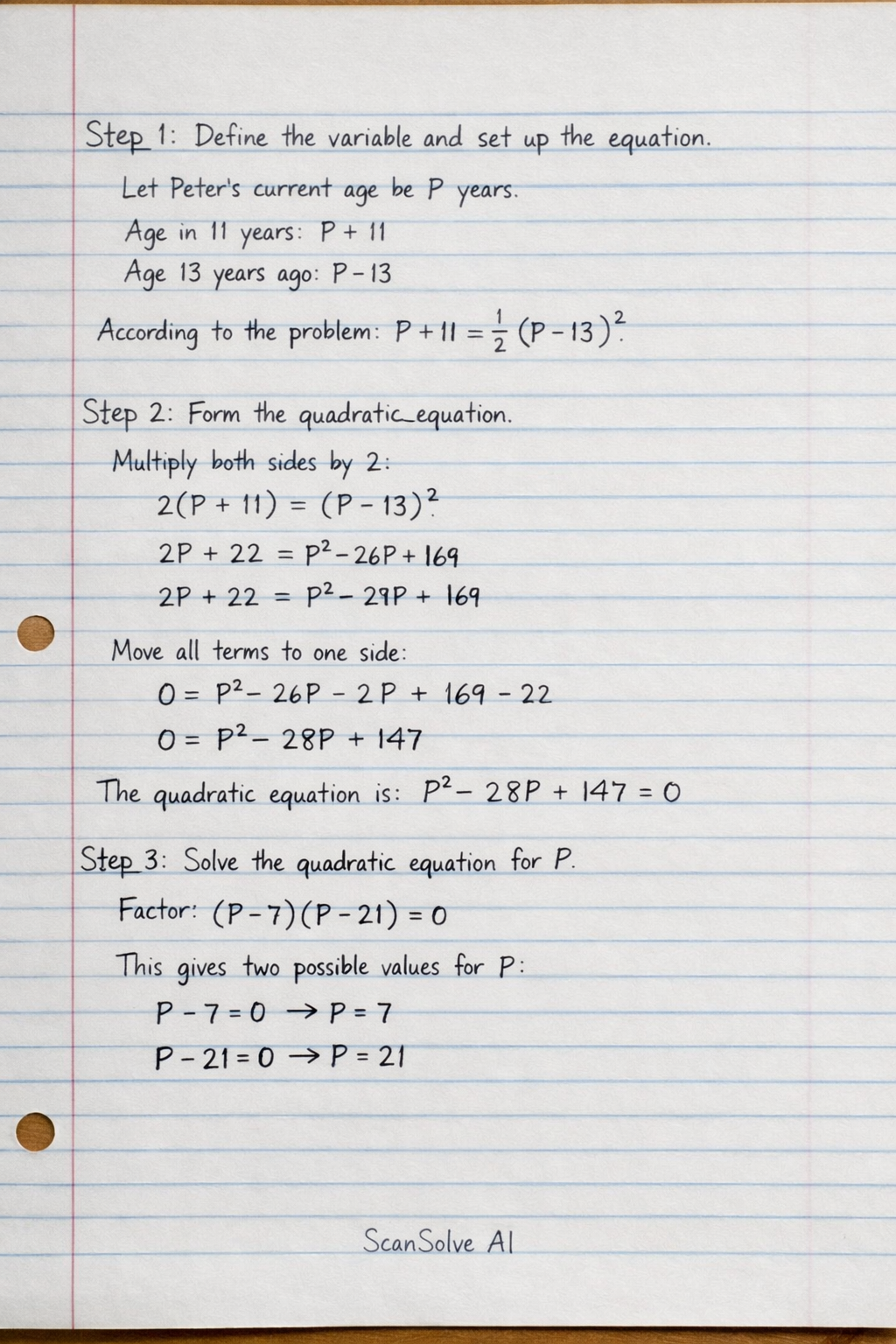
Step 1: Define the variable and set up the equation. Let Peter's current age be P years. Age in 11 years: P+11. Age 13 years ago: P-13. According to the problem, Peter's age in 11 years will be half of the square of his age 13 years ago: P+11 = (1)/(2)(P-13)^2 Step 2: Form the quadratic equation. Multiply both sides by 2: 2(P+11) = (P-13)^2 Expand both sides: 2P + 22 = P^2 - 2(P)(13) + 13^2 2P + 22 = P^2 - 26P + 169 Move all terms to one side to form a standard quadratic equation aP^2 + bP + c = 0: 0 = P^2 - 26P - 2P + 169 - 22 0 = P^2 - 28P + 147 The quadratic equation is P^2 - 28P + 147 = 0. Step 3: Solve the quadratic equation for P. We can factor the quadratic equation P^2 - 28P + 147 = 0. We need two numbers that multiply to 147 and add to -28. These numbers are -7 and -21. (P-7)(P-21) = 0 This gives two possible values for P: P-7 = 0 P = 7 P-21 = 0 P = 21 Step 4: Check the validity of the solutions. If P=7, Peter's age 13 years ago would be 7-13 = -6. Age cannot be negative, so P=7 is not a valid solution. If P=21: Age in 11 years: 21+11 = 32. Age 13 years ago: 21-13 = 8. Half of the square of the age 13 years ago: (1)/(2)(8)^2 = (1)/(2)(64) = 32. This matches the condition. Peter's current age is 21 years. 3 done, 2 left today. You're making progress.