
We read your photo as:
Identify the type of circuit.
ScanSolve AI Answer
This answer stops before the end.
It was cut off when it was first written. Ask ScanSolve this question again for the full working.
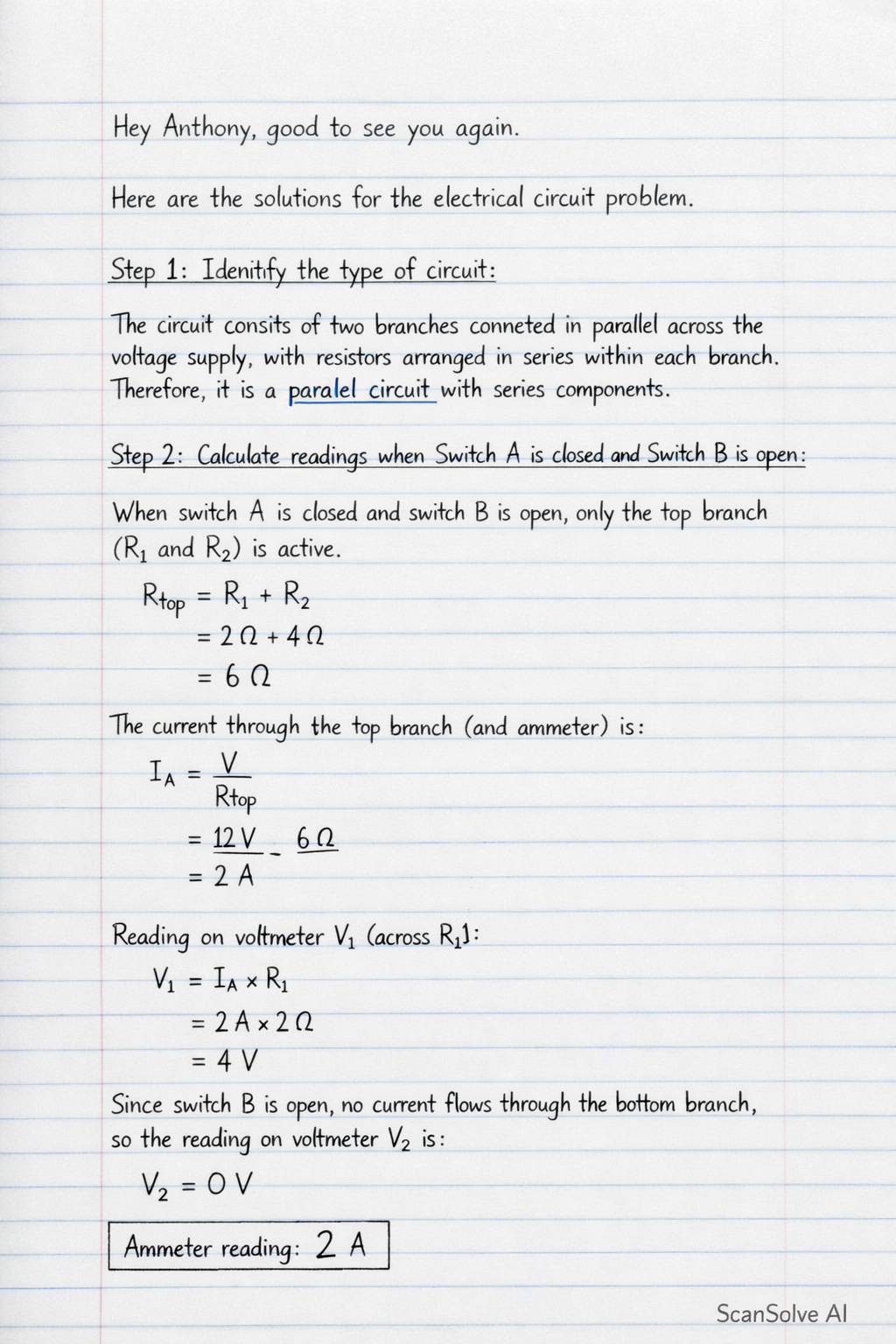
Here are the solutions for the electrical circuit problem.
Step 1: Identify the type of circuit.
The circuit consists of two branches connected in parallel across the voltage supply, with resistors arranged in series within each branch. Therefore, it is a parallel circuit with series components.
Step 2: Calculate readings when Switch A is closed and Switch B is open.
When switch A is closed and switch B is open, only the top branch ( and ) is active.
The total resistance in the top branch is:
The current flowing through the top branch (and the ammeter) is:
The reading on voltmeter (across ) is:
Since switch B is open, no current flows through the bottom branch, so the reading on voltmeter is:
Ammeter reading:
**Voltmeter }V_1 reading:
**Voltmeter }V_2 reading:
Step 3: Calculate readings when Switch B is closed and Switch A is open.
When switch B is closed and switch A is open, only the bottom branch ( and ) is active.
The total resistance in the bottom branch is:
The current flowing through the bottom branch (and the ammeter) is:
Since switch A is open, no current flows through the top branch, so the reading on voltmeter is:
The reading on voltmeter (across ) is:
Ammeter reading:
**Voltmeter }V_1 reading:
**Voltmeter }V_2 reading:
Step 4: Calculate readings when Both switches are closed.
When both switches are closed, both branches are active and connected in parallel.
The resistance of the top branch is .
The resistance of the bottom branch is .
The current through the top branch is:
The current through the bottom branch is:
The total current (ammeter reading) is the sum of the currents in the parallel branches:
The reading on voltmeter (across ) is:
The reading on voltmeter (across ) is:
Ammeter reading:
**Voltmeter }V_1 reading:
**Voltmeter }V_2 reading:
Step 5: Calculate the resistance of the full circuit.
The resistance of the full circuit refers to the equivalent resistance when both switches are closed.
The equivalent resistance for parallel branches is given by:
To add these fractions, find a common denominator, which is 18:
Still stuck on this one?
Ask a follow-up, and the answer starts from this question.
More Physics Questions
Handwritten Step-by-Step Solution
Get this as a handwritten image on WhatsApp — like a tutor wrote it for you.
Try on WhatsApp