
We read your photo as:
The Doppler effect is the apparent change in the frequency or wavelength of a wave (like sound or light) due to the relative motion between the source of the wave and the observer.
ScanSolve AI Answer
Step-by-step solution
2 steps6.1.1
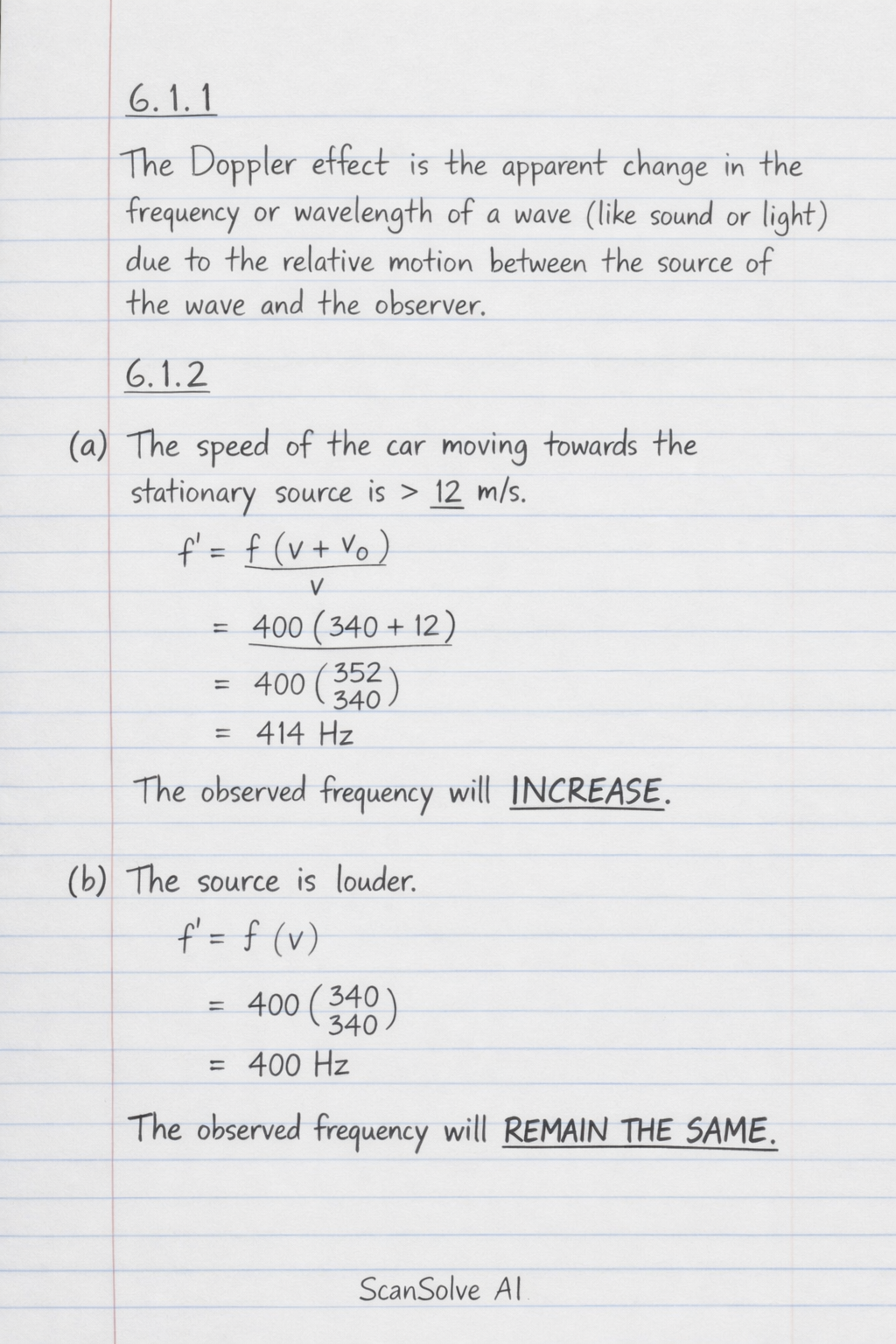
The Doppler effect is the apparent change in the frequency or wavelength of a wave (like sound or light) due to the relative motion between the source of the wave and the observer.
6.1.2
a) The constant speed of the car moving towards the stationary sound source is greater than .
The observed frequency will INCREASE.
b) The sound produced by the source is louder.
The observed frequency will REMAIN THE SAME.
6.1.3
Calculate the observed frequency () in the first scenario.
The Doppler effect formula for a moving listener approaching a stationary source is:
Given:
- Source frequency
- Speed of sound
- Listener speed
Calculate the new frequency of the sound source () in the second scenario.
The observed frequency is still .
The listener now travels towards the stationary sound source at .
The formula is:Rearrange to solve for :
Substitute the values:
The new frequency of the sound source is .
6.2
The spectrum that shows the absorption lines of light from another star that is moving AWAY from Earth is Z.
Explanation: When a star moves away from Earth, the light it emits undergoes redshift. This means the wavelengths of the absorption lines are shifted towards the red end of the spectrum (longer wavelengths). Compared to the reference spectrum X (from the sun), spectrum Z shows the absorption lines shifted towards the 'R' (red) side, indicating redshift.
Still stuck on this one?
Ask a follow-up, and the answer starts from this question.
More Physics Questions
Handwritten Step-by-Step Solution
Get this as a handwritten image on WhatsApp — like a tutor wrote it for you.
Try on WhatsApp