
![Calculate the work done in raising the pendulum to point B, if the mass of the bob is 50 g. [g = 10 m s^-2]](/_next/image?url=https%3A%2F%2Fohijasnjvprzodcmxltt.supabase.co%2Fstorage%2Fv1%2Fobject%2Fpublic%2Fwhatsapp-images%2F1780315842204-fe203ba22843420d.png&w=3840&q=75)
This physics problem tests your understanding of fundamental physical laws and their applications. The step-by-step solution below breaks down the problem using relevant equations and physical reasoning.
ScanSolve AI Answer
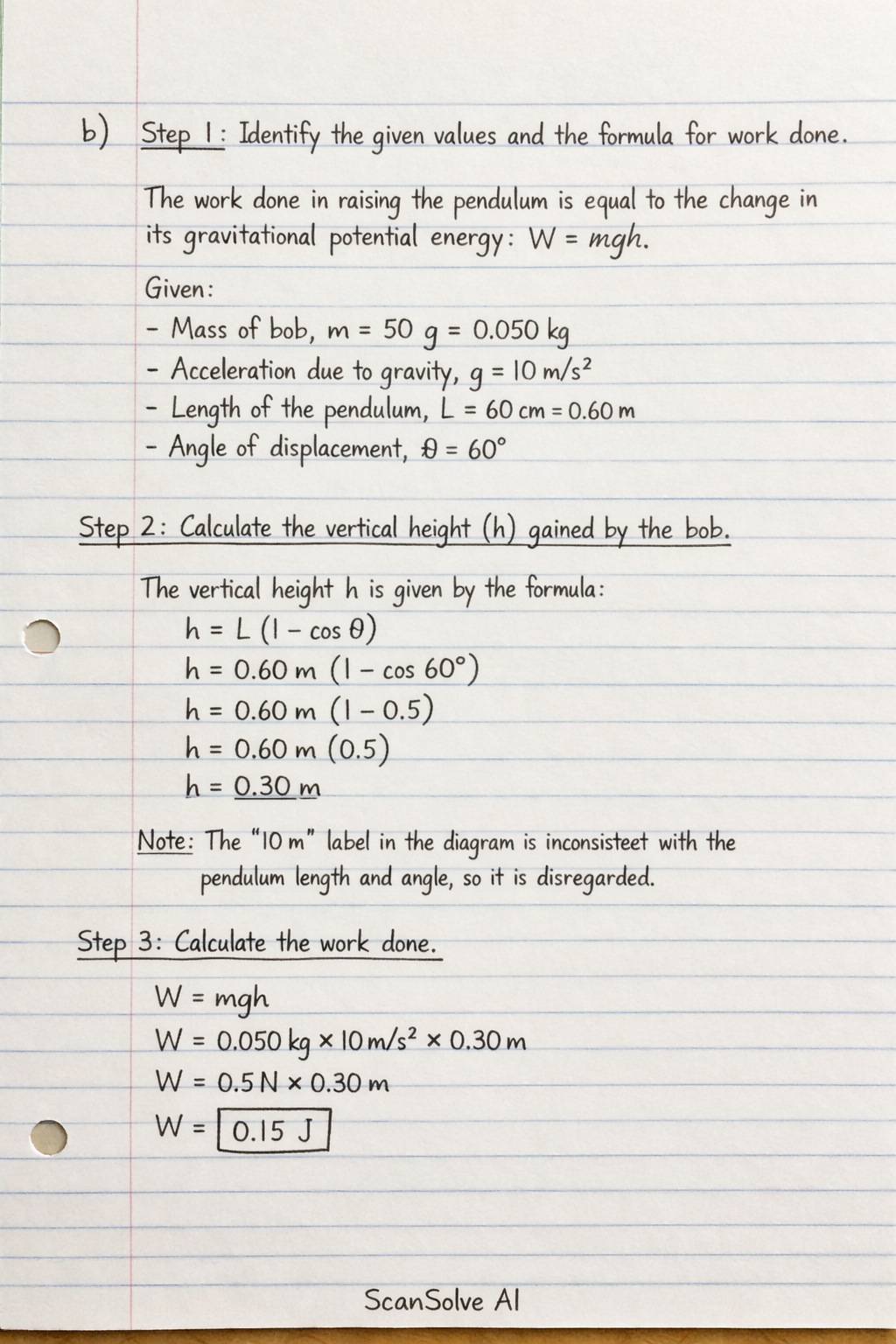
b) Step 1: Identify the given values and the formula for work done. The work done in raising the pendulum is equal to the change in its gravitational potential energy, W = mgh. Given: Mass of bob, m = 50 g = 0.050 kg Acceleration due to gravity, g = 10 m/s^2 Length of the pendulum, L = 60 cm = 0.60 m Angle of displacement, = 60^ Step 2: Calculate the vertical height (h) gained by the bob. The vertical height h is given by the formula h = L(1 - ). h = 0.60 m (1 - 60^) h = 0.60 m (1 - 0.5) h = 0.60 m (0.5) h = 0.30 m Note: The "10 m" label in the diagram is inconsistent with the pendulum length and angle, so it is disregarded. Step 3: Calculate the work done. W = mgh W = 0.050 kg × 10 m/s^2 × 0.30 m W = 0.5 N × 0.30 m W = 0.15 J c) Step 1: Formulate equations based on Hooke's Law. Hooke's Law states that the force exerted by a spring is proportional to its extension, F = kx. The force is the weight of the mass, F = Mg. The extension x is the total length of the spring (L_total) minus its natural length (l), so x = L_total - l. Thus, Mg = k(L_total - l). The mass of the scale pan is m_pan = 0.04 kg. Acceleration due to gravity, g = 10 m/s^2. Case 1: Object mass m_1 = 0.20 kg. Total mass M_1 = m_pan + m_1 = 0.04 kg + 0.20 kg = 0.24 kg. Length of the spring L_1 = 0.055 m. Equation 1: M_1 g = k(L_1 - l) 0.24 kg × 10 m/s^2 = k(0.055 m - l) 2.4 = k(0.055 - l) (1) Case 2: Object mass m_2 = 0.28 kg. Total mass M_2 = m_pan + m_2 = 0.04 kg + 0.28 kg = 0.32 kg. Length of the spring L_2 = 0.065 m. Equation 2: M_2 g = k(L_2 - l) 0.32 kg × 10 m/s^2 = k(0.065 m - l) 3.2 = k(0.065 - l) (2) Step 2: Solve the system of equations for l. From equation (1), k = (2.4)/(0.055 - l). Substitute this expression for k into equation (2): 3.2 = (2.4)/(0.055 - l) (0.065 - l) 3.2 (0.055 - l) = 2.4 (0.065 - l) 0.176 - 3.2l = 0.156 - 2.4l 0.176 - 0.156 = 3.2l - 2.4l 0.020 = 0.8l l = (0.020)/(0.8) l = 0.025 m Step 3: Substitute the value of l back into one of the equations to find k. Using equation (1): 2.4 = k(0.055 - 0.025) 2.4 = k(0.030) k = (2.4)/(0.030) k = 80 N/m Drop the next question.