
We read your photo as:
Calculate the work done to move an electron from the positive to the negative terminal of a 12 V battery.
ScanSolve AI Answer
Answer
Step-by-step solution
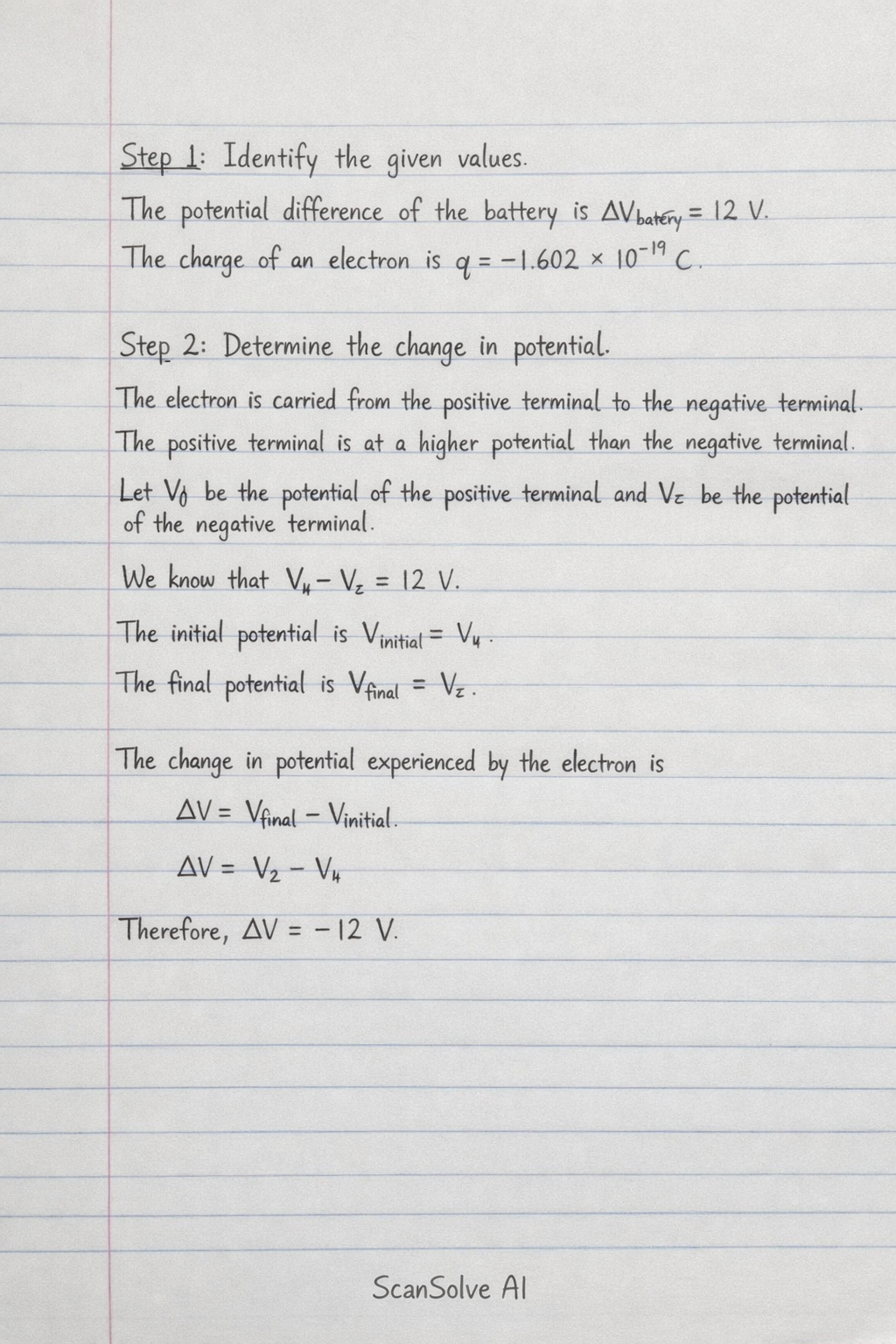
3 stepsIdentify the given values.
The potential difference of the battery is .
The charge of an electron is .Determine the change in potential.
The electron is carried from the positive terminal to the negative terminal.
The positive terminal is at a higher potential than the negative terminal.
Let be the potential of the positive terminal and be the potential of the negative terminal.
We know that .
The initial potential is .
The final potential is .
The change in potential experienced by the electron is .
Therefore, .Calculate the work required.
The work required to move a charge through a potential difference is given by the formula:
Substitute the values:
Rounding to two significant figures, consistent with the given voltage:
The work required is positive because an electron (negative charge) is being moved from a higher potential (positive terminal) to a lower potential (negative terminal), which is against the direction it would naturally move under the influence of the electric field.
The work required is .
Try one yourself
A new problem that tests the same skill.
Still stuck on this one?
Ask a follow-up, and the answer starts from this question.
More Physics Questions
Handwritten Step-by-Step Solution
Get this as a handwritten image on WhatsApp — like a tutor wrote it for you.
Try on WhatsApp