
We read your photo as:
You are given a gas at 750 torr with a volume of 0.62 L at 25°C. A while later, you measure the temperature and notice a 5°C temperature increase in the system. Assuming there is no pressure change and that this is an ideal gas, what is the new volume?
ScanSolve AI Answer
Answers
2 partsStep-by-step solution
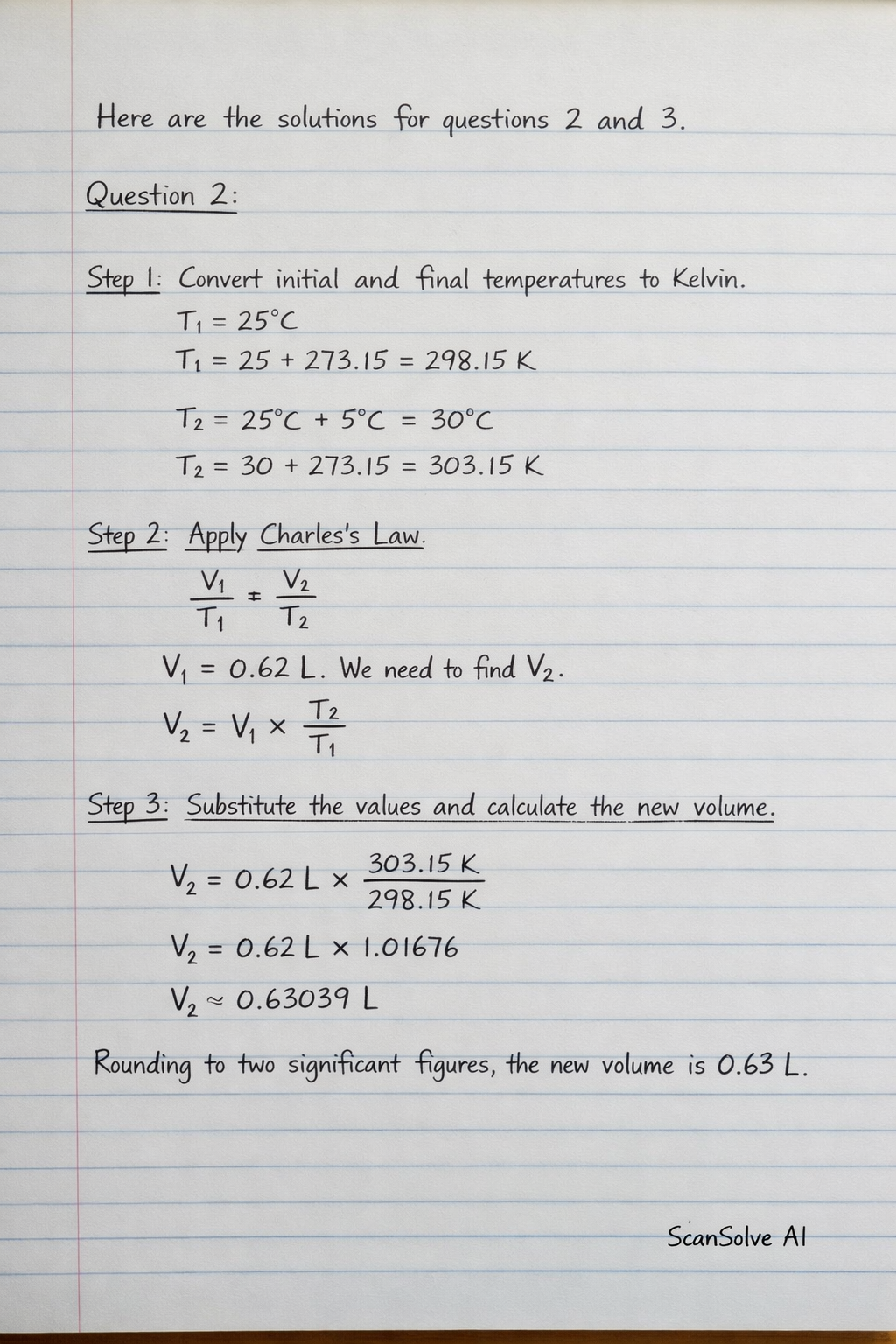
6 stepsHere are the solutions for questions 2 and 3.
Part 2· 3 steps
Convert initial and final temperatures to Kelvin.
The initial temperature .
The temperature increases by , so the final temperature .
Apply Charles's Law.
Since the pressure is constant, we can use Charles's Law, which states that for a fixed amount of gas at constant pressure, the volume is directly proportional to its absolute temperature:
We are given . We need to find .
Rearrange the formula to solve for :Substitute the values and calculate the new volume.
Rounding to two significant figures, the new volume is .
The final answer is .
Part 3
Convert temperature to Kelvin and pressure to atmospheres.
The given temperature .
The given pressure . Convert torr to atmospheres (1 atm = 760 torr):
The given density .
The ideal gas constant .Use the ideal gas law in terms of density and molar mass.
The ideal gas law is . We know that the number of moles , where is mass and is molar mass.
Substituting into the ideal gas law:Rearranging to solve for molar mass :
Since density , we can substitute with :
Substitute the values and calculate the molar mass.
Rounding to three significant figures, the molar mass is .
The final answer is .
Try one yourself
A new problem that tests the same skill.
Still stuck on this one?
Ask a follow-up, and the answer starts from this question.
More Physics Questions
Handwritten Step-by-Step Solution
Get this as a handwritten image on WhatsApp — like a tutor wrote it for you.
Try on WhatsApp