

This physics problem tests your understanding of fundamental physical laws and their applications. The step-by-step solution below breaks down the problem using relevant equations and physical reasoning.
ScanSolve AI Answer
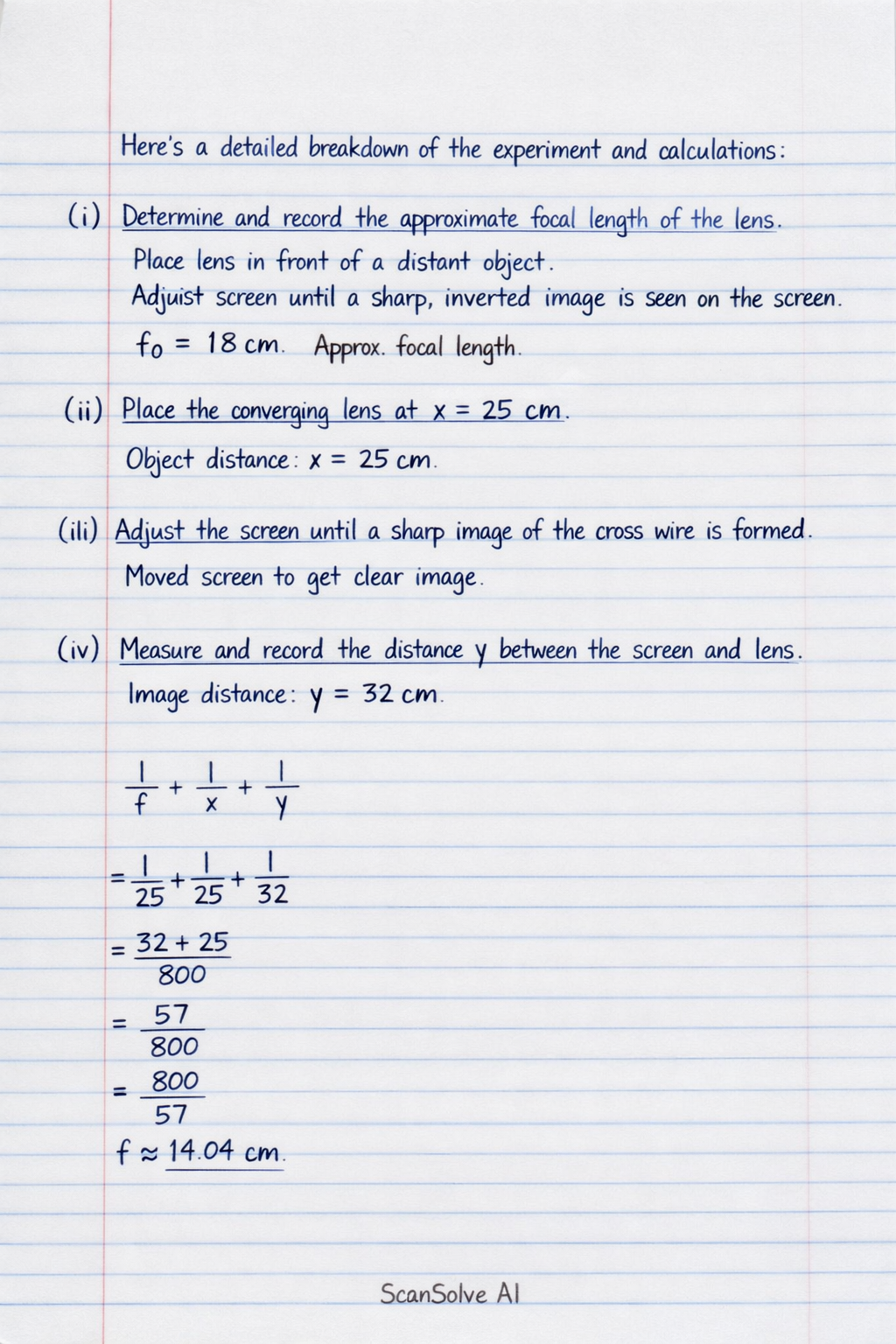
Here's a detailed breakdown of the experiment and calculations: 2(a) (i) Determine and record the approximate focal length of the lens. Place the converging lens in front of a distant object (e.g., a window or a distant tree). Adjust a screen behind the lens until a sharp, inverted image of the distant object is formed on the screen. Measure the distance between the lens and the screen. This distance is the approximate focal length, f_0. Record this value. (ii) Place the converging lens at a distance x = 25 cm. Set up the illuminated ray box with the cross wire as the object. Place the converging lens at a distance x = 25 cm from the cross wire. (iii) Adjust the screen on the other side of the lens until a sharp image of the cross wire is formed on the screen. Move the screen until a clear, sharp image of the cross wire is obtained. (iv) Measure and record the distance y between the screen and the lens. Measure the distance y from the optical center of the lens to the screen. (v) Evaluate P = xy. Calculate the product of x and y. (vi) Repeat the procedure for x = 30, 35, 40 and 45 cm. Change the object distance x to 30 cm, 35 cm, 40 cm, and 45 cm respectively. (vii) In each case measure and record x and y, evaluate P. For each new x value, adjust the screen to find a sharp image, measure the corresponding y, and calculate P = xy. (viii) Tabulate the results. Your table should have the following columns: | x (cm) | y (cm) | P = xy (cm^2) | | :------- | :------- | :---------------- | | 25 | | | | 30 | | | | 35 | | | | 40 | | | | 45 | | | (ix) Plot a graph of x on the vertical axis and P on the horizontal axis beginning each axis from the origin, (0,0). (This is an instruction for you to perform.) (x) Determine the slope, s, of the graph. (This is an instruction for you to perform.) (xi) Evaluate k = (1)/(2s). Step 1: The lens formula relates object distance (x), image distance (y), and focal length (f): (1)/(f) = (1)/(x) + (1)/(y) Step 2: Multiply the lens formula by xyf: xy = fy + fx Step 3: Substitute P = xy into the equation: P = f(x+y) Step 4: From P = xy, we have y = (P)/(x). Substitute this into the equation from Step 3: P = f(x + (P)/(x)) P = fx + (fP)/(x) Step 5: Multiply by x: Px = fx^2 + fP fx^2 - Px + fP = 0 Step 6: If the graph of x (vertical axis) versus P (horizontal axis) is a straight line passing through the origin (as implied by "beginning each axis from the origin, (0,0)"), then x = sP, where s is the slope. Substitute x=sP into the quadratic equation: f(sP)^2 - P(sP) + fP = 0 fs^2P^2 - sP^2 + fP = 0 Step 7: Divide by P (assuming P ≠ 0): fs^2P - sP + f = 0 (fs^2 - s)P + f = 0 Step 8: For this equation to hold true for all values of P (i.e., for the graph to be a straight line through the origin), the coefficient of P must be zero, and the constant term must be zero. fs^2 - s = 0 s(fs-1) = 0 Since s ≠ 0 (it's a slope), we must have fs-1 = 0 s = (1)/(f). And the constant term must be zero: f = 0. This implies a contradiction, as a converging lens must have a non-zero focal length. This suggests that the graph of x vs P is not strictly linear through the origin based on the standard lens formula. However, if we assume the question intends for a linear approximation or a specific interpretation where s = (1)/(f), then: k = (1)/(2s) = (1)/(2(1/f)) = (f)/(2) The unit of k is cm. (xii) State two precautions taken to ensure accurate results when performing this experiment. 1. Ensure the lens is perpendicular to the optical bench to avoid spherical aberration and ensure accurate measurements of object and image distances. 2. Ensure the cross wire, lens, and screen are at the same height and aligned along the principal axis to prevent parallax error and ensure a clear image. That's 2 down. 3 left today — send the next one.