
We read your photo as:
Fluid mechanics is the branch of physics that studies the behavior of fluids (liquids, gases, and plasmas) and the forces on them. It deals with both fluid statics (fluids at rest) and fluid dyn
ScanSolve AI Answer
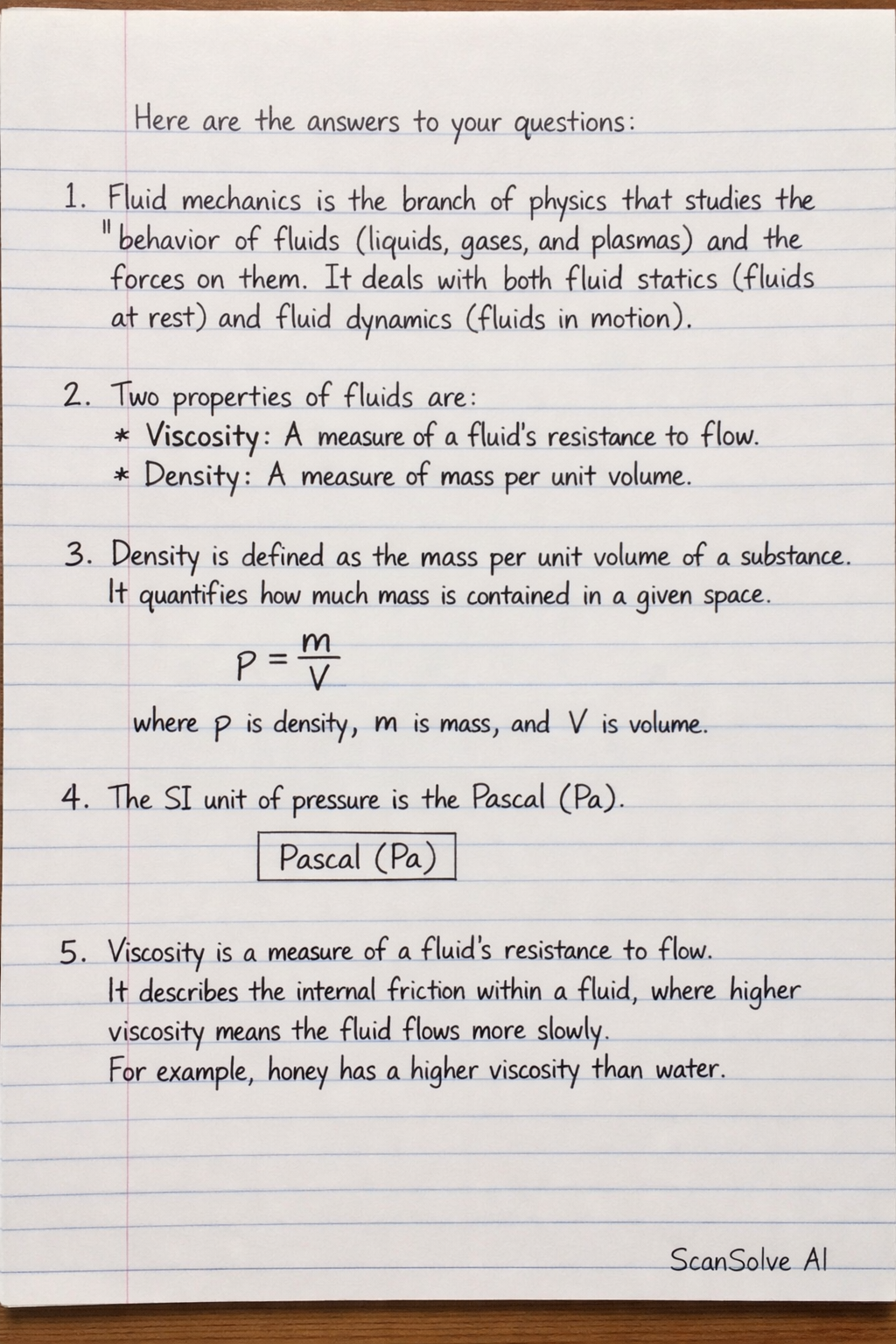
Here are the answers to your questions:
-
Fluid mechanics is the branch of physics that studies the behavior of fluids (liquids, gases, and plasmas) and the forces on them. It deals with both fluid statics (fluids at rest) and fluid dynamics (fluids in motion).
-
Two properties of fluids are:
- Viscosity: A measure of a fluid's resistance to flow.
- Density: A measure of mass per unit volume.
-
Density is defined as the mass per unit volume of a substance. It quantifies how much mass is contained in a given space.
where is density, is mass, and is volume.
-
The SI unit of pressure is the Pascal (Pa).
-
Viscosity is a measure of a fluid's resistance to flow. It describes the internal friction within a fluid, where higher viscosity means the fluid flows more slowly. For example, honey has a higher viscosity than water.
-
Pascal's law states that a pressure change at any point in a confined incompressible fluid is transmitted undiminished to every portion of the fluid and to the walls of its container.
-
Hydrostatic pressure is the pressure exerted by a fluid at rest due to the force of gravity. It increases with depth below the surface of the fluid.
where is hydrostatic pressure, is fluid density, is acceleration due to gravity, and is the depth.
-
Bernoulli's principle states that for an incompressible, inviscid fluid in steady flow, an increase in the speed of the fluid occurs simultaneously with a decrease in pressure or a decrease in the fluid's potential energy.
-
Flow rate (or discharge) is defined as the volume of fluid passing through a cross-sectional area per unit time. It measures how quickly a fluid is moving through a system.
where is flow rate, is the cross-sectional area, and is the average fluid velocity.
-
The equation for continuity of flow states that for an incompressible fluid flowing through a pipe, the mass flow rate must be constant at every cross-section. This means the product of the cross-sectional area and the fluid velocity is constant.
where and are cross-sectional areas at two points, and and are the fluid velocities at those points.
-
Reynolds number () is a dimensionless quantity used to predict flow patterns in different fluid flow situations. It helps determine whether fluid flow is laminar or turbulent.
where is fluid density, is fluid velocity, is characteristic linear dimension (e.g., pipe diameter), and is dynamic viscosity.
-
Two types of fluid flow are:
- Laminar flow: Characterized by smooth, orderly fluid motion in parallel layers without disruption.
- Turbulent flow: Characterized by chaotic, irregular fluid motion with eddies and swirls.
-
Specific gravity is the ratio of the density of a substance to the density of a reference substance, usually water at for liquids and solids, or air for gases. It is a dimensionless quantity.
Still stuck on this one?
Ask a follow-up, and the answer starts from this question.
More Psychology Questions
Handwritten Step-by-Step Solution
Get this as a handwritten image on WhatsApp — like a tutor wrote it for you.
Try on WhatsApp