
We read your photo as:
In testing for the sign of charge on a body, state and explain the behavior of a positively charged electroscope when a negatively charged body is brought closer to the cap of the electroscope:
ScanSolve AI Answer
Step-by-step solution
4 stepsHere are the solutions to the questions:
-
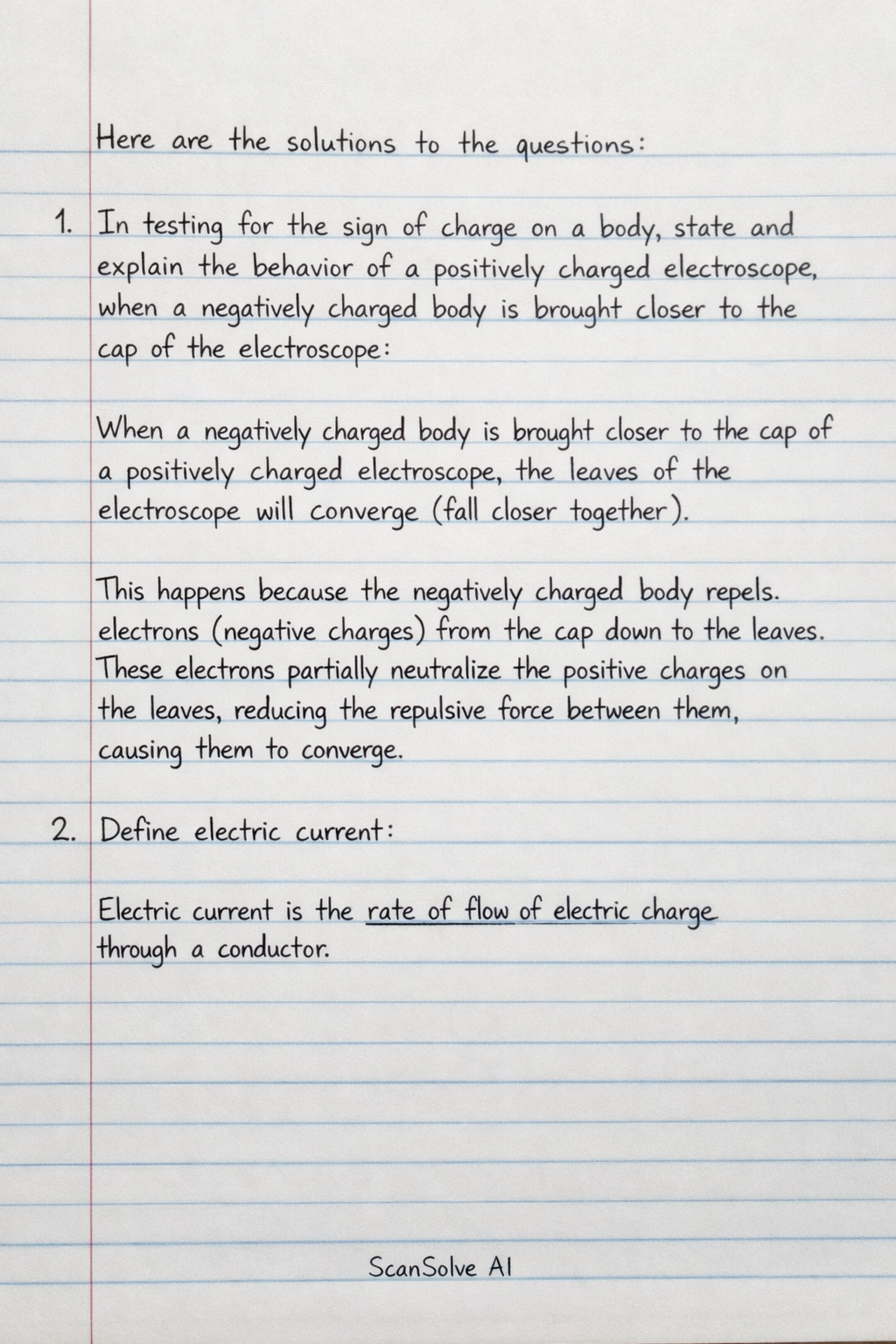
In testing for the sign of charge on a body, state and explain the behavior of a positively charged electroscope when a negatively charged body is brought closer to the cap of the electroscope: When a negatively charged body is brought closer to the cap of a positively charged electroscope, the leaves of the electroscope will converge (fall closer together). This happens because the negatively charged body repels electrons (negative charges) from the cap down to the leaves. These electrons partially neutralize the positive charges on the leaves, reducing the repulsive force between them, causing them to converge.
-
Define electric current: Electric current is the rate of flow of electric charge through a conductor.
-
A current of is flowing through a lamp. Find the time it will take for of charge to pass through the lamp.
Recall the formula relating current (), charge (), and time ().
$$ I = \frac{Q}{t} $$Rearrange the formula to solve for time ().
$$ t = \frac{Q}{I} $$Substitute the given values
and .
Calculate the time.
$$ t = 300 \, \text{s} $$ The time it will take is $\boxed{\text{300 s}}$.4. The figure below shows a microscope M focused on smoke particles inside a glass chamber. * a) Explain what is observed. The smoke particles are observed to be in continuous, random, and erratic motion. This is known as Brownian motion. * b) What change is observed in the movement of smoke particles if temperature is increased? If the temperature is increased, the smoke particles will move more vigorously and faster.
-
State the property of light associated with the formation of shadows: The property of light associated with the formation of shadows is that light travels in straight lines (rectilinear propagation of light).
-
State three differences between alcohol and mercury as thermometric liquids:
- Freezing Point: Alcohol has a much lower freezing point (around ) than mercury (around ), making alcohol suitable for measuring very low temperatures.
- Boiling Point: Mercury has a much higher boiling point (around ) than alcohol (around ), making mercury suitable for measuring very high temperatures.
- Wetting: Alcohol wets the glass tube, while mercury does not, which can lead to inaccuracies in alcohol thermometers if not properly designed.
-
a) Differentiate between scalar and vector quantity. Give one example of each.
- A scalar quantity is a physical quantity that has only magnitude. Example: Mass.
- A vector quantity is a physical quantity that has both magnitude and direction. Example: Force.
b) In a vacuum flask, the walls enclosing the vacuum are silvered on the inside. State the reason for this.
The walls are silvered on the inside to reduce heat transfer by radiation. The shiny silver surface is a poor emitter and a good reflector of thermal radiation, preventing heat from radiating into or out of the flask.
-
Still stuck on this one?
Ask a follow-up, and the answer starts from this question.
More Psychology Questions
Handwritten Step-by-Step Solution
Get this as a handwritten image on WhatsApp — like a tutor wrote it for you.
Try on WhatsApp