

This psychology problem is solved step by step below, with detailed explanations to help you understand the method and arrive at the correct answer.
ScanSolve AI Answer
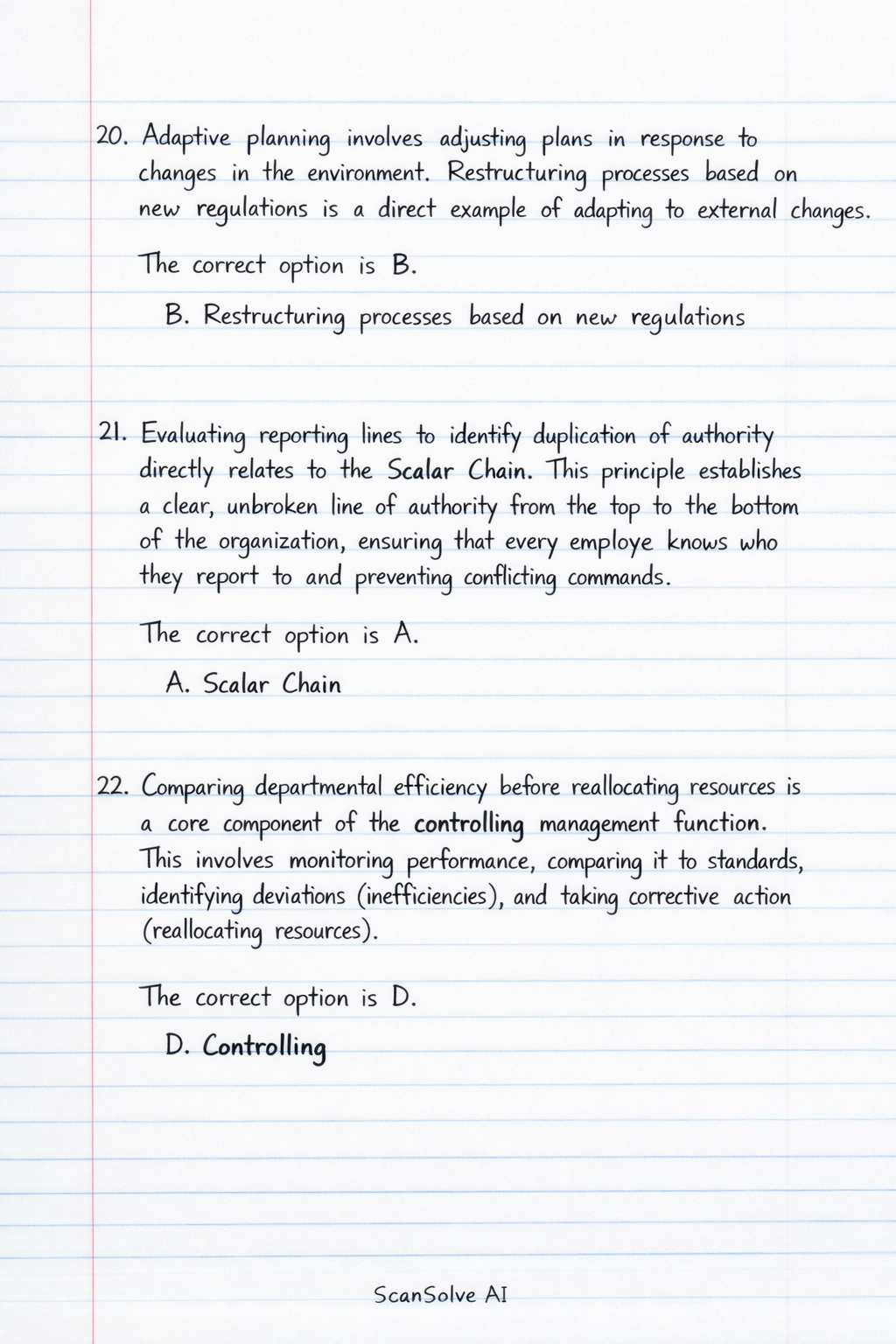
20. Adaptive planning involves adjusting plans in response to changes in the environment. Restructuring processes based on new regulations is a direct example of adapting to external changes. The correct option is B. B. Restructuring processes based on new regulations 21. Evaluating reporting lines to identify duplication of authority directly relates to the Scalar Chain. This principle establishes a clear, unbroken line of authority from the top to the bottom of the organization, ensuring that every employee knows who they report to and preventing conflicting commands. The correct option is A. A. Scalar Chain 22. Comparing departmental efficiency before reallocating resources is a core component of the controlling management function. This involves monitoring performance, comparing it to standards, identifying deviations (inefficiencies), and taking corrective action (reallocating resources). The correct option is D. D. Controlling 23. Analyzing whether employees' skills match job requirements is a fundamental aspect of job design. Job design involves structuring jobs to ensure that tasks are appropriate for the skills and abilities of the employees performing them. The correct option is A. A. Job design 24. Comparing functional versus divisional structures primarily examines reporting relationships. These structures define how departments and individuals are grouped and how authority flows within the organization. The correct option is A. A. Reporting relationships 25. Analyzing whether a team's structure supports strategic goals reflects the principle of Unity of Direction. This principle ensures that all efforts within the organization, including team structures, are aligned towards achieving common objectives. The correct option is A. A. Unity of Direction 26. Rewarding employees based on achievement exemplifies Expectancy Theory. This theory posits that individuals are motivated to act when they believe their effort will lead to good performance (achievement), that good performance will be recognized and rewarded, and that the rewards are desirable. The correct option is D. D. Expectancy Theory 27. Comparing hygiene factors versus motivators (from Herzberg's Two-Factor Theory) requires analysis. This Bloom's Taxonomy level involves breaking down information into its constituent parts and understanding the relationships between them to identify similarities and differences. The correct option is A. A. Analysis 28. Evaluating which needs are unmet in a team applies the concept of Need Hierarchy Analysis, which is the process of using Maslow's Hierarchy of Needs to identify and understand the different levels of needs that may be unfulfilled within a group. The correct option is D. D. Need Hierarchy Analysis 29. Determining whether Theory X or Theory Y assumptions fit a team exemplifies conceptual analysis. This involves evaluating broad management philosophies (like McGregor's theories) and applying them to understand the underlying assumptions about employee behavior within a specific context. The correct option is A. A. Conceptual analysis 30. Analyzing how motivation affects performance and retention reflects productivity correlation. This involves studying the relationship between employee motivation levels and their output (productivity) and their likelihood of remaining with the organization (retention). The correct option is A. A. Productivity correlation 31. A manager comparing actual team performance against planned targets is performing feedback analysis. This is a key part of the controlling function, where performance data is collected, compared to standards, and analyzed to identify deviations and inform future actions. The correct option is A. A. Feedback analysis