
We read your photo as:
A. Differentiate between the concepts of learning and training providing examples. b. Explain the use of behaviour modification techniques to reduce lateness in exams. c. Describe five characteristics of a well-formed educational theory.
ScanSolve AI Answer
Step-by-step solution
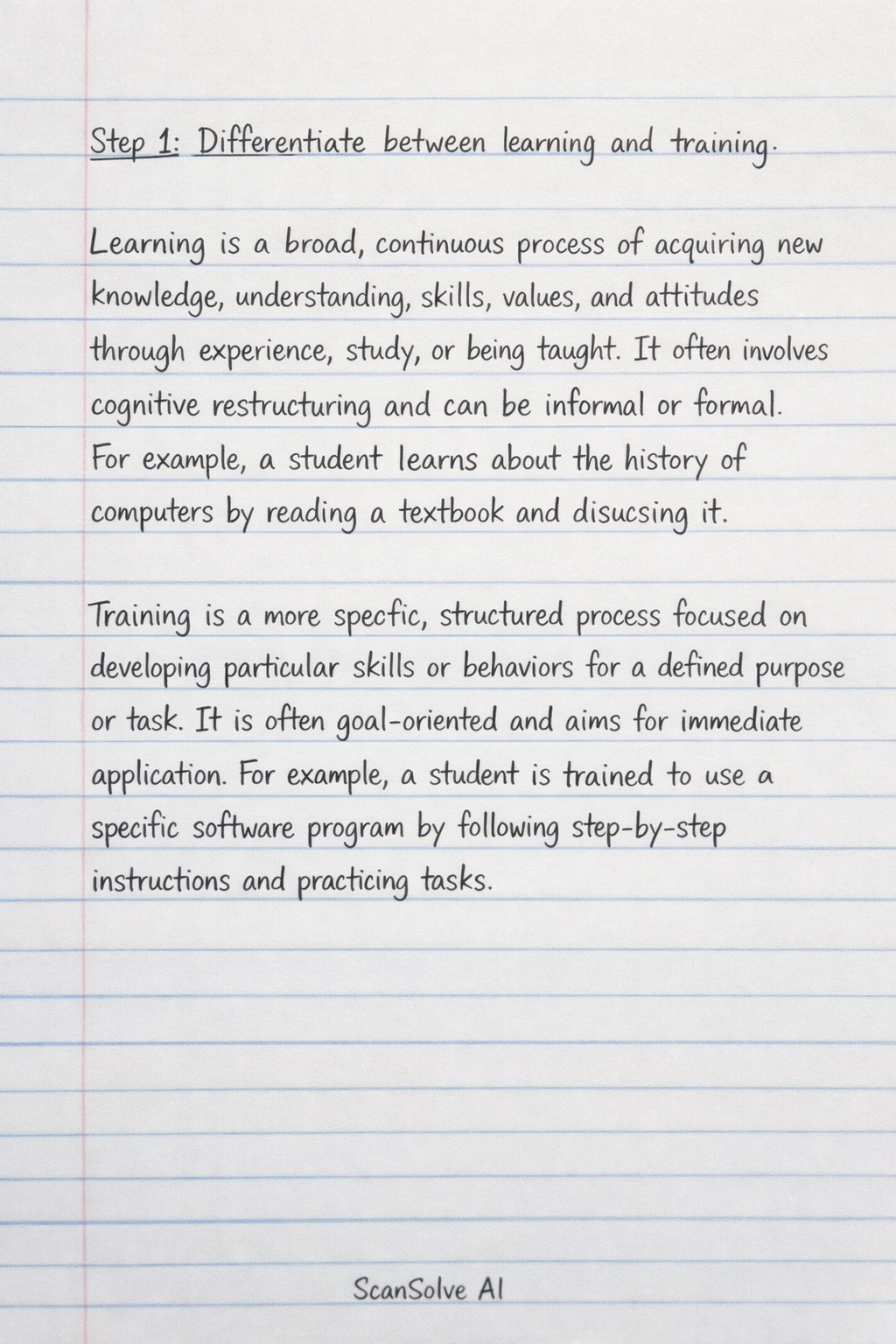
3 stepsDifferentiate between learning and training.
Learning is a broad, continuous process of acquiring new knowledge, understanding, skills, values, and attitudes through experience, study, or being taught. It often involves cognitive restructuring and can be informal or formal. For example, a student learns about the history of computers by reading a textbook and discussing it.
Training is a more specific, structured process focused on developing particular skills or behaviors for a defined purpose or task. It is often goal-oriented and aims for immediate application. For example, a student is trained to use a specific software program by following step-by-step instructions and practicing tasks.Explain the importance for educators to understand learning and training.
It is important for educators to understand both learning and training because it allows them to select the most effective instructional strategies for different educational goals. Understanding learning helps educators design curricula that foster deep comprehension, critical thinking, and long-term knowledge retention. Understanding training enables them to develop practical, skill-based instruction that prepares students for specific tasks or professions, ensuring they can apply knowledge effectively in real-world scenarios. This distinction helps educators tailor their approach to achieve desired outcomes, whether it's conceptual understanding or practical proficiency.
Describe five characteristics of a well-formed educational theory.
A well-formed educational theory typically possesses the following characteristics:
- Explanatory Power: It clearly explains how and why learning occurs, providing insights into the underlying processes and mechanisms.
- Predictive Power: It can predict future learning outcomes or behaviors under specific conditions, allowing educators to anticipate results and plan interventions.
- Testability/Falsifiability: It can be empirically tested through research and observation, and there must be a possibility for it to be proven wrong.
- Internal Consistency: Its components and principles are logically coherent and do not contradict each other.
- Practical Applicability: It offers clear implications and guidance for educational practice, helping educators design effective teaching methods and curricula.
Still stuck on this one?
Ask a follow-up, and the answer starts from this question.
More Psychology Questions
Handwritten Step-by-Step Solution
Get this as a handwritten image on WhatsApp — like a tutor wrote it for you.
Try on WhatsApp