
We read your photo as:
A) Define learning. b) With one (1) example each, explain any Four (4) types of learning.
ScanSolve AI Answer
Step-by-step solution
4 stepsPart a
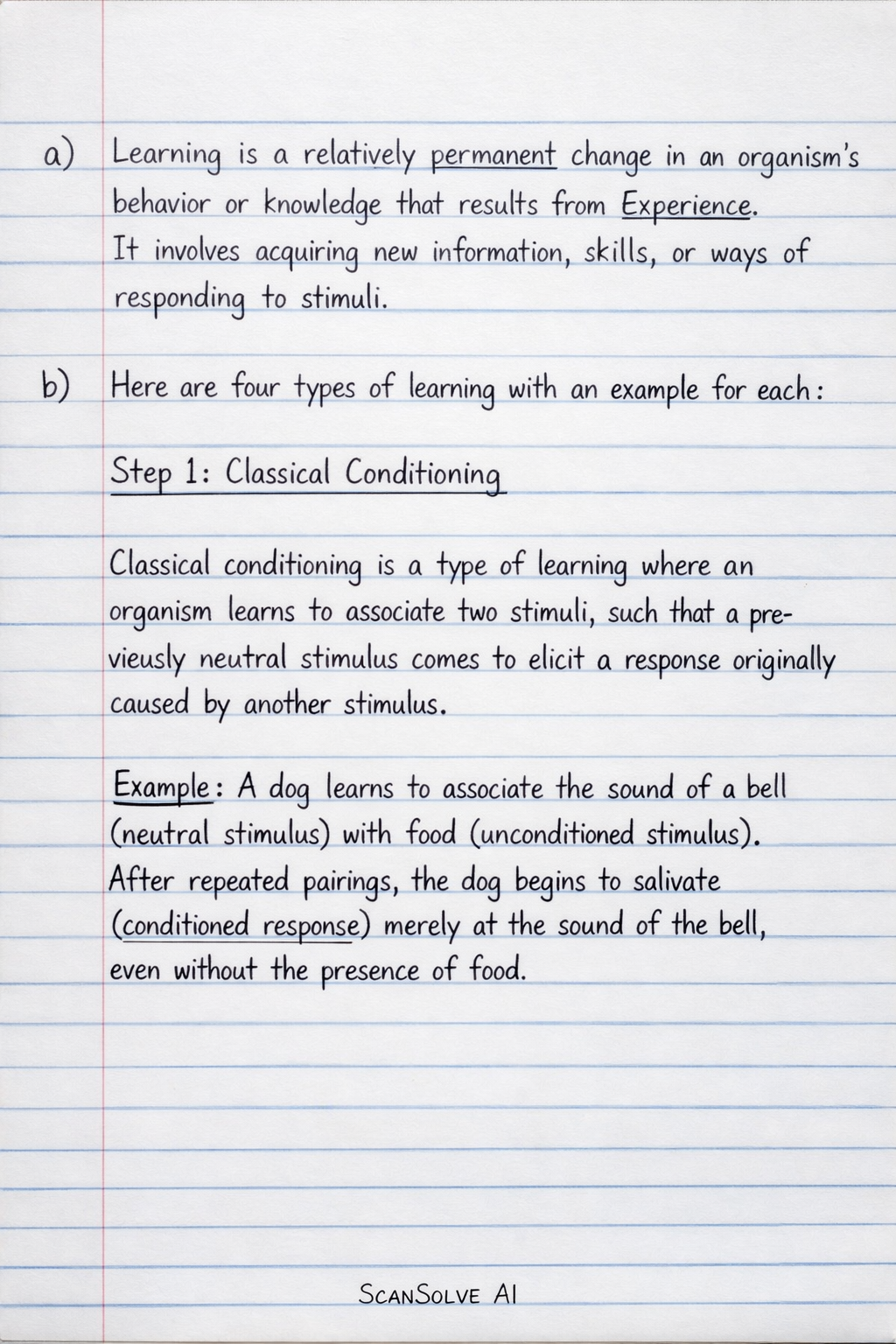
Learning is a relatively permanent change in an organism's behavior or knowledge that results from experience. It involves acquiring new information, skills, or ways of responding to stimuli.
Part b· 4 steps
Here are four types of learning with an example for each
Classical Conditioning
Classical conditioning is a type of learning where an organism learns to associate two stimuli, such that a previously neutral stimulus comes to elicit a response originally caused by another stimulus.
Example: A dog learns to associate the sound of a bell (neutral stimulus) with food (unconditioned stimulus). After repeated pairings, the dog begins to salivate (conditioned response) merely at the sound of the bell, even without the presence of food.Operant Conditioning
Operant conditioning is a type of learning in which behavior is strengthened if followed by a reinforcer or diminished if followed by a punisher. It involves learning through the consequences of one's actions.
Example: A student studies diligently for an exam and receives a high grade (positive reinforcement). This positive outcome increases the likelihood that the student will study diligently for future exams.Observational Learning
Observational learning, also known as social learning or modeling, occurs when an individual learns by watching and imitating the behavior of others. It involves paying attention, retaining the information, being able to reproduce the behavior, and being motivated to do so.
Example: A child watches their older sibling successfully ride a bicycle. By observing the sibling's actions and movements, the child learns how to balance and pedal, and later attempts to ride the bicycle themselves.Cognitive Learning
Cognitive learning involves mental processes such as problem-solving, memory, and insight. It focuses on how information is processed, stored, and retrieved, and often involves understanding relationships and concepts rather than just forming associations.
Example: A person is trying to solve a complex puzzle. Instead of trial and error, they mentally visualize different arrangements of pieces, use logical reasoning to deduce the correct fit, and suddenly arrive at the solution through insight.
Still stuck on this one?
Ask a follow-up, and the answer starts from this question.
More Psychology Questions
Handwritten Step-by-Step Solution
Get this as a handwritten image on WhatsApp — like a tutor wrote it for you.
Try on WhatsApp