
We read your photo as:
What are the three processes of memory, two types of behavioral learning theory, four psychological processes, two relationships between memory and learning, four affective domains of learning, and tw
ScanSolve AI Answer
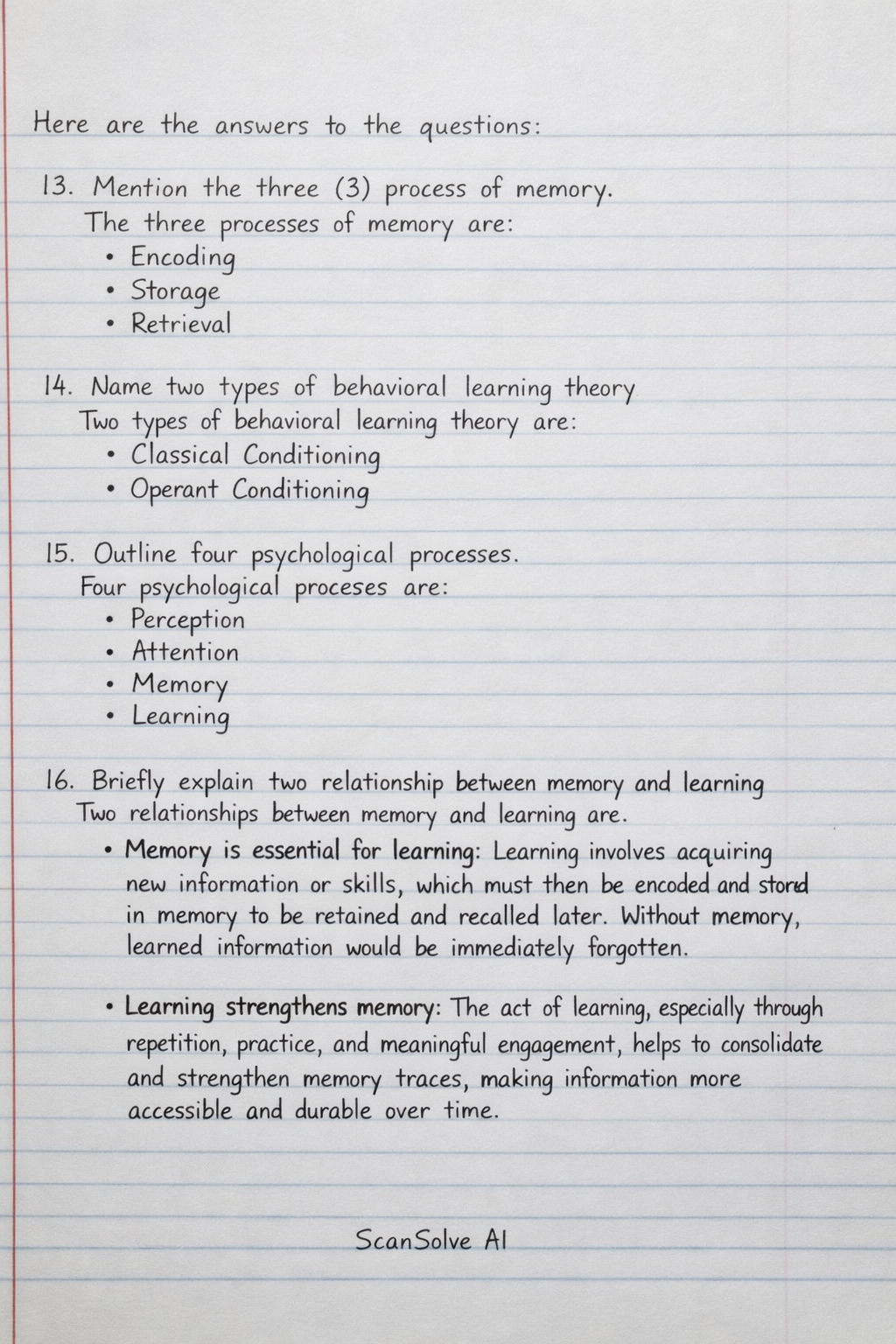
Here are the answers to the questions:
13. Mention the three (3) process of memory.
The three processes of memory are:
- Encoding
- Storage
- Retrieval
14. Name two types of behavioral learning theory
Two types of behavioral learning theory are:
- Classical Conditioning
- Operant Conditioning
15. Outline four psychological processes
Four psychological processes are:
- Perception
- Attention
- Memory
- Learning
16. Briefly explain two relationship between memory and learning
Two relationships between memory and learning are:
- Memory is essential for learning: Learning involves acquiring new information or skills, which must then be encoded and stored in memory to be retained and recalled later. Without memory, learned information would be immediately forgotten.
- Learning strengthens memory: The act of learning, especially through repetition, practice, and meaningful engagement, helps to consolidate and strengthen memory traces, making information more accessible and durable over time.
17. List down four affective domain of learning
Four levels of the affective domain of learning are:
- Receiving
- Responding
- Valuing
- Organization
18. Give the types of motivation according to the following examples:
- a. A man fighting for his wife
- Extrinsic Motivation (driven by external factors like protecting a loved one)
- b. A person giving assistance for self satisfaction.
- Intrinsic Motivation (driven by internal reward or personal fulfillment)
19. Distinguish between classical and operant condition
- Classical conditioning involves associating an involuntary response and a stimulus. It focuses on automatic, reflexive behaviors.
- Operant conditioning involves associating a voluntary behavior and a consequence. It focuses on how consequences (reinforcement or punishment) influence the likelihood of a behavior recurring.
20. Give out three types of operant
Three types of consequences in operant conditioning are:
- Positive Reinforcement
- Negative Reinforcement
- Punishment
21. When do we use
- a. Continuous schedule
- A continuous schedule of reinforcement is used when initially teaching a new behavior to ensure rapid acquisition.
- b. Intermittent schedule
- An intermittent schedule of reinforcement is used to maintain a behavior and make it more resistant to extinction once it has been established.
22. Mention down four basic types intermittent schedules of reinforcement
Four basic types of intermittent schedules of reinforcement are:
- Fixed Ratio (FR)
- Variable Ratio (VR)
- Fixed Interval (FI)
- Variable Interval (VI)
23. Describe the application of operant condition
Operant conditioning is applied in various settings to modify behavior. For example, in education, teachers use positive reinforcement (e.g., praise, rewards) to encourage desired behaviors like completing homework or participating in class. In therapy, it's used in behavior modification programs to reduce undesirable behaviors or teach new skills. It's also seen in animal training, where desired actions are rewarded.
23. b. a. Define contextual learning then list down four strategies for Contextual Teaching and Learning.
- Contextual learning is an educational approach that connects learning to real-world situations, experiences, and applications, making the content more relevant and meaningful to students.
- Four strategies for Contextual Teaching and Learning are:
- Relating: Connecting new information to students' prior knowledge and experiences.
- Experiencing: Providing hands-on activities, simulations, or field trips.
- Applying: Giving students opportunities to use knowledge in practical, real-world scenarios.
- Cooperating: Encouraging collaborative learning through group projects and discussions.
24. Briefly explain the areas of personal development
Areas of personal development encompass various aspects of an individual's growth and self-improvement. These typically include physical development (health, fitness), intellectual development (knowledge, critical thinking), emotional development (managing feelings, empathy), social development (interpersonal skills, relationships), and spiritual development (values, purpose).
25. Fill the blanks in the table below then shortly describe three stages among them
| SN | STAGE | AGE | EROGENOUS ZONE |
|---|---|---|---|
| 1 | Anal Stage | 1-3 years | Anus |
| 2 | Oral Stage | 0-1 year | Mouth |
| 3 | Phallic Stage | 3-6 years | Genitals |
| 4 | Latency Stage | 6 years - Puberty | None |
| 5 | Genital Stage | Puberty onwards | Genitals |
Here are descriptions of three stages:
- Oral Stage (0-1 year): During this stage, the infant's primary source of interaction and pleasure is through the mouth. Activities like sucking, biting, and feeding are crucial for development. Fixation at this stage can lead to oral habits in adulthood, such as smoking or overeating.
- Anal Stage (1-3 years): This stage focuses on the anus as the primary erogenous zone, associated with bowel and bladder control. Toilet training is a significant event, and how parents handle it can influence a child's personality, leading to either an "anal-retentive" (orderly, rigid) or "anal-expulsive" (messy, rebellious) personality.
- Phallic Stage (3-6 years): The focus of pleasure shifts to the genitals. Children become aware of the differences between sexes and develop sexual curiosity. This stage is associated with the Oedipus complex in boys and the Electra complex in girls, involving desires for the opposite-sex parent and rivalry with the same-sex parent.
Still stuck on this one?
Ask a follow-up, and the answer starts from this question.
More Psychology Questions
Handwritten Step-by-Step Solution
Get this as a handwritten image on WhatsApp — like a tutor wrote it for you.
Try on WhatsApp