
We read your photo as:
Provide definitions and explanations for key terms in memory encoding, developmental psychology, and learning.
ScanSolve AI Answer
here are the answers to the remaining questions:
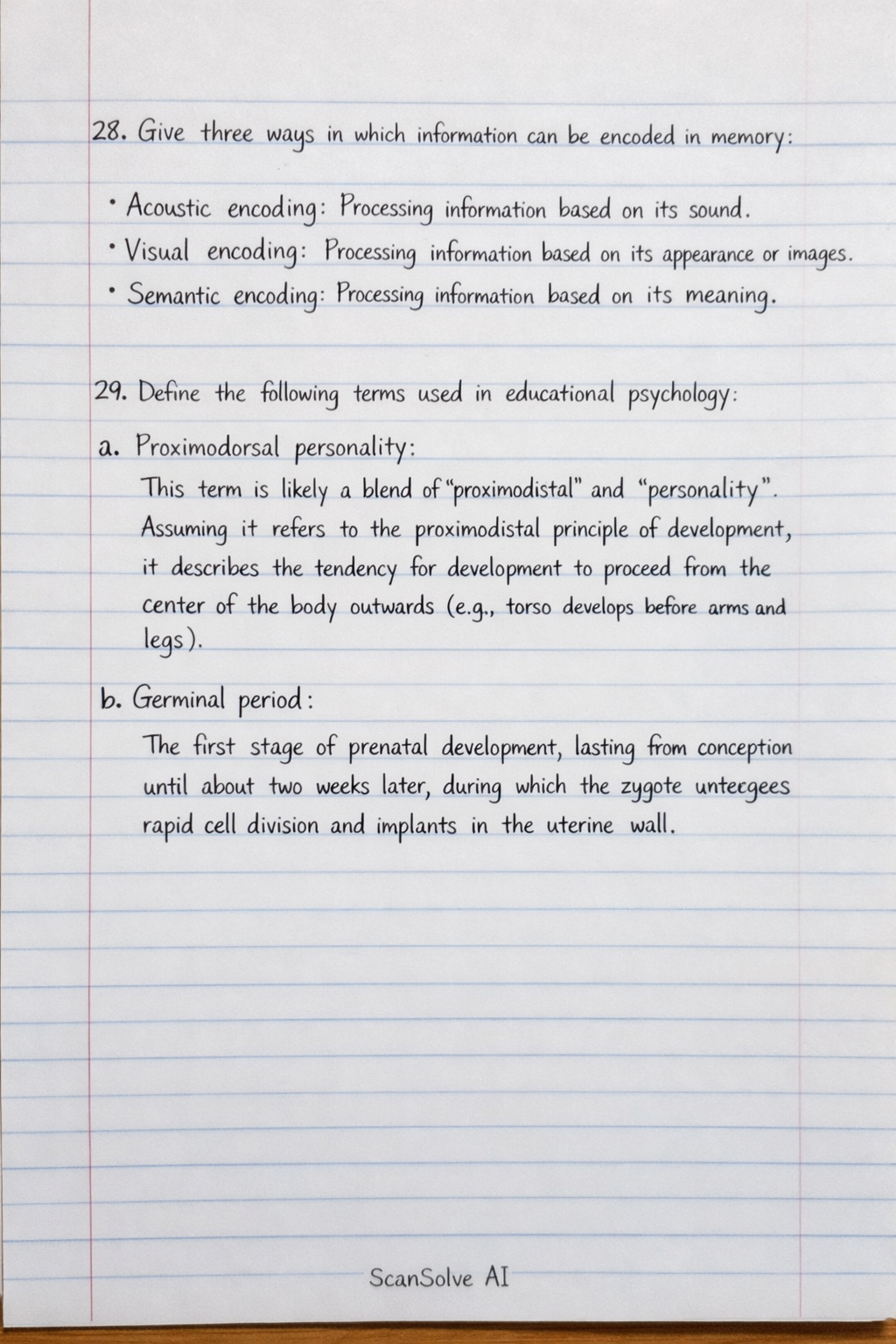
28. Give out three ways in which information can be encoded in the memory
Three ways information can be encoded in memory are:
- Acoustic encoding: Processing information based on its sound.
- Visual encoding: Processing information based on its appearance or images.
- Semantic encoding: Processing information based on its meaning.
29. Define the following terms used in educational psychology
- a. Proximodorsal personality: This term appears to be a combination of "proximodistal" (a developmental principle) and "personality." Assuming it refers to the proximodistal principle of development, it describes the tendency for development to proceed from the center of the body outwards (e.g., torso develops before arms and legs).
- b. Germinal period: This is the first stage of prenatal development, lasting from conception until about two weeks later, during which the zygote undergoes rapid cell division and implants itself in the uterine wall.
- c. Inductive learning: This is a learning approach where students discover rules and principles by observing and analyzing specific examples, rather than being explicitly taught the rules first.
- d. Psychomotor domain: This domain of learning, according to Bloom's Taxonomy, involves physical movement, coordination, and the use of motor skills. It focuses on the development of physical abilities and dexterity.
30. State four (4) possible characteristics of extraversion
Four possible characteristics of extraversion are:
- Sociable
- Outgoing
- Assertive
- Energetic
31. Differentiate pre operational stage from formal stage. Use four (4) points
Here are four points differentiating the pre-operational stage from the formal operational stage:
- Age range: Pre-operational (2-7 years) vs. Formal operational (11 years and up).
- Thought process: Pre-operational thought is largely egocentric, while formal operational thought is decentered and considers multiple perspectives.
- Reasoning: Pre-operational children struggle with logical reasoning and rely on intuition, whereas formal operational thinkers use hypothetical-deductive reasoning.
- Abstract thinking: Pre-operational children think concretely, while formal operational individuals can engage in abstract thought and consider possibilities beyond reality.
32. Give four (4) usefulness of learning theories in classroom situation
Four usefulness of learning theories in a classroom situation are:
- Guiding instructional design: They help teachers structure lessons and activities effectively.
- Explaining student behavior: They provide insights into why students act and react in certain ways.
- Developing effective teaching strategies: They inform the selection of methods to promote engagement and understanding.
- Assessing learning outcomes: They help teachers evaluate what and how students have learned.
33. Why professional teacher should to learn child study. Give four (4) points
A professional teacher should learn child study for these four reasons:
- Tailor instruction: To adapt teaching methods and materials to the specific developmental levels and needs of students.
- Identify learning difficulties: To recognize early signs of developmental delays or learning challenges and provide appropriate support.
- Create supportive environments: To foster a classroom atmosphere that is conducive to the social, emotional, and cognitive growth of children.
- Understand individual differences: To appreciate the unique strengths, weaknesses, and backgrounds of each student, promoting inclusive education.
34. Identify four (4) types of attention as psychological process
Four types of attention as a psychological process are:
- Sustained attention: The ability to maintain focus on a task over a prolonged period.
- Selective attention: The ability to focus on relevant stimuli while ignoring distractions.
- Divided attention: The ability to attend to and process multiple tasks or stimuli simultaneously.
- Alternating attention: The ability to shift focus between different tasks or stimuli.
35. Briefly explain four (4) areas of personal development.
Four areas of personal development are:
- Physical development: Focuses on improving health, fitness, and bodily well-being.
- Intellectual development: Involves enhancing knowledge, critical thinking, problem-solving, and learning abilities.
- Emotional development: Concerns understanding and managing one's own emotions, as well as developing empathy for others.
- Social development: Relates to improving interpersonal skills, building relationships, and effectively interacting with others.
36. As a teacher how you can develop a child who is in second stage of autonomy and shame/doubt according to Erickson. Use four points.
To develop a child in Erikson's second stage (Autonomy vs. Shame and Doubt, 18 months - 3 years), a teacher can:
- Allow choices: Offer limited, age-appropriate choices to foster a sense of control and independence.
- Encourage independence: Provide opportunities for children to perform tasks themselves, such as dressing or cleaning up, with minimal assistance.
- Provide support for mistakes: Create a safe environment where children can try new things and make mistakes without fear of excessive criticism or ridicule.
- Set clear boundaries: Establish consistent rules and limits to provide a sense of security while still allowing for exploration within safe parameters.
37. Mention four (4) principles of classical conditioning theory.
Four principles of classical conditioning theory are:
- Acquisition: The initial stage where a neutral stimulus becomes associated with an unconditioned stimulus, leading to a conditioned response.
- Extinction: The gradual weakening and disappearance of a conditioned response when the conditioned stimulus is repeatedly presented without the unconditioned stimulus.
- Generalization: The tendency for stimuli similar to the conditioned stimulus to elicit the conditioned response.
- Discrimination: The ability to distinguish between the conditioned stimulus and other similar stimuli that do not signal an unconditioned stimulus.
38. List down four (4) impacts of punishment on learning to student's good performance. Use four (4) points
Four potential negative impacts of punishment on a student's good performance are:
- Increased anxiety and fear: Punishment can create a stressful learning environment, leading to anxiety that hinders cognitive processing and performance.
- Avoidance of learning situations: Students may try to avoid the teacher, subject, or classroom where punishment occurs, rather than engaging with the material.
- Damaged teacher-student relationship: Frequent punishment can erode trust and rapport, making students less receptive to instruction and guidance.
- Does not teach desired behavior: Punishment only suppresses undesirable behavior; it does not explicitly teach or reinforce the appropriate alternative behaviors.
39. "Human being build their moral behavior according to environment". Use five (5) ways that will be used to enhancing morality among the learners.
Five ways to enhance morality among learners, acknowledging environmental influence, are:
- Role modeling: Teachers and adults demonstrating ethical behavior and values consistently.
- Moral discussions: Engaging students in conversations about ethical dilemmas to develop their reasoning and perspective-taking skills.
- Consequences for actions: Implementing fair and consistent consequences for misbehavior, focusing on restitution and understanding impact.
- Empathy development: Designing activities that encourage students to understand and share the feelings of others.
- Creating a just classroom environment: Establishing clear rules and expectations that promote fairness, respect, and responsibility among all students.
40. Briefly explain five (5) criticisms of behaviorism theory of learning
Five criticisms of behaviorism theory of learning are:
- Ignores mental processes: It largely disregards internal cognitive processes such as thoughts, feelings, and motivations, focusing solely on observable behavior.
- Reductionist: It simplifies complex human learning and behavior to simple stimulus-response associations, overlooking the richness of human experience.
- Ethical concerns: Early behaviorist experiments, particularly with animals, raised ethical questions about control and manipulation.
- Limited explanation for complex behaviors: It struggles to adequately explain higher-order cognitive functions like language acquisition, creativity, or abstract reasoning.
- Doesn't account for free will: By emphasizing environmental determinism, it often overlooks the role of individual choice, intention, and self-direction in learning.
Still stuck on this one?
Ask a follow-up, and the answer starts from this question.
More Psychology Questions
Handwritten Step-by-Step Solution
Get this as a handwritten image on WhatsApp — like a tutor wrote it for you.
Try on WhatsApp