
We read your photo as:
A) Meditation is one of the body-mind medicine use in managing various health conditions. State SIX (6) examples of this health conditions. b) Identify NINE (9) benefits of meditation. c) Describe THR
ScanSolve AI Answer
QUESTION ONE
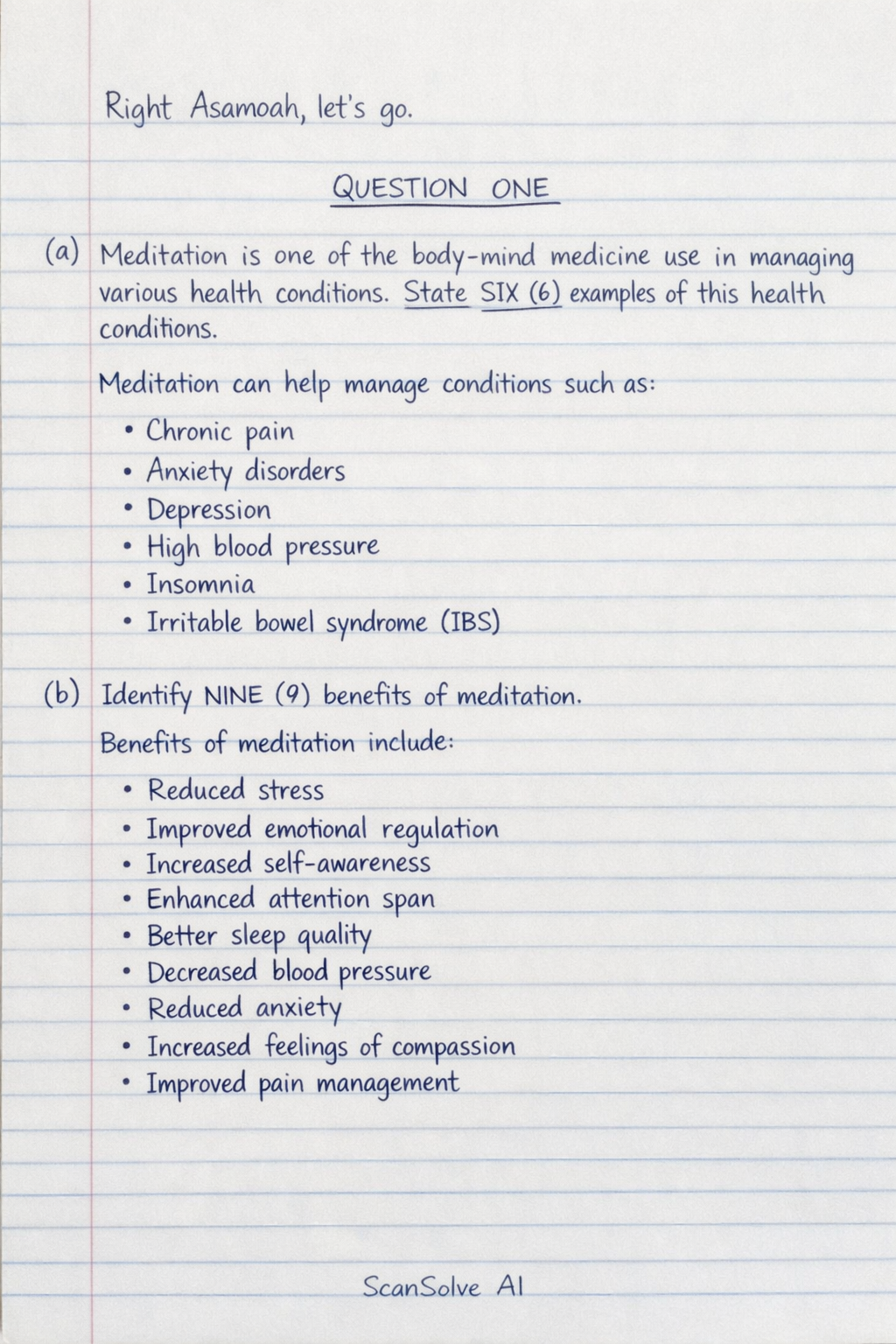
a) Meditation is one of the body-mind medicine use in managing various health conditions. State SIX (6) examples of this health conditions.*
Meditation can help manage conditions such as:
- Chronic pain
- Anxiety disorders
- Depression
- High blood pressure
- Insomnia
- Irritable bowel syndrome (IBS)
b) Identify NINE (9) benefits of meditation.*
Benefits of meditation include:
- Reduced stress
- Improved emotional regulation
- Increased self-awareness
- Enhanced attention span
- Better sleep quality
- Decreased blood pressure
- Reduced anxiety
- Increased feelings of compassion
- Improved pain management
c) Describe THREE (3) applications of biofeedback.*
Biofeedback is used to help individuals gain voluntary control over involuntary bodily functions.
- Stress and Anxiety Management: Patients learn to control physiological responses like heart rate, muscle tension, and skin temperature to reduce stress and anxiety symptoms.
- Chronic Pain Relief: It helps individuals manage pain by teaching them to relax muscles and reduce tension in affected areas, often used for headaches or back pain.
- Urinary Incontinence: Biofeedback can strengthen pelvic floor muscles, helping individuals regain control over bladder function.
d) According to ayurvedic medicine, FIVE (5) elements make up the universe. What are these elements?*
The five elements in Ayurvedic medicine are:
- Earth (Prithvi)
- Water (Jala)
- Fire (Agni)
- Air (Vayu)
- Space/Ether (Akasha)
QUESTION TWO
a) Describe the homeopathic treatment process.*
Homeopathic treatment involves a detailed consultation to understand the patient's complete physical, mental, and emotional state. A highly diluted substance, chosen based on the principle of "like cures like," is then prescribed. The aim is to stimulate the body's natural healing response, with remedies often prepared through a process of serial dilution and succussion (vigorous shaking).
b) The five (5) elements of ayurveda combined to form the three doshas. What are these doshas?*
The three doshas formed from the five elements are:
- Vata (Air and Space)
- Pitta (Fire and Water)
- Kapha (Earth and Water)
c) Name the FOUR (4) types of evidence commonly cited to support the safety or efficacy of dietary supplements.*
The four types of evidence commonly cited are:
- Clinical trials (randomized controlled trials)
- Observational studies (cohort studies, case-control studies)
- Epidemiological data
- Traditional use and historical evidence
d) State THREE (3) risks associated with chelation therapy.*
Risks associated with chelation therapy include:
- Kidney damage
- Electrolyte imbalances (e.g., low calcium)
- Allergic reactions
e) Briefly explain the term "acupuncture".*
Acupuncture is a traditional Chinese medicine technique that involves inserting thin needles into specific points on the body. It is believed to stimulate the body's energy flow (Qi) to restore balance and promote healing.
f) What SIX (6) conditions can be managed through acupuncture?*
Acupuncture can help manage conditions such as:
- Chronic pain (e.g., back pain, neck pain)
- Headaches and migraines
- Osteoarthritis
- Nausea and vomiting (e.g., chemotherapy-induced)
- Allergies
- Anxiety and depression
Still stuck on this one?
Ask a follow-up, and the answer starts from this question.
More Psychology Questions
Handwritten Step-by-Step Solution
Get this as a handwritten image on WhatsApp — like a tutor wrote it for you.
Try on WhatsApp