

This psychology problem is solved step by step below, with detailed explanations to help you understand the method and arrive at the correct answer.
ScanSolve AI Answer
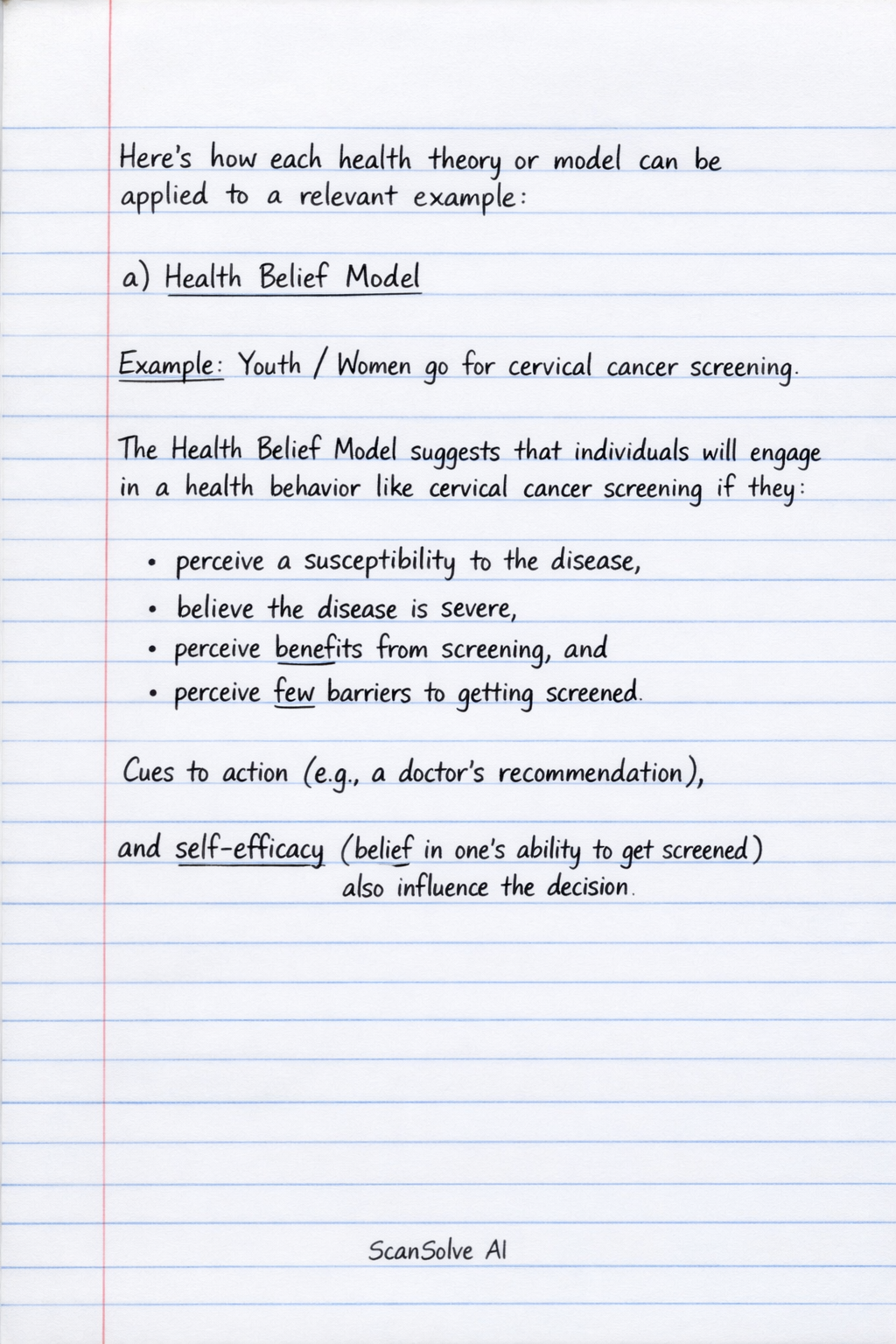
Here's how each health theory or model can be applied to a relevant example: a) Health Belief Model Example: 2) Youth/Women go for cervical cancer screening.* Explanation: The Health Belief Model suggests that individuals will engage in a health behavior like cervical cancer screening if they perceive a susceptibility to the disease, believe the disease is severe, perceive benefits from screening, and perceive few barriers to getting screened. Cues to action (e.g., a doctor's recommendation) and self-efficacy* (belief in one's ability to get screened) also influence the decision. b) Theory of Reasoned Action (or Theory of Planned Behavior) Example: 6) Adherence to HIV medication.* Explanation: This theory posits that a person's behavioral intention is the primary predictor of behavior. For HIV medication adherence, intention is shaped by the individual's attitude towards taking the medication (e.g., believing it's beneficial) and subjective norms (e.g., perceived social pressure or support from family or healthcare providers). The Theory of Planned Behavior adds perceived behavioral control* (belief in one's ability to adhere consistently). c) Social Cognitive Theory Example: 4) Youth stop alcohol abuse.* Explanation: Social Cognitive Theory explains that behavior change is influenced by the interaction between personal factors, environmental factors, and behavior itself (reciprocal determinism). Youth may stop alcohol abuse if they have high self-efficacy (belief in their ability to quit), observe positive outcomes in others who have stopped (observational learning), and anticipate positive outcome expectations* for themselves. d) Social Learning Theory Example: 5) Young men stop smoking.* Explanation: Social Learning Theory emphasizes that individuals learn behaviors through observation, imitation, and modeling*. Young men might stop smoking by observing peers or role models who have successfully quit, seeing the positive consequences of quitting, or being influenced by social norms that discourage smoking. e) Diffusion of Innovation Theory Example: 1) Mothers delivers at health facility.* Explanation: This theory describes how new ideas or practices (innovations) spread through a population. Delivering at a health facility can be considered an innovation. Its adoption depends on factors like its relative advantage (safer birth), compatibility with cultural values, complexity, trialability, and observability*. The spread is influenced by different adopter categories (e.g., early adopters) and communication channels. f) Social Ecological Model Example: 3) Women between age 25-30 go for breast cancer screening.* Explanation: The Social Ecological Model views health behavior as influenced by multiple levels of interaction. For breast cancer screening, this includes individual factors (knowledge, beliefs), interpersonal factors (family support, peer influence), organizational factors (workplace policies, clinic availability), community factors (local campaigns, cultural norms), and public policy* (national screening guidelines, insurance coverage). Send me the next one 📸