
We read your photo as:
Explain the different types of misconceptions with examples.
ScanSolve AI Answer
Here are the explanations for the types of misconceptions:
-
i. Factual misconceptions: These are incorrect beliefs about specific facts or pieces of information. They often arise from misinformation or misremembering details. For example, believing that the sun revolves around the Earth.
-
ii. Preconceived notions: These are ideas or opinions formed before having complete evidence or knowledge. They are often based on prior experiences, cultural beliefs, or informal observations and can be resistant to change. For example, thinking all heavy objects sink.
-
iii. Conceptual misconceptions: These are fundamental misunderstandings of core scientific concepts or principles. They involve flawed mental models that lead to incorrect interpretations of phenomena. For example, believing that electricity is "used up" in a circuit.
-
iv. Vernacular misconceptions: These arise from the use of everyday language that differs from scientific terminology, leading to confusion. Common words used in a scientific context can have different meanings in daily life. For example, using "force" and "power" interchangeably.
-
v. Non-scientific beliefs: These are beliefs that are not based on scientific evidence or methods, often stemming from tradition, superstition, or personal anecdotes. They are outside the realm of scientific inquiry. For example, believing in astrology or lucky charms.
Still stuck on this one?
Ask a follow-up, and the answer starts from this question.
More Psychology Questions
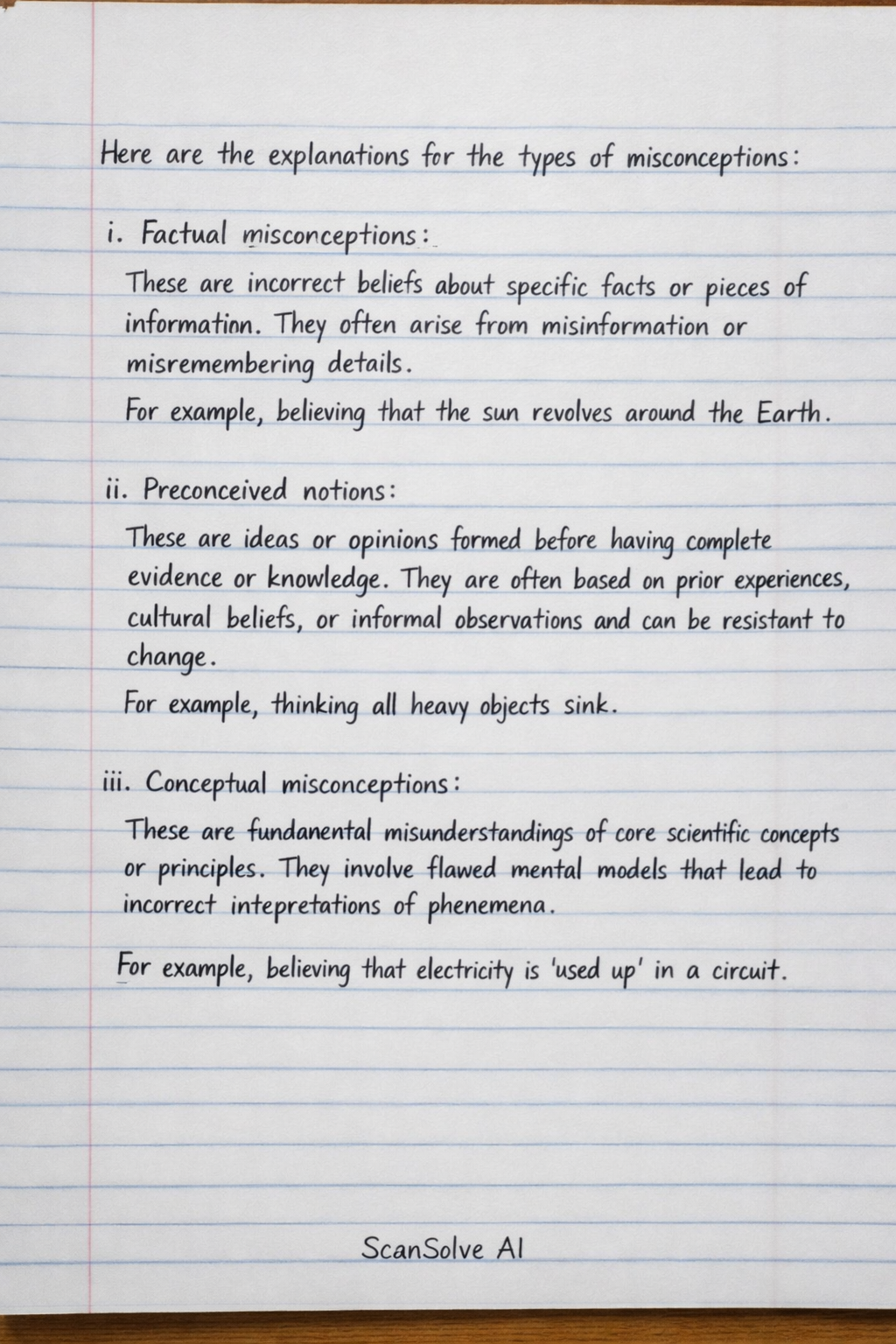
Handwritten Step-by-Step Solution
Get this as a handwritten image on WhatsApp — like a tutor wrote it for you.
Try on WhatsApp