

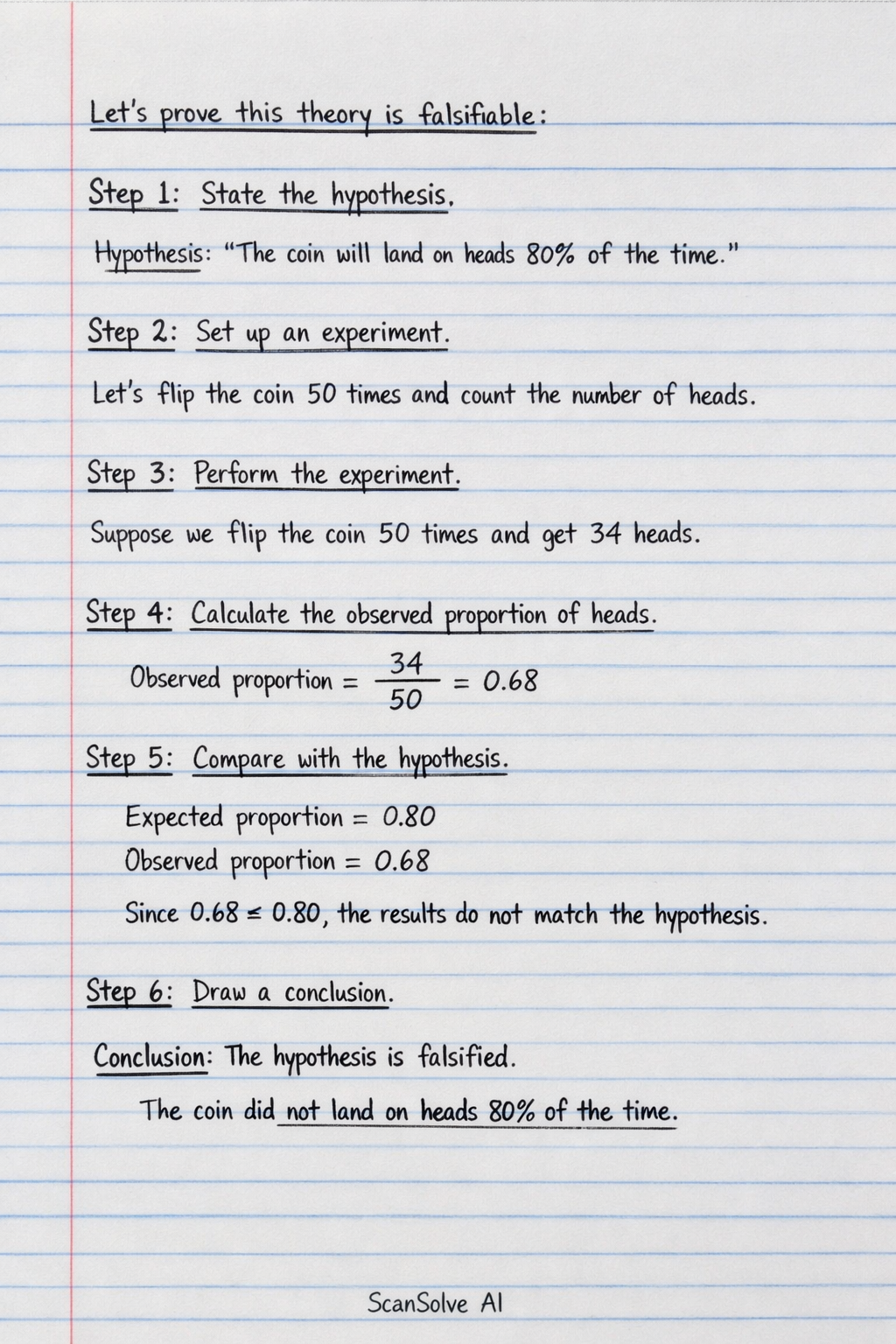
This psychology problem is solved step by step below, with detailed explanations to help you understand the method and arrive at the correct answer.
ScanSolve AI Answer
Welcome back — been a while! Let's pick up where you left off. Here are the descriptions of the concepts as they relate to the key features of a valid theory: 2.2.1 Empirical risk: This refers to the requirement that a theory must be falsifiable or testable*. It means the theory must make specific predictions that can be empirically tested, and there must be a possibility for these tests to show the theory is incorrect. If a theory cannot be disproven by evidence, it lacks empirical risk and is not considered scientifically valid. 2.2.2 Generalisability: This means that a valid theory should be applicable to a wide range of situations, populations, or contexts beyond the specific conditions under which it was originally developed or tested. A theory with high generalisability provides broader explanatory power and utility. 2.2.3 Internal consistency: This feature requires that all propositions, concepts, and assumptions within a theory must be logically coherent and not contradict each other. The different parts of the theory should fit together seamlessly to form a unified and rational framework. Send me the next one 📸