
We read your photo as:
Explain factors that influence intrinsic motivation and the essential role of educational psychology, guidance, and counseling in college.
ScanSolve AI Answer
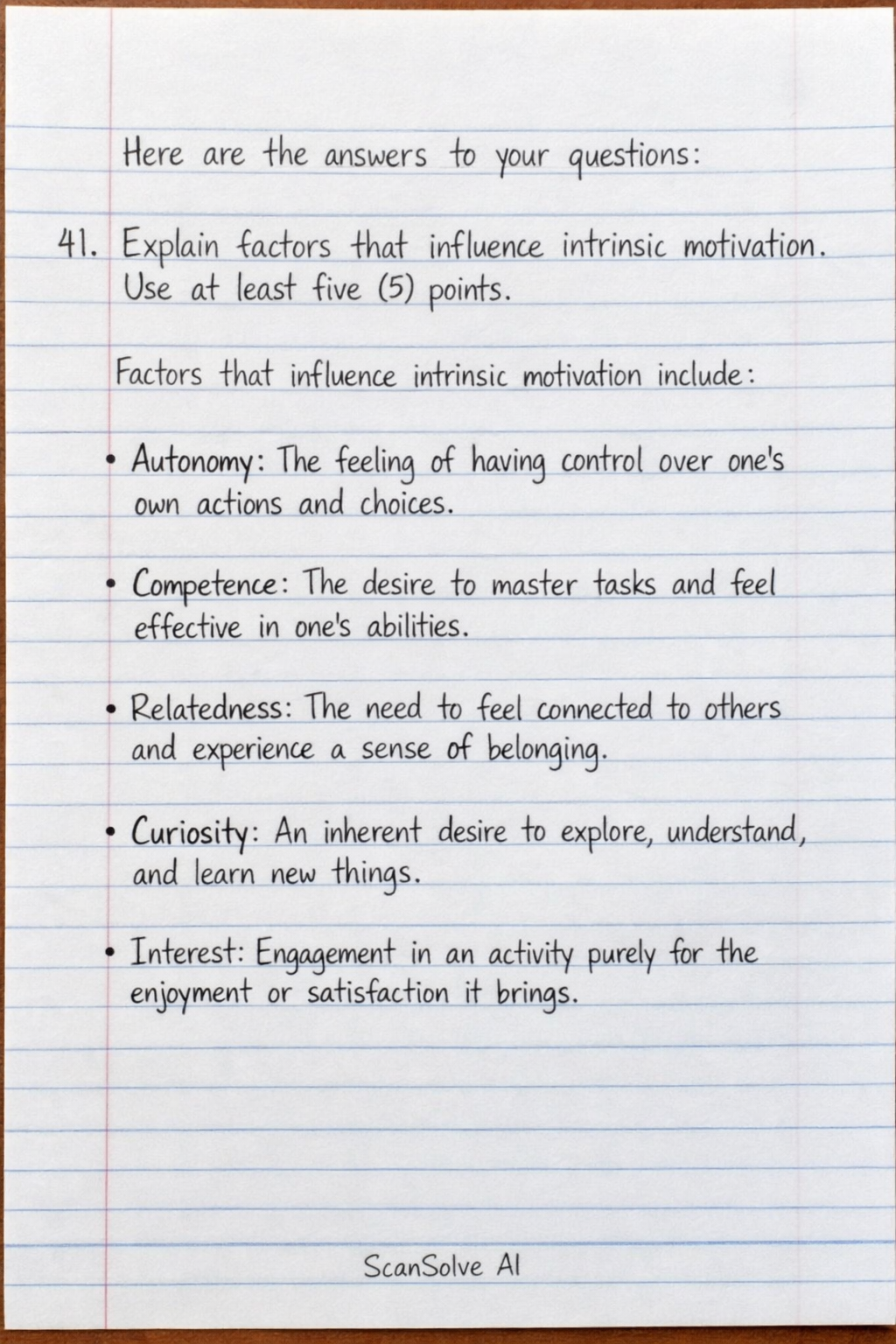
Here are the answers to your questions:
41. Explain factors that influence intrinsic motivation. Use at least five (5) points.
Factors that influence intrinsic motivation include:
- Autonomy: The feeling of having control over one's own actions and choices.
- Competence: The desire to master tasks and feel effective in one's abilities.
- Relatedness: The need to feel connected to others and experience a sense of belonging.
- Curiosity: An inherent desire to explore, understand, and learn new things.
- Interest: Engagement in an activity purely for the enjoyment or satisfaction it brings.
42. By using your different experience comment how far education psychology, guidance and counseling is essential to teacher student in college. Use five (5) points to justify the statements.
Educational psychology, guidance, and counseling are essential for college teachers and students because:
- Understanding learning processes: Educational psychology helps teachers understand how students learn, enabling them to design more effective instructional strategies.
- Addressing diverse needs: It equips teachers to identify and cater to the varied learning styles, cognitive abilities, and emotional needs of college students.
- Promoting student well-being: Guidance and counseling services provide students with support for academic, personal, and career challenges, reducing stress and improving mental health.
- Enhancing academic performance: By addressing psychological barriers to learning and providing academic support, these services help students improve their grades and retention.
- Fostering personal growth: They assist students in developing self-awareness, decision-making skills, and resilience, which are crucial for success beyond college.
43. Differentiate between psychology and educational psychology.
- Psychology is the broad scientific study of mind and behavior, encompassing all aspects of human and animal experience.
- Educational psychology is a specialized branch of psychology that focuses specifically on how humans learn in educational settings, the effectiveness of educational interventions, the psychology of teaching, and the social psychology of schools.
44. Explain factors that influence intrinsic and extrinsic motivation. Use three factors to each.
Factors influencing motivation:
- Intrinsic Motivation:
- Personal interest: Enjoyment derived from the activity itself.
- Sense of accomplishment: Feeling of mastery and achievement.
- Curiosity: Desire to explore and understand.
- Extrinsic Motivation:
- Rewards: Tangible incentives like grades, money, or prizes.
- Punishment avoidance: Performing tasks to avoid negative consequences.
- Social recognition: Desire for praise, approval, or status from others.
45. Analyse six ways where motivation might be useful in the classroom.
Motivation is useful in the classroom in these six ways:
- Increases engagement: Motivated students are more likely to participate actively in lessons and discussions.
- Enhances persistence: It helps students persevere through challenging tasks and overcome obstacles.
- Improves learning outcomes: Higher motivation often correlates with deeper understanding and better academic performance.
- Fosters self-regulation: Students learn to set goals, monitor their progress, and manage their own learning.
- Promotes positive behavior: Motivated students are less likely to engage in disruptive behaviors and more likely to follow classroom rules.
- Stimulates creativity: When intrinsically motivated, students are more inclined to think innovatively and explore new ideas.
46. Discuss six factors that flourish remembering to the learners.
Six factors that enhance remembering for learners are:
- Meaningfulness: Information that is personally relevant or connected to existing knowledge is easier to remember.
- Elaboration: Actively processing information by linking it to other concepts, examples, or experiences.
- Organization: Structuring information logically (e.g., using outlines, categories) makes it more retrievable.
- Repetition/Rehearsal: Repeated exposure to information, especially through spaced practice, strengthens memory traces.
- Retrieval practice: Actively testing oneself on material (e.g., flashcards, practice tests) improves recall.
- Emotional connection: Information associated with strong emotions tends to be remembered more vividly.
47. Explain how overt and covert behavior undermines student's performance. Use five (5) points to justify the statement.
Overt behavior refers to observable actions, while covert behavior refers to unobservable mental processes like thoughts and feelings. Both can undermine student performance:
- Overt: Disruptive actions: Behaviors like talking out of turn or fidgeting distract the student and others, hindering focus.
- Overt: Procrastination: Visible delays in starting or completing tasks lead to rushed work and missed deadlines.
- Covert: Negative self-talk: Internal thoughts like "I can't do this" erode confidence and reduce effort.
- Covert: Anxiety/Stress: Internal feelings of worry can impair concentration, memory retrieval, and test performance.
- Covert: Lack of metacognition: Not actively monitoring one's own understanding or learning strategies leads to inefficient study habits.
48. Analyze five (5) areas of personal development.
Five areas of personal development are:
- Physical development: Focuses on improving health, fitness, and bodily well-being.
- Intellectual development: Involves enhancing knowledge, critical thinking, problem-solving, and learning abilities.
- Emotional development: Concerns understanding and managing one's own emotions, as well as developing empathy for others.
- Social development: Relates to improving interpersonal skills, building relationships, and effectively interacting with others.
- Spiritual development: Involves exploring one's values, purpose, and sense of meaning in life.
49. Define memory encoding. b. Give three (3) main ways of encoding memory.
- a. Memory encoding: This is the initial process of transforming sensory information into a form that can be stored in memory.
- b. Three main ways of encoding memory:
- Acoustic encoding: Processing information based on its sound.
- Visual encoding: Processing information based on its appearance or images.
- Semantic encoding: Processing information based on its meaning.
50. List down four (4) stages of personal development in learning.
Four stages of personal development relevant to learning are:
- Infancy (0-1 year): Focus on basic trust, sensory exploration, and motor skill development.
- Early Childhood (1-6 years): Development of autonomy, initiative, language, and pre-operational thought.
- Middle Childhood (6-11 years): Growth of competence, industry, logical thinking, and social skills.
- Adolescence (12-18 years): Formation of identity, abstract reasoning, and moral development.
51. Briefly explain the types of giftedness.
Giftedness refers to individuals who demonstrate outstanding aptitude or competence in one or more domains. Types often include:
- Intellectual giftedness: High general intelligence, strong academic abilities, and advanced reasoning skills.
- Creative giftedness: Exceptional ability to generate novel ideas, think divergently, and produce original works.
- Artistic giftedness: Outstanding talent in visual arts, music, drama, or dance.
- Leadership giftedness: Exceptional ability to influence, motivate, and guide others.
- Psychomotor giftedness: Superior physical coordination, athletic prowess, or mechanical aptitude.
52. Differentiate between oral stage and anal stage as proposed by Sigmund Freud. Use two (2) points.
- Erogenous Zone: In the oral stage, pleasure is centered on the mouth (sucking, biting), while in the anal stage, pleasure is focused on the anus (bowel and bladder control).
- Developmental Task: The oral stage involves developing trust and dependency, whereas the anal stage is crucial for developing autonomy and self-control through toilet training.
53. Write four (4) sources of diversity in learning.
Four sources of diversity in learning are:
- Socioeconomic background: Differences in resources, experiences, and home environments.
- Cultural background: Variations in values, communication styles, and prior knowledge.
- Learning styles/preferences: Individual differences in how students best process and retain information.
- Cognitive abilities: Variations in intelligence, processing speed, memory, and problem-solving skills.
54. Mention down four (4) features of social quotient.
Four features of social quotient (SQ) are:
- Empathy: The ability to understand and share the feelings of others.
- Social skills: Proficiency in interacting effectively with others, including communication and conflict resolution.
- Social awareness: The capacity to understand social cues, norms, and dynamics.
- Relationship management: The ability to build and maintain healthy relationships.
55. Briefly explain the categories of attentions as identified by psychologists.
Categories of attention include:
- Sustained attention: The ability to maintain focus on a task over a prolonged period.
- Selective attention: The ability to focus on relevant stimuli while ignoring distractions.
- Divided attention: The ability to attend to and process multiple tasks or stimuli simultaneously.
- Alternating attention: The ability to shift focus between different tasks or stimuli.
56. In affective domain of learning there is an organizing level that is used conceptualize values into hierarchy. List down four (4) key words used in this category.
The "Organization" level in the affective domain involves conceptualizing values into a hierarchy. Four key words used in this category are:
- Prioritizing
- Synthesizing
- Comparing
- Relating
57. Frontal parts acts as a lobe of the brain and play great role in human activity. Give four (4) executive functions of this part.
Four executive functions of the frontal lobe are:
- Planning and decision-making: Formulating strategies and making choices.
- Working memory: Holding and manipulating information temporarily.
- Problem-solving: Analyzing situations and finding solutions.
- Impulse control: Regulating behavior and inhibiting inappropriate responses.
58. Outline four (4) periods of child development.
Four periods of child development are:
- Prenatal Period: From conception to birth.
- Infancy and Toddlerhood: From birth to approximately 2 years.
- Early Childhood: From approximately 2 to 6 years.
- Middle Childhood: From approximately 6 to 11 years.
Still stuck on this one?
Ask a follow-up, and the answer starts from this question.
More Psychology Questions
Handwritten Step-by-Step Solution
Get this as a handwritten image on WhatsApp — like a tutor wrote it for you.
Try on WhatsApp