
We read your photo as:
Define the following terms. According to Freud, personality is composed of three interacting structures, name them. Explain four applications of classical conditioning in a classroom. Justify that all
ScanSolve AI Answer
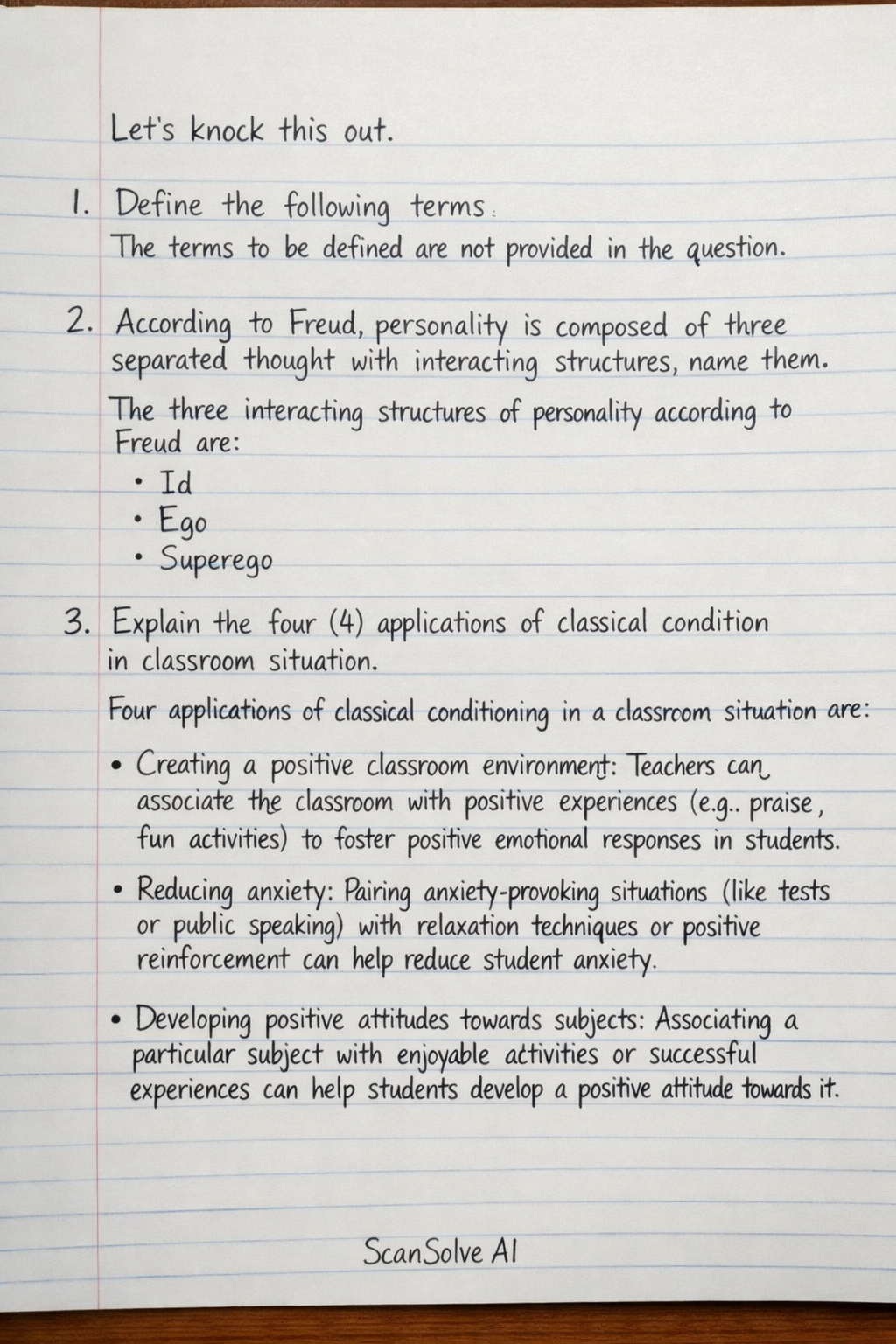
Let's knock this out.
1. Define the following terms
The terms to be defined are not provided in the question.
2. According to Freud, personality is composed of three separated thought with interacting structures, name them
The three interacting structures of personality according to Freud are:
- Id
- Ego
- Superego
3. Explain the four (4) applications of classical condition in classroom situation
Four applications of classical conditioning in a classroom situation are:
- Creating a positive classroom environment: Teachers can associate the classroom with positive experiences (e.g., praise, fun activities) to foster positive emotional responses in students.
- Reducing anxiety: Pairing anxiety-provoking situations (like tests or public speaking) with relaxation techniques or positive reinforcement can help reduce student anxiety.
- Developing positive attitudes towards subjects: Associating a particular subject with enjoyable activities or successful experiences can help students develop a positive attitude towards it.
- Managing disruptive behavior: Using specific cues or signals consistently to indicate desired behavior can help students associate the cue with the appropriate action, reducing disruptive behavior.
4. All human being created with sense of forget. Justify by using four (4) Factors that lead a person to forget.
Forgetting is a natural process influenced by several factors:
- Decay theory: Memory traces fade over time if they are not rehearsed or retrieved, leading to forgetting.
- Interference theory: New information (retroactive interference) or old information (proactive interference) can block or distort the retrieval of specific memories.
- Retrieval failure: The information is stored in long-term memory but cannot be accessed due to a lack of appropriate cues or prompts.
- Motivated forgetting (Repression): Individuals may unconsciously block out traumatic or unpleasant memories as a defense mechanism.
5. Punishment in school setting always create enmity between teachers and students. List down four (4) criterion for considering on taking punishment for students who condemned with misbehavior
Four criteria for considering punishment for student misbehavior are:
- Severity of the misbehavior: The punishment should be proportionate to the seriousness of the offense.
- Intent of the student: Consider whether the misbehavior was accidental, negligent, or deliberate.
- Student's history of misbehavior: A student's past record of behavior can influence the type and severity of punishment.
- Impact on others: Assess how the misbehavior affected other students, the teacher, or the learning environment.
6. As you are professional teacher give a lesson how you will use an alternative punishment to punish students who have misbehaviour in your class. Use four (4) points
As a professional teacher, I would use alternative, constructive approaches to address misbehavior:
- Time-out: Temporarily remove the student from the reinforcing environment to a designated quiet space, allowing them to calm down and reflect.
- Loss of privileges: Temporarily revoke a desired privilege (e.g., recess time, computer access) that is related to the misbehavior.
- Restitution/Restorative justice: Have the student take responsibility for their actions by repairing any harm caused, such as cleaning up a mess or writing an apology.
- Behavior contracts: Work with the student to create a formal agreement outlining expected behaviors and mutually agreed-upon consequences and rewards.
7. Complete the sentences by writing only one or two words related to statements
- i. Is refers as increasing in complexity or change from simple to more complex and detailed level of function — Development
- ii. Is aspect of development that child develop thinking ability, problem solving, understanding and skills from birth to death — Cognitive development
- iii. Are mental frame work that guides our behavior and organize our knowledge — Schemas
- iv. People follow internalized principles of justice, even if they conflict with law and rules — Post-conventional morality
8. Mention four (4) significance of the theory of motivation of theory as proposed by Marslow in teaching and learning process.
Four significances of Maslow's Hierarchy of Needs in the teaching and learning process are:
- Understanding student needs: Teachers can identify and address unmet basic needs (e.g., hunger, safety, belonging) that may hinder a student's ability to learn.
- Creating a supportive environment: Ensuring students feel safe, accepted, and valued in the classroom is crucial for them to progress to higher-level learning.
- Fostering self-actualization: Teachers can design activities that encourage creativity, problem-solving, and personal growth, helping students reach their full potential.
- Motivating students: By understanding which needs are most salient for students, teachers can tailor motivational strategies to move beyond basic rewards towards intrinsic motivation and a love for learning.
9. List down four (4) application of cognitive domain on children performance
Four applications of the cognitive domain (based on Bloom's Taxonomy) on children's performance are:
- Knowledge: Children demonstrate knowledge by recalling facts, definitions, or basic concepts (e.g., naming colors or counting numbers).
- Comprehension: Children show comprehension by explaining ideas or concepts in their own words (e.g., summarizing a story or explaining a simple rule).
- Application: Children apply learned knowledge to new situations (e.g., using addition skills to solve a word problem or drawing a map of their neighborhood).
- Analysis: Children analyze information by breaking it down into parts and identifying relationships (e.g., comparing and contrasting two characters in a book or identifying cause and effect).
10. Some of students argued that " they study hard even though they failed to transfer knowledge. Give four (4) factors that effects transfer of learning in educational context.
Four factors that affect the transfer of learning in an educational context are:
- Similarity between learning and transfer contexts: The more similar the features, principles, or procedures between the original learning situation and the new situation, the easier the transfer.
- Meaningfulness of original learning: When students deeply understand the underlying principles and concepts, rather than just memorizing facts, they are more likely to apply that knowledge effectively.
- Practice with variety: Providing opportunities to apply learned concepts in diverse contexts and with varied examples helps students generalize their knowledge and skills.
- Metacognitive awareness: Students who are aware of their own learning processes and strategies, and understand how to transfer knowledge, are more successful at doing so.
11. Define the following terms:
- a. Explicit memory: This refers to conscious, intentional recollection of factual information, previous experiences, and concepts. It is also known as declarative memory and includes episodic memory (events) and semantic memory (facts).
- b. Learning theory: This is a set of principles and constructs that explain how individuals acquire, process, and retain information and skills during the learning process. It encompasses various perspectives such as behaviorism, cognitivism, and constructivism.
12. State the Thorndike's law of effect.
Thorndike's Law of Effect states that responses that produce a satisfying or pleasant effect in a particular situation are more likely to occur again in that situation, while responses that produce a discomforting or unpleasant effect are less likely to occur again.
Still stuck on this one?
Ask a follow-up, and the answer starts from this question.
More Psychology Questions
Handwritten Step-by-Step Solution
Get this as a handwritten image on WhatsApp — like a tutor wrote it for you.
Try on WhatsApp