
We read your photo as:
Explain Freud's Psychosexual Developmental Theory and how fixation at each stage can affect adult personality.
ScanSolve AI Answer
Thank you for providing the full image. Here are the answers to the remaining questions:
QUESTION 1: On Personality and Attachment Theory
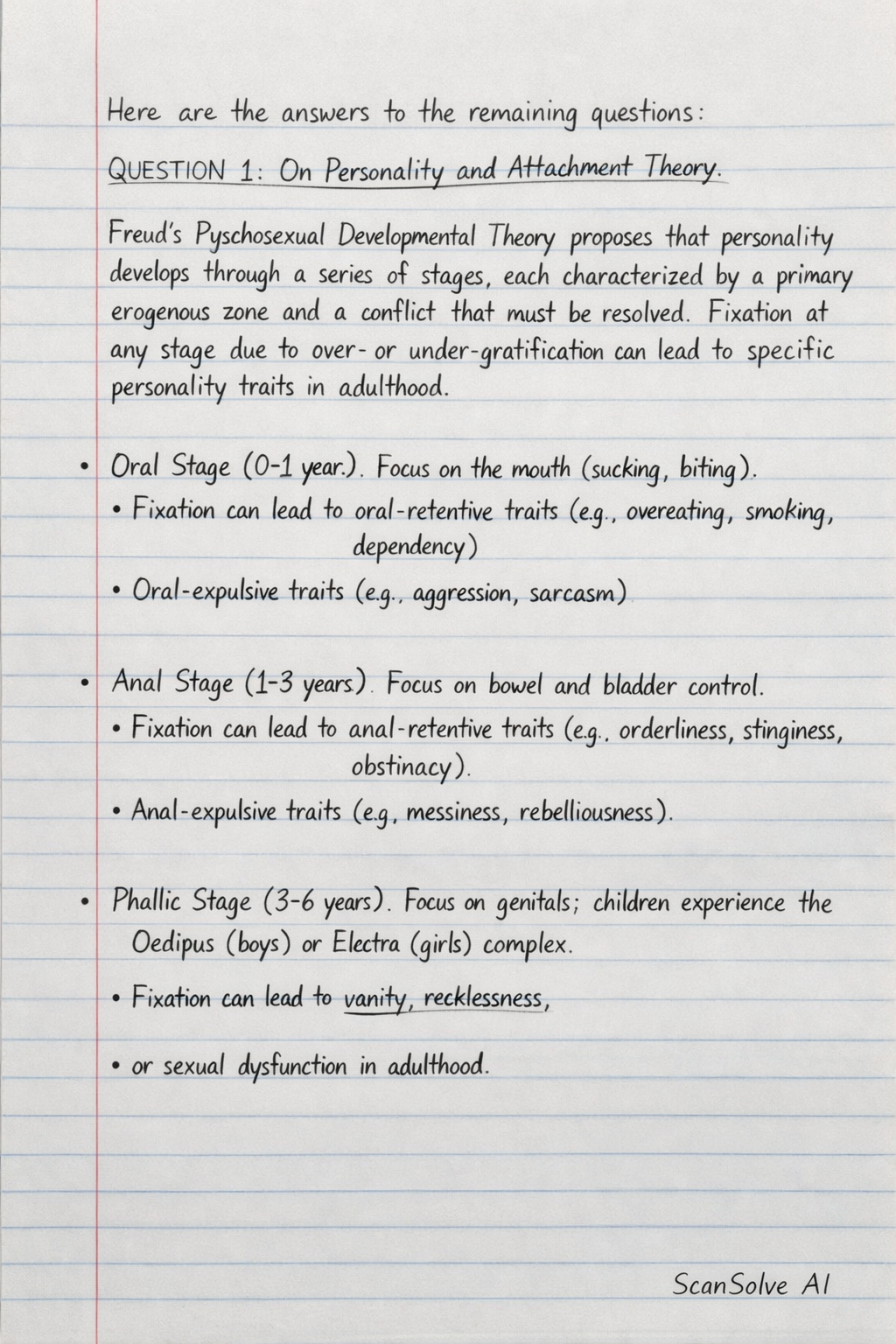
b) Freud's Psychosexual Developmental Theory proposes that personality develops through a series of stages, each characterized by a primary erogenous zone and a conflict that must be resolved. Fixation at any stage due to over- or under-gratification can lead to specific personality traits in adulthood.
- Oral Stage (0-1 year): Focus on the mouth (sucking, biting). Fixation can lead to oral-retentive traits (e.g., overeating, smoking, dependency) or oral-expulsive traits (e.g., aggression, sarcasm).
- Anal Stage (1-3 years): Focus on bowel and bladder control. Fixation can lead to anal-retentive traits (e.g., orderliness, stinginess, obstinacy) or anal-expulsive traits (e.g., messiness, rebelliousness).
- Phallic Stage (3-6 years): Focus on genitals; children experience the Oedipus (boys) or Electra (girls) complex. Fixation can lead to vanity, recklessness, or sexual dysfunction in adulthood.
- Latency Stage (6 years to puberty): Sexual urges are repressed, and energy is directed towards social and intellectual development. No significant fixations occur here.
- Genital Stage (puberty onwards): Maturation of sexual interests and establishment of mature, adult relationships. Successful navigation leads to a well-adjusted personality.
d) The types of attachment, primarily identified by Mary Ainsworth's "Strange Situation" study, describe patterns of how infants interact with their caregivers and react to separation and reunion. These patterns form internal working models that influence adult relationships:
- Secure Attachment: Infants are distressed when the caregiver leaves but are easily comforted upon their return. In adulthood, this often translates to comfortable intimacy, trust, and independence in relationships.
- Anxious-Ambivalent (Preoccupied) Attachment: Infants are highly distressed when the caregiver leaves and are not easily comforted upon return, often showing both clinginess and resistance. Adults with this style may be overly dependent, crave intimacy, and worry about their partner's love.
- Anxious-Avoidant (Dismissing) Attachment: Infants show little distress when the caregiver leaves and avoid them upon return. Adults with this style tend to be uncomfortable with intimacy, highly independent, and may suppress emotions.
- Disorganized-Disoriented Attachment: Infants show inconsistent and often contradictory behaviors (e.g., approaching the caregiver while looking away). This is often linked to frightening or inconsistent parenting. In adulthood, this can manifest as fear of intimacy, chaotic relationships, and difficulty regulating emotions.
QUESTION 2: On the Concept of Attitude and Social Behaviour
b) Attitudes significantly influence social behavior through several mechanisms:
- i. Persuasion and attitude change: Persuasion is the process of changing an attitude through communication. Factors like the source (credibility, attractiveness), message (logic, emotional appeal), and audience (intelligence, self-esteem) influence how effectively an attitude can be changed, thereby altering subsequent behavior. For example, a credible advertisement (source) with strong arguments (message) can persuade someone to buy a product (behavior).
- ii. Cognitive dissonance: This is the psychological discomfort experienced when an individual holds two or more conflicting cognitions (beliefs, attitudes, or behaviors). To reduce this unpleasant state, people are motivated to change one of their attitudes or behaviors to align with the other. For instance, if someone believes smoking is bad (cognition 1) but continues to smoke (behavior), they might reduce dissonance by changing their attitude to "smoking isn't that bad" or "I'll quit soon."
- iii. Social influence: Attitudes can be shaped and expressed through social influence, which refers to the ways in which individuals change their behavior to meet the demands of a social environment. This includes conformity (adjusting attitudes to fit group norms), compliance (agreeing to a request), and obedience (following direct orders). For example, a person might adopt a positive attitude towards a political candidate because their social group strongly supports that candidate.
Still stuck on this one?
Ask a follow-up, and the answer starts from this question.
More Psychology Questions
Handwritten Step-by-Step Solution
Get this as a handwritten image on WhatsApp — like a tutor wrote it for you.
Try on WhatsApp