

This psychology problem is solved step by step below, with detailed explanations to help you understand the method and arrive at the correct answer.
ScanSolve AI Answer
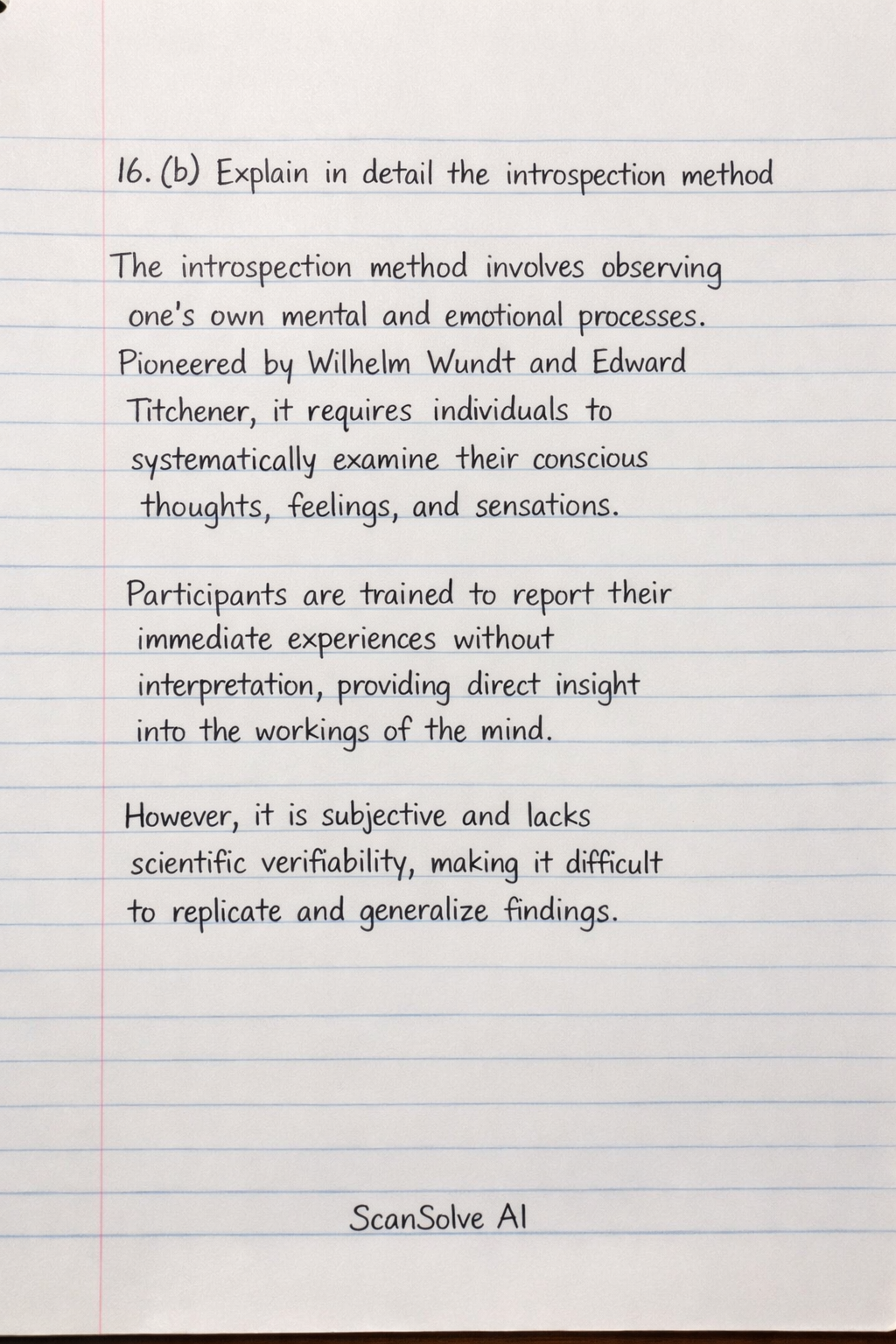
16. (b) Explain in detail the introspection method The introspection method involves observing one's own mental and emotional processes. Pioneered by Wilhelm Wundt and Edward Titchener, it requires individuals to systematically examine their conscious thoughts, feelings, and sensations. Participants are trained to report their immediate experiences without interpretation, providing direct insight into the workings of the mind. However, it is subjective and lacks scientific verifiability, making it difficult to replicate and generalize findings. 17. (a) Discuss in detail the arguments of heredity and the environment. The debate of heredity (nature) versus environment (nurture) explores the extent to which genetic factors and environmental influences shape human development. Arguments for heredity emphasize that traits like intelligence, personality, and predispositions to certain conditions are largely determined by an individual's genetic makeup inherited from parents. Conversely, arguments for environment highlight the profound impact of upbringing, education, culture, social interactions, and life experiences on shaping an individual's characteristics and behaviors. Modern psychology largely accepts an interactionist perspective, recognizing that both heredity and environment constantly interact and influence each other to produce complex human traits. 17. (b) Explain facts related to the growth, maturation and development of humanbeings Growth refers to the quantitative increase in size, weight, and number of cells, primarily physical changes. Maturation involves qualitative changes and the genetically programmed unfolding of an individual's biological potential, leading to the emergence of new abilities and characteristics independent of specific learning experiences. Development is a comprehensive, lifelong process encompassing all changes—physical, cognitive, and socio-emotional—that occur from conception to death. These three processes are interconnected: growth provides the physical basis, maturation sets the biological timetable, and development integrates these changes with environmental interactions to form a complete human being. 18. (a) Discuss in detail Erikson's eight stages of social development. Erik Erikson's theory of psychosocial development proposes that individuals progress through eight distinct stages across the lifespan, each characterized by a unique psychosocial crisis or conflict. The successful resolution of each crisis leads to the development of a specific virtue and a healthy personality, while an unsuccessful resolution can lead to difficulties in later life. These stages range from Trust vs. Mistrust in infancy, focusing on forming secure attachments, to Integrity vs. Despair in late adulthood, involving reflection on one's life. The theory emphasizes the role of social interactions and cultural influences in shaping personality and identity throughout life. 18. (b) Assess the levels of Maslow's hierarchy of needs. Abraham Maslow's hierarchy of needs is a motivational theory proposing that human needs are arranged in a pyramid, with the most fundamental needs at the bottom. The five levels, from bottom to top, are: Physiological needs (e.g., food, water, shelter), Safety needs (e.g., security, stability), Love and Belongingness needs (e.g., friendship, intimacy), Esteem needs (e.g., self-worth, recognition), and Self-actualization needs (e.g., achieving one's full potential). Maslow argued that lower-level needs must be largely satisfied before individuals can pursue higher-level needs. While influential, the hierarchy has been criticized for its rigid structure and cultural specificity, as the order of needs may vary across individuals and cultures. 19. (a) Analyse the importance and needs of a time table in an organization. A timetable in an organization is a crucial tool for planning, scheduling, and managing activities and resources efficiently. Its importance lies in ensuring optimal utilization of time, personnel, and equipment, thereby enhancing productivity and operational effectiveness. It helps in coordinating tasks across different departments, setting clear deadlines, and ensuring that projects are completed on schedule. A well-structured timetable also promotes accountability, reduces conflicts over resource allocation, and provides a clear framework for employees to understand their responsibilities and priorities, leading to improved workflow and overall organizational success. That's 2 down. 3 left today — send the next one.