
We read your photo as:
Define psychology, medical sociology, and anthropology. Outline reasons for studying sociology and psychology.
Psychology
ScanSolve AI Answer
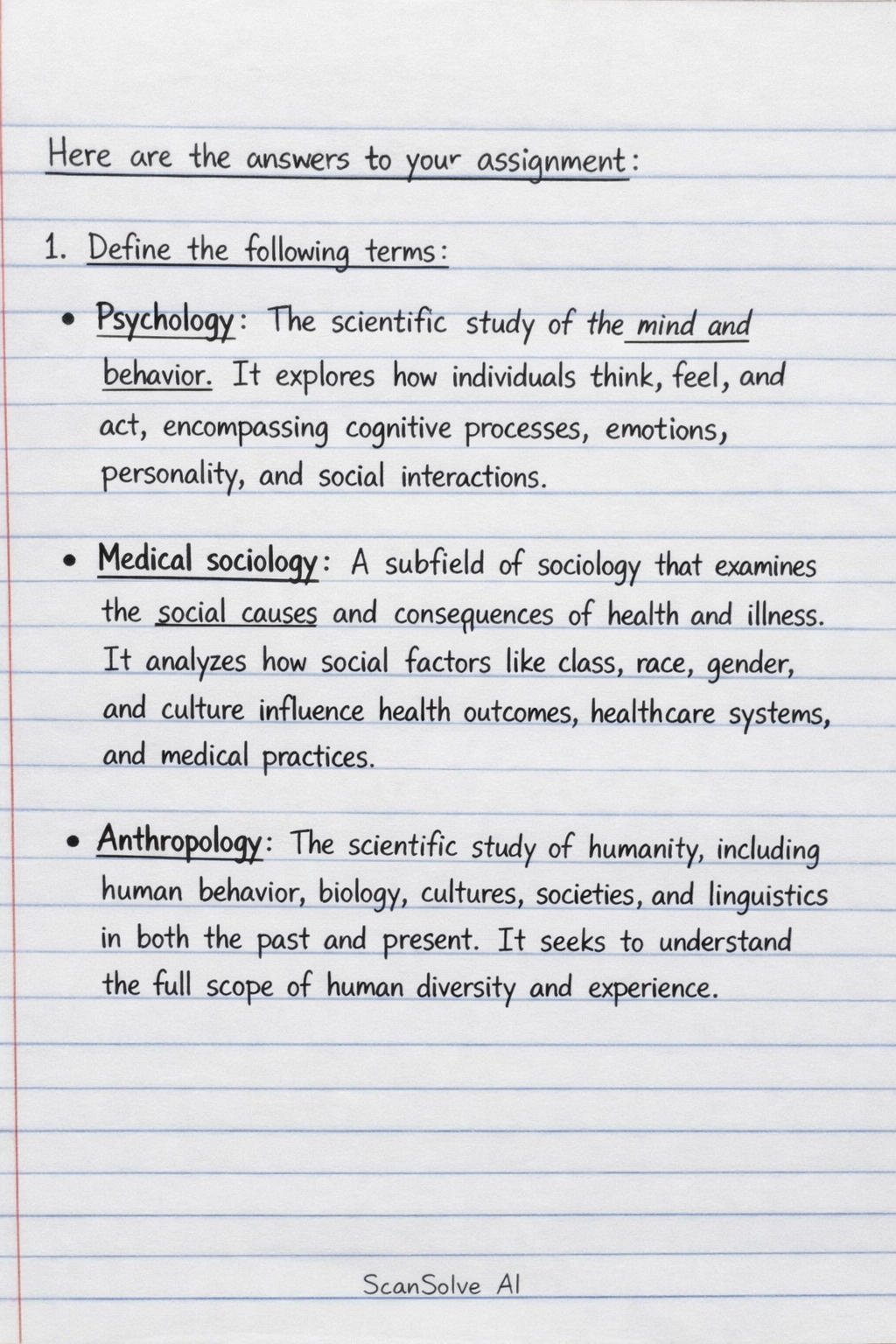
Here are the answers to your assignment:
-
Define the following terms:
- Psychology: The scientific study of the mind and behavior. It explores how individuals think, feel, and act, encompassing cognitive processes, emotions, personality, and social interactions.
- Medical sociology: A subfield of sociology that examines the social causes and consequences of health and illness. It analyzes how social factors like class, race, gender, and culture influence health outcomes, healthcare systems, and medical practices.
- Anthropology: The scientific study of humanity, including human behavior, biology, cultures, societies, and linguistics in both the past and present. It seeks to understand the full scope of human diversity and experience.
-
Outline reasons for studying the following:
- Sociology:
- To understand social structures, institutions, and processes that shape human behavior and societies.
- To analyze social problems and inequalities, contributing to informed policy-making and social change.
- To develop a critical perspective on the world, recognizing the diverse social and cultural contexts of human life.
- Psychology:
- To gain insight into individual behavior, thoughts, and emotions, helping to understand oneself and others.
- To apply psychological principles to address mental health issues, improve education, and enhance workplace productivity.
- To conduct research that advances knowledge about the human mind and its complexities.
- Social psychology:
- To understand how individuals' thoughts, feelings, and behaviors are influenced by the actual, imagined, or implied presence of others.
- To explain phenomena like conformity, prejudice, group dynamics, and interpersonal attraction.
- To apply this understanding to solve real-world problems in areas such as conflict resolution, public health campaigns, and leadership.
- Sociology:
-
Discuss Theories of socio-psychology Socio-psychology (or social psychology) draws on various theories to explain human behavior in social contexts. Key theoretical perspectives include:
- Cognitive Theories: Focus on how individuals process, store, and apply information about others and social situations. Examples include Social Cognition Theory, which examines how people perceive and interpret social information, and Cognitive Dissonance Theory, which explains how people strive for consistency in their beliefs and behaviors.
- Behavioral Theories: Emphasize that social behavior is learned through conditioning and reinforcement. Social Learning Theory (Bandura) is prominent, suggesting that individuals learn by observing and imitating others, as well as through direct experience.
- Motivational Theories: Explore the drives and needs that underlie social behavior. For instance, theories related to self-esteem or the need for belonging explain why people engage in certain social actions.
- Evolutionary Theories: Propose that social behaviors are rooted in evolutionary adaptations that enhanced survival and reproduction. This perspective explains universal patterns in human social interaction, such as altruism or mate selection.
- Sociocultural Theories: Highlight the profound impact of culture, social norms, and societal structures on individual behavior and psychological processes. Social Identity Theory is an example, explaining how group membership and social categories influence self-concept and intergroup relations.
-
Discuss elements of society and describe characteristics of a society.
- Elements of society:
- Culture: Shared beliefs, values, norms, customs, language, and artifacts that characterize a group.
- Social Structure: The organized pattern of relationships and institutions that make up a society, including social classes, roles, and statuses.
- Institutions: Established and enduring patterns of social behavior organized around particular purposes, such as family, education, government, economy, and religion.
- Groups: Collections of people who interact with each other and share common characteristics or interests.
- Territory: A defined geographical area that a society occupies.
- Population: The aggregate of individuals living within the territory.
- Characteristics of a society:
- Social Interaction: Members of a society regularly interact with each other.
- Shared Culture: A common set of values, beliefs, and practices binds the members together.
- Common Territory: Societies typically occupy a specific geographical area.
- Sense of Belonging/Identity: Members often share a collective identity and a feeling of belonging to the group.
- Relative Permanence: Societies tend to be enduring and self-perpetuating over generations.
- Social Organization: They have established patterns of social relationships and institutions that govern behavior.
- Cooperation and Conflict: Both cooperative efforts and internal conflicts are inherent aspects of societal dynamics.
- Elements of society:
Was this helpful?
Still stuck on this one?
Ask a follow-up, and the answer starts from this question.
Got a different question?Ask your own question
More Psychology Questions
QWhat is medical sociology. How key aspect impact health and illness a. Write brief notes on the…QFocus points on psychology ❌ why medical psychology is important in the medical practice ❌ list the…QExplain all according to physical, mental, social, and spiritual approah in psychologyQPossible questions on psychology and answerQExplain the nature of education and psychology.
Handwritten Step-by-Step Solution
Get this as a handwritten image on WhatsApp — like a tutor wrote it for you.
Try on WhatsApp