
We read your photo as:
What are recommendations for victims of cyberbullying and ways to encourage bystanders to speak out?
ScanSolve AI Answer
Step-by-step solution
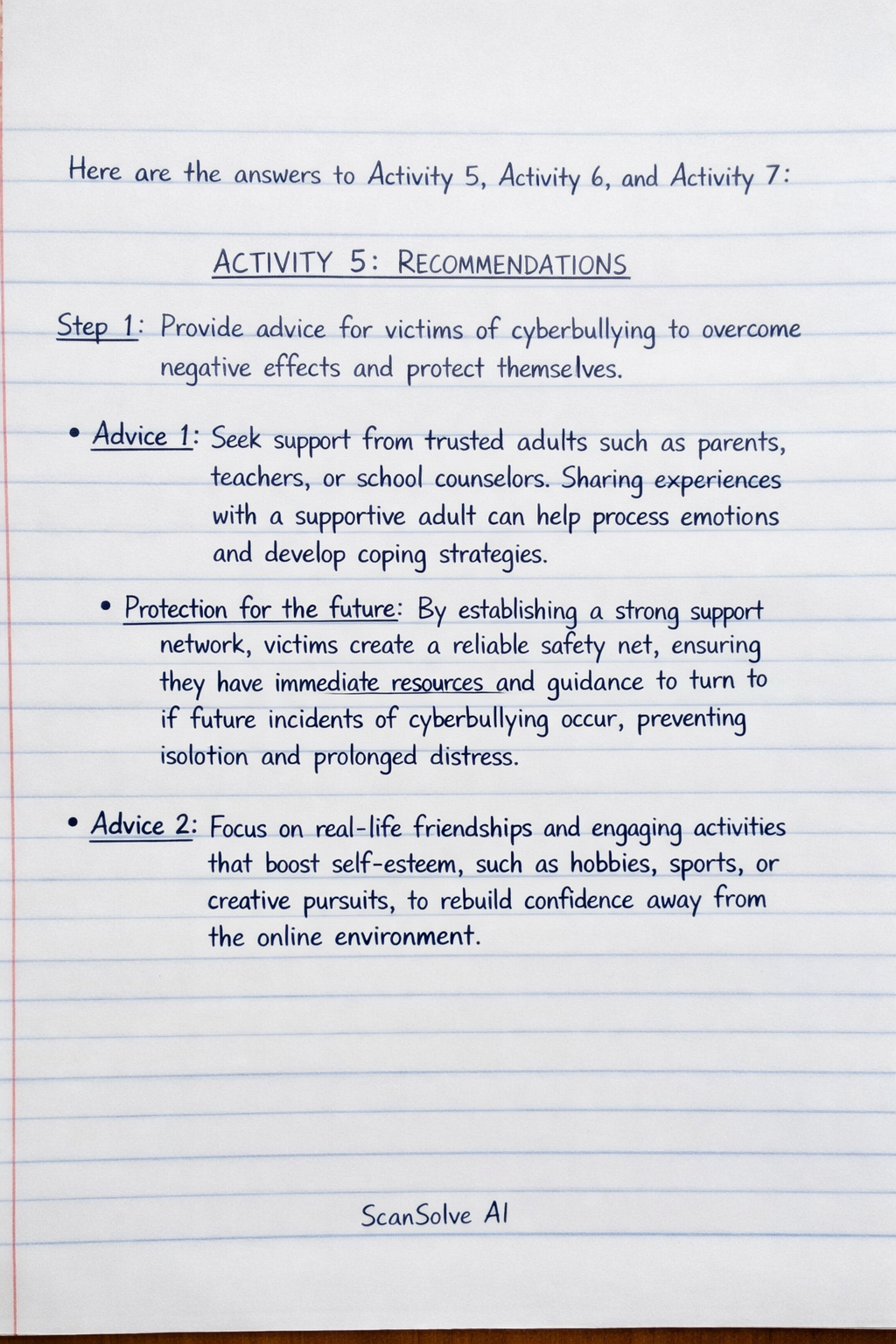
5 stepsHere are the answers to Activity 5, Activity 6, and Activity 7:
ACTIVITY 5: RECOMMENDATIONS
Provide advice for victims of cyberbullying to overcome negative effects and protect themselves.
- Advice 1: Seek support from trusted adults such as parents, teachers, or school counselors. Sharing experiences with a supportive adult can help process emotions and develop coping strategies.
- Protection for the future: By establishing a strong support network, victims create a reliable safety net, ensuring they have immediate resources and guidance to turn to if future incidents of cyberbullying occur, preventing isolation and prolonged distress.
- Advice 2: Focus on real-life friendships and engaging activities that boost self-esteem, such as hobbies, sports, or creative pursuits, to rebuild confidence away from the online environment.
- Protection for the future: Developing a strong sense of self-worth and finding validation in offline achievements makes individuals less susceptible to the emotional impact of online negativity, as their self-esteem is not solely dependent on digital interactions or approval.
- Advice 1: Seek support from trusted adults such as parents, teachers, or school counselors. Sharing experiences with a supportive adult can help process emotions and develop coping strategies.
Suggest two ways to encourage bystanders to speak out against cyberbullying.
- Way 1: Implement educational programs that highlight the significant impact of cyberbullying on victims and emphasize the collective responsibility of the community to intervene. These programs should teach bystanders how to safely report incidents and the importance of not being a silent observer.
- Way 2: Establish anonymous reporting systems within schools or online platforms. This reduces the fear of retaliation for bystanders, making it easier and safer for them to report cyberbullying incidents without directly confronting the bully or being identified.
Recommend three ways to promote responsible online behavior among teenagers.
- Way 1: Integrate comprehensive digital citizenship education into the school curriculum, teaching students about online ethics, privacy settings, the permanence of digital footprints, and the legal consequences of cyberbullying and other harmful online actions.
- Way 2: Encourage open and regular communication between teenagers and their parents/guardians about online activities. Parents should foster a non-judgmental environment where teenagers feel comfortable discussing online challenges, seeking advice, and understanding appropriate online conduct.
- Way 3: Promote positive online role models and campaigns that showcase respectful interactions, empathy, and constructive use of social media. Highlighting the benefits of a positive online presence can inspire teenagers to adopt responsible behaviors.
ACTIVITY 6: REFLECTION
Evaluate your own position regarding cyberbullying.
My position is that cyberbullying is a pervasive and serious issue in the digital age, demanding a proactive and multi-faceted approach. It is not merely a trivial aspect of youth interaction but a form of harassment with profound psychological, emotional, and social consequences for victims. I believe that fostering digital literacy and empathy from a young age is crucial, empowering individuals to understand the impact of their online actions and to act as responsible digital citizens. Furthermore, I advocate for robust support systems for victims and clear, enforced policies against cyberbullying in all online and educational environments.
ACTIVITY 7: LIST OF REFERENCES
Write your list of references.
As I do not have access to the specific sources used in your project or the "attached guide to referencing," I will provide an example of how four references could be formatted using a common style (e.g., APA 7th edition). Please replace these with your actual sources and follow the specific referencing guide provided for your project.
- Example 1 (Book): Smith, J. (2020). The Digital Playground: Understanding Cyberbullying in the 21st Century. Tech Press.
- Example 2 (Journal Article): Johnson, L., & Miller, K. (2019). The psychological impact of cyberbullying on adolescents. Journal of Adolescent Health, 65(3), 345-352.
- Example 3 (Website): National Bullying Prevention Center. (n.d.). Cyberbullying facts. Retrieved from https://www.pacer.org/bullying/resources/cyberbullying-facts.asp
- Example 4 (Report): UNESCO. (2017). School violence and bullying: Global status report. UNESCO Publishing.
Still stuck on this one?
Ask a follow-up, and the answer starts from this question.
More Psychology Questions
Handwritten Step-by-Step Solution
Get this as a handwritten image on WhatsApp — like a tutor wrote it for you.
Try on WhatsApp