

This psychology problem is solved step by step below, with detailed explanations to help you understand the method and arrive at the correct answer.
ScanSolve AI Answer
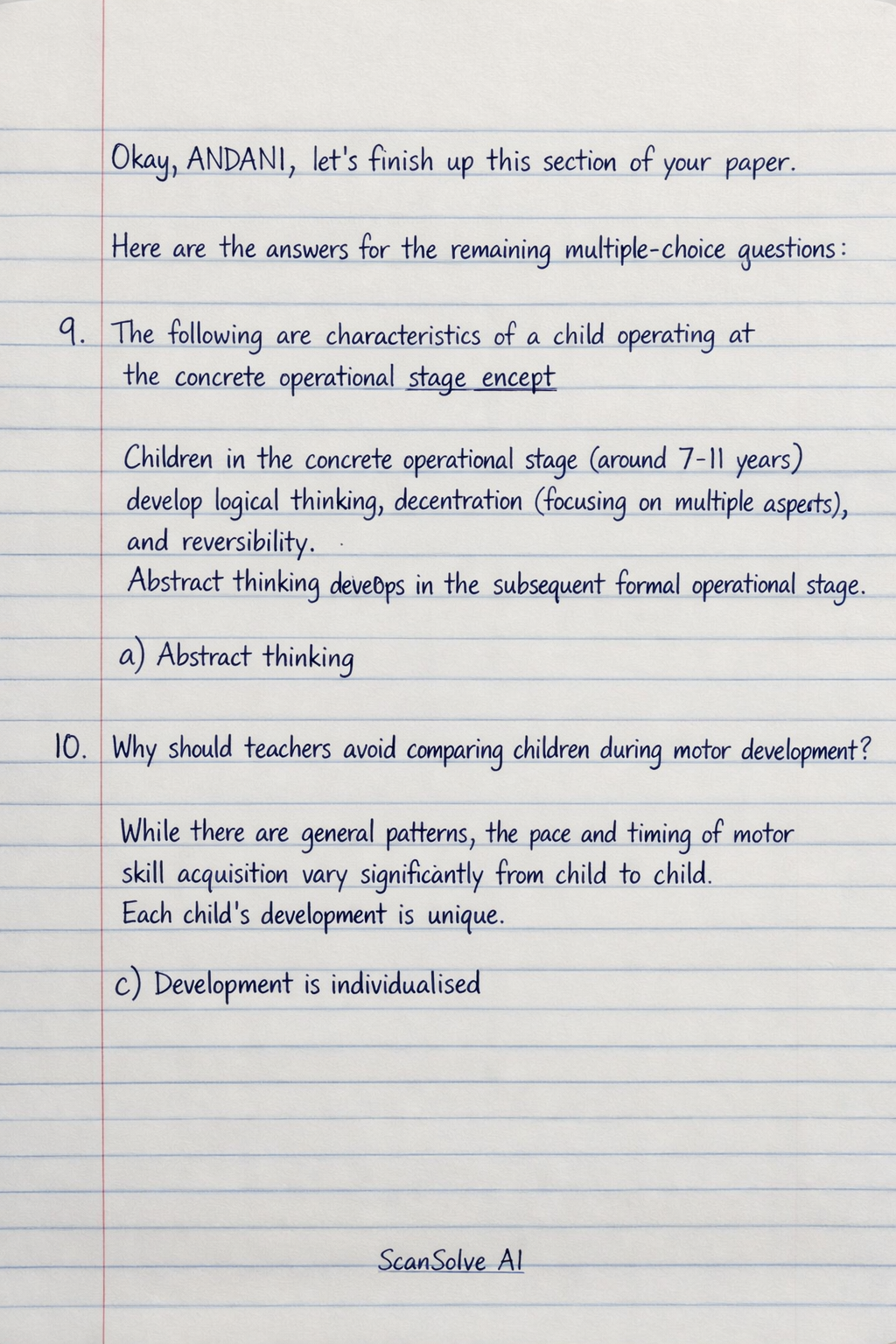
Okay, ANDANI, let's finish up this section of your paper. Here are the answers for the remaining multiple-choice questions: 9. The following are characteristics of a child operating at the concrete operational stage except Children in the concrete operational stage (around 7-11 years) develop logical thinking, decentration (focusing on multiple aspects), and reversibility. Abstract thinking* develops in the subsequent formal operational stage. a) Abstract thinking 10. Why should teachers avoid comparing children during motor development? While there are general patterns, the pace and timing of motor skill acquisition vary significantly from child to child. Each child's development is unique. c) Development is individualised 11. The statement that development is "continuous rather than discrete" means that Continuous development suggests that development is a gradual, cumulative process where skills and knowledge build upon previous ones, meaning each stage influences the next. c) Each stage of development influences the next 12. A teacher introduces an anti-bullying policy and ensures that learners who are victims of bullying receive emotional support in school. Which level of Maslow's Hierarchy of Needs is being addressed? An anti-bullying policy and emotional support aim to create a secure and protected environment, addressing the fundamental need for safety and security. c) Safety needs 13. Human development differs from growth because development involves Growth refers to quantitative increases (e.g., height, weight), while development involves qualitative changes in complexity, organization, and functioning. d) Qualitative and orderly changes 14. When an infant learns to crawl before walking, it demonstrates the principle of The cephalocaudal principle states that development proceeds from the head downwards to the feet. Control over the upper body (like crawling) typically precedes control over the lower body (like walking). a) Cephalocaudal development 15. The driving force that propels an individual to achieve the highest form of self-actualization is referred to as Self-actualization is the highest level of Maslow's hierarchy, and the internal drive to achieve one's full potential is a form of motivation. b) Motivation 16. When a learner prefers diagrams, charts, and concept maps, the learner is likely a Learners who process information best through visual aids like diagrams, charts, and maps are considered visual learners. d) Visual learner 17. Which of the following best illustrates intrinsic motivation? Intrinsic motivation is performing an activity for its inherent satisfaction or enjoyment, without external rewards. Reading a novel purely for personal enjoyment is a clear example of this. b) Reading a novel for personal enjoyment 18. A major cause of difficulty faced by pre-adolescent learners is While pre-adolescents (typically 9-12 years old) generally have developed motor skills, impaired eye-hand coordination can still be a significant challenge for some, affecting tasks like writing, drawing, and sports. The other options are generally not characteristic difficulties for this age group. a) Impaired eye-hand coordination 19. Turner's syndrome commonly affects Turner's syndrome is a chromosomal disorder that occurs when a female is born with only one X chromosome instead of the usual two. Therefore, it affects only girls. d) Girls only 20. Which of the following is an example of a negative reinforcement in the classroom? Negative reinforcement involves removing an undesirable stimulus to increase a desired behavior. Giving a learner more rest (removing the task/effort) after they complete their work on time increases the likelihood of them completing work on time in the future. b) Giving the learner more rest after completing their work on time Last free one today — make it count tomorrow, or type /upgrade for unlimited.